
What if the main supplier risk isn’t a poor product, but a change introduced without a controlled transition? A new scientific supplier may appear suitable on paper, yet questions about product identity, documentation or consistency can remain until materials enter a research workflow. Mitigating risks of using new scientific suppliers means treating onboarding as a managed process, not a one-off approval.
It’s reasonable to want confidence that a supplier change won’t interrupt research or affect whether materials suit their intended use. At the same time, applying the same extensive review to every supplier can create unnecessary administration. Match the level of scrutiny to the supplier, product and research context, including the consequences of a failure.
This checklist sets out how to identify relevant risks, document a proportionate assessment and introduce a supplier in a controlled way. It also explains how to monitor performance and respond to concerns, so decisions remain traceable and research workflows are better protected.
Key Takeaways
- Assess risk in relation to the supplier, product and intended research use, rather than applying one review to every purchase.
- Use a concise risk register to record potential impact, likelihood, controls and the person responsible for each risk.
- For mitigating risks of using new scientific suppliers, connect each document requested to a defined requirement and record how evidence gaps are resolved.
- Introduce a supplier in stages, with responsibilities, review points and conditions for pausing use agreed before the first order.
- Use existing laboratory records to monitor delivery, documentation and product issues, then review recurring discrepancies or changes systematically.
Why using a new scientific supplier creates specific, manageable risks
Supplier-transition risk is the uncertainty introduced when a laboratory changes its source, the product it buys or the processes used to order, receive and use that product. It doesn’t mean failure is likely. It means established assumptions may no longer apply, so assess the change against the work the material is intended to support.
The consequences depend on context. A replaceable consumable used in one limited workflow may need a narrower review than a critical material used across several procedures, especially if interruption could delay planned work. Break supplier risk into specific questions instead of treating it as one broad concern:
- Product suitability: Does the product’s identity and available information align with the intended research use?
- Documentation: Do the records support identification, traceability and the laboratory’s requirements?
- Continuity: Could a supply change interrupt work or leave no practical alternative?
- Operational compatibility: Do ordering, receipt, storage and handling information fit existing processes?
This distinction helps direct review towards the relevant uncertainties. For example, when assessing bacteriostatic water for research applications, define the intended purpose and the information needed for that use. Don’t assume that familiarity with the product category resolves supplier-specific questions. The broader cycle of identifying, assessing, treating and monitoring risk is described in the Supply Chain Risk Management Overview. A UK laboratory supplier vetting guide can also help structure a review.
How a supplier change can affect research workflows
Established procedures may rely on product identification, documentation or handling information that has stayed consistent over time. If a new source provides different information, staff may need to establish how it relates to existing records or local procedures before use. Record this as a supplier-related change, separate from changes to equipment or research methods where possible. If several changes happen together, document each one so the cause of any observed difference is easier to assess.
Continuity is another consideration. A familiar supply route may change, or a product may become difficult to obtain, leaving the laboratory to assess alternatives and the effect on planned work. Map which workflows depend on the material. This helps show whether a delay would affect one activity or several.
When a more formal review is proportionate
Choose the review depth according to the potential consequences of interruption or unsuitable material. Consider whether the item is critical to the work, readily replaceable or used across multiple workflows. Also consider what evidence is already available and how easily a discrepancy could be detected before it affects research outputs.
Document the rationale using the laboratory’s own quality procedures. A concise record can state the intended use, the main risks considered, why the chosen review is appropriate and who approved the decision. This keeps the process proportionate: avoid both a blanket review for every purchase and an undocumented assumption that a supplier change is inconsequential.
Which risks should a new scientific supplier assessment cover?
A useful assessment identifies risks that could affect the planned work. A supplier’s newness alone is not a risk. Use four categories to organise the review: product suitability, supporting evidence, supply continuity and operational compatibility. The balance will depend on the material and its role in the laboratory.
- Product suitability: Does the product identity and stated purpose match the laboratory’s defined requirement? Record differences from the material it may replace instead of assuming products in the same category are interchangeable.
- Evidence and traceability: What information supports identification and use for the planned work? Consider relevant batch or lot details and documentation, then link records to the laboratory’s established reagent traceability workflow.
- Supply continuity: Could an interruption delay time-sensitive work or affect dependent activities? Consider how readily the material could be replaced and what contingency is available.
- Operational compatibility: Could the change affect ordering, receipt, storage or inventory processes? Identify any changed information or steps staff need to follow.
Assess each risk in relation to its consequences for the specific work. A material used in several dependent workflows may need closer attention than a readily replaceable item used in a limited context. The U.S. Department of Energy’s scientific supply chain risk mitigation resource provides further context on supply-chain risk in scientific settings. The assessment should still reflect the laboratory’s own requirements and procedures.
Use a concise risk register
For each relevant risk, record its potential impact, likelihood, existing or proposed controls and an accountable owner. Include the intended use and the basis for the assessment, so reviewers can understand why a concern was prioritised. Keep entries brief but clear enough to support a decision and update when circumstances change.
Distinguish an evidence gap from a confirmed deficiency. If a document hasn’t yet been reviewed, record its status as unresolved. That isn’t proof that the supplier lacks the document. If evidence is available but doesn’t address a defined requirement, describe the mismatch precisely and note what action would resolve it. Factual records help prevent uncertainty from being overstated.
Account for continuity and operational fit
Map where the material enters laboratory processes, from ordering and receipt through storage, use and record-keeping. Identify whether an interruption could affect scheduled or dependent work, and note contingency options and escalation responsibilities within existing procedures. The purpose is to make potential effects visible before a disruption, not to assume one will occur.
BacLab supplies bacteriostatic water for laboratory and research applications. If it suits your laboratory’s defined purpose, review the 10ml bacteriostatic water vials against your intended application and local requirements.
How to assess supplier evidence before placing a first order
Review supplier evidence against the laboratory’s stated requirements, not a general impression of credibility. A polished website, persuasive product description or low price may inform a purchasing decision, but none establishes that a product suits a particular research application. A document is useful when it answers a defined question about identity, use, traceability or operational requirements.
Use an ordered review to make the decision transparent and keep unresolved points visible:
- Define the requirement. Record the product identity needed, its intended application and any constraints arising from the workflow or existing procedures.
- Examine relevant evidence. Compare product and supplier information with each requirement. Review documents where they address a specific risk or research need.
- Resolve gaps. Identify what remains unclear, decide whether it matters to the planned use and determine what evidence or action would address it.
- Record the decision. Document the evidence considered, the rationale, the reviewer and any conditions attached to initial use.
This sequence supports mitigating risks of using new scientific suppliers without turning onboarding into indiscriminate document collection. Give every document request a clear purpose. For example, a record may help identify a supplied product or connect a lot to the laboratory’s own records. If it doesn’t address a defined requirement, reconsider its relevance to the decision.
Match supplier and product information to the requirement
Write the intended product identity and application in specific terms before comparing supplier information. Include workflow constraints that could affect suitability, such as established handling or record-keeping processes. Assess the information consistently against those points, rather than letting differences in presentation or marketing detail influence the standard applied. If an answer is unavailable or ambiguous, record an evidence gap, not proof of a deficiency.
A broader procurement structure is available in this UK laboratory supplier evaluation checklist. Use frameworks like this to organise review questions, while keeping evidence requests proportionate to the material and its intended use.
Document the decision and its limits
The decision record should identify what was reviewed, who reviewed it, why the evidence was considered adequate for the defined purpose and any conditions for initial use. State what the review does not establish as well. Evidence available before an order cannot, by itself, demonstrate performance beyond the information assessed or guarantee consistency in future supply. A separate UK supplier vetting guide offers broader context for supplier review.
BacLab sells 10ml bacteriostatic water vials for laboratory and research applications. If your laboratory’s requirements suit a five-vial option, review BacLab’s 5x 10ml bacteriostatic water against the same product identity, application and documentation criteria used for any laboratory consumable.
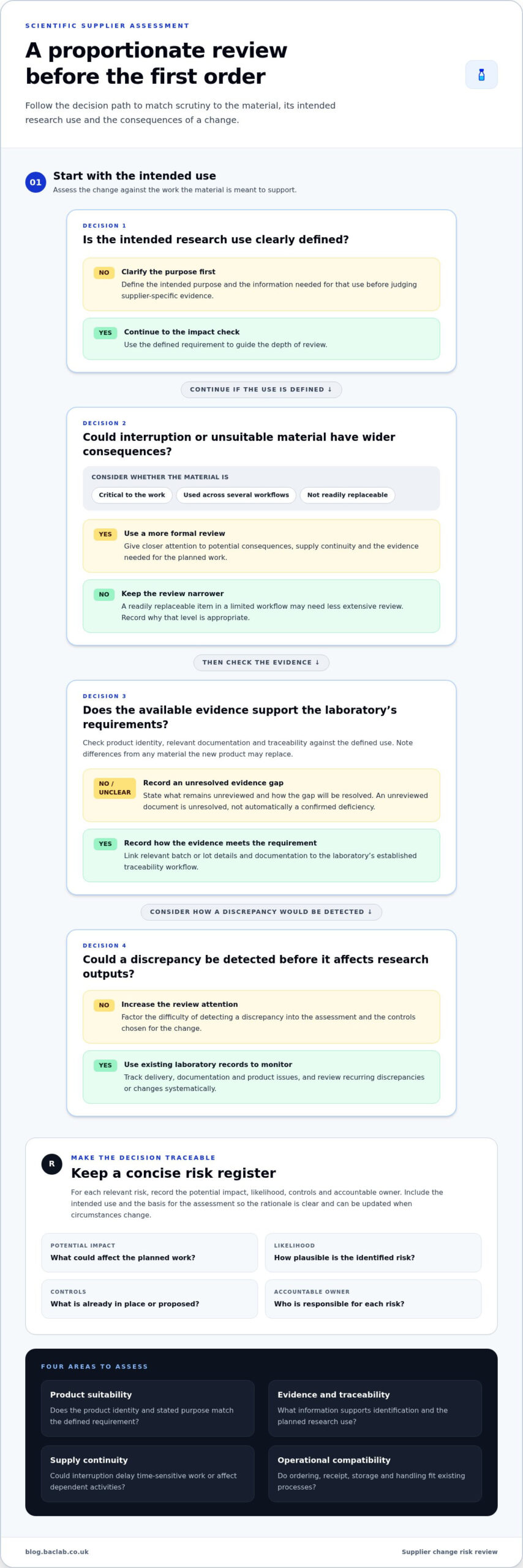
A staged onboarding checklist for reducing supplier-change disruption
Introduce a new supplier through a controlled sequence rather than switching it into every relevant workflow at once. The stages below are adaptable controls, not a universal validation protocol. Set the scope and review criteria according to the material, its intended use and the laboratory’s procedures. Before initial use, assign responsibilities, specify the records to retain and agree what would trigger a pause or escalation.
- Approve the defined scope. Record the product, intended workflow and users covered by the initial introduction. Identify the decision-maker and the person responsible for the onboarding record.
- Introduce at limited scope. Where the work permits, restrict initial use to the defined application and users. Make relevant information and procedures available to staff involved.
- Review the initial experience. Compare observations and delivery experience with expectations set in advance. Record discrepancies, actions taken and any unresolved concerns.
- Decide whether to expand, pause or stop. Use the laboratory’s documented decision process to determine the next step. Expand only after a reasoned review, not simply because time has passed or an order is complete.
Set the scope and controls before introduction
Define what the introduction includes and excludes. Specify the product and workflow under review, which users are involved and which existing records will capture observations. Set criteria that can be assessed in practice, such as whether received product information aligns with the approved requirement or whether delivery and receipt fit established processes. Name who records deviations, who can pause use and who receives an escalation.
Agree stop conditions before work begins. These might include a discrepancy in product identity, missing information needed for the defined application or an issue that prevents the laboratory from following its existing process. The relevant conditions depend on local requirements. Clear criteria help staff respond consistently without making an improvised judgement during a workflow.
Review the initial experience before expanding
At the planned review point, compare what happened with the expectations recorded before introduction. Consider the product and documentation received, any delivery or handling issues, and whether the intended workflow could be followed as specified. Record satisfactory observations as well as discrepancies. No reported problems, on their own, don’t show that every relevant risk has been assessed.
If an issue arose, document its effect, the response and whether uncertainty remains. If the evidence supports expansion, record the rationale and scope of the next stage. If concerns remain unresolved, retain the current limits or pause the introduction in line with local procedures.
Where practical, keep supplier onboarding distinct from simultaneous changes to a method or equipment. When several changes happen together, it may be harder to determine which one contributed to an observed difference. Separating and recording changes makes the evidence easier to interpret and supports proportionate decisions when mitigating risks of using new scientific suppliers.
Review BacLab’s 5x 10ml bacteriostatic water
Monitor supplier performance and choose a suitable next step
Supplier approval isn’t the end of the assessment. Monitor relevant delivery, documentation and product issues through records the laboratory already uses. Reviewing them helps identify patterns and whether existing controls remain appropriate. This keeps mitigating risks of using new scientific suppliers focused on evidence connected to the work.
Make supplier monitoring part of routine review
Assign responsibility for recording relevant events and reviewing them through existing laboratory processes. Depending on the purchase, records might include delivery discrepancies, missing or changed documentation, or product-related issues identified during receipt or use. Record the date, material and context, along with any action taken. This helps later reviews distinguish a single event from a recurring concern.
Set review triggers in advance. These could include repeated discrepancies, a change to the research requirement, altered supply arrangements or an interruption that affects planned work. A trigger prompts a review; it doesn’t automatically prove that a supplier is unsuitable. Consider the circumstances, potential effect and available controls before deciding whether to revise the assessment.
If the requirement or supply arrangement changes, update the relevant risk record and responsibilities. A material previously used in one workflow, for example, may become relevant to additional work. The earlier assessment may no longer cover the full context, even if no performance issue has been recorded. Keep the rationale for revised controls alongside the decision and follow established procedures.
Choose a response based on documented findings
Monitoring should lead to a defined next step. Depending on the nature and recurrence of an issue, a laboratory may retain the current arrangement, restrict use to a narrower scope, pause use while a concern is reviewed or reconsider the supplier relationship. Record the evidence behind the decision, who authorised it and what follow-up is required. This avoids treating every isolated event as proof of systemic failure while ensuring recurring or unresolved issues are not overlooked.
If a concern affects a defined requirement, document whether existing controls address it. If they don’t, revise the controls or limit the scope until there is a reasoned basis for proceeding. Record satisfactory observations in context too, without treating them as evidence beyond what was actually monitored.
BacLab supplies 10ml bacteriostatic water vials for laboratory and research applications, available for individual purchase and through wholesale options. Laboratories whose requirements suit a five-vial option can review the product details against their research-use requirements and local procedures.
Review BacLab’s five-vial option
Make supplier decisions easier to revisit
A well-kept assessment becomes a useful reference when research requirements or supply arrangements change. Rather than treating each purchase as an isolated decision, use the documented rationale to identify what still applies, what needs review and where new evidence is required. This keeps mitigating risks of using new scientific suppliers connected to the laboratory’s evolving work, rather than to a one-time approval.
For each relevant purchase, compare the product information with the intended research use and requirements already defined by the laboratory. A clear record of that comparison supports a considered decision and makes it easier to reassess if the context changes.
Review BacLab’s 5x 10ml bacteriostatic water
A proportionate process makes supplier changes easier to assess and introduce systematically. Use the same disciplined approach for future purchasing decisions, and let the evidence guide each step.
Frequently Asked Questions
Is a new scientific supplier automatically higher risk than an established supplier?
No. A supplier’s newness doesn’t, by itself, determine the level of risk. The key question is whether the supplier, product and available evidence meet the needs of the planned work. An established relationship may offer useful history, but it doesn’t remove the need to assess changed products or requirements. For a new source, focus the review on uncertainties that could affect the specific research activity.
Can a laboratory introduce a new supplier without changing its existing workflow?
Often, yes, if product information, ordering and receipt arrangements fit current procedures. Before introduction, map the steps from placing an order to recording the material in laboratory systems. For example, check whether the usual process captures the product identity and any supplied lot details. If a new requirement doesn’t fit an existing record or procedure, document an appropriate adjustment instead of relying on an informal workaround.
What should a laboratory record when assessing a new supplier?
Record the intended application, the product requirements used for comparison, the evidence considered and who made or approved the decision. Include the order and product identifiers needed to connect the assessment with later receipt and use records. Note unresolved questions, any restrictions on use and the reason for those limits. This creates a traceable decision history that can be revisited if research needs or supplier arrangements change.
What happens if a supplier cannot provide information needed for an assessment?
First determine whether the missing information is essential to a defined research or quality requirement. Record precisely what is unavailable and why it matters. An absence of evidence isn’t automatically proof of a product defect. If the gap prevents a reasoned suitability decision, the laboratory can defer approval, restrict the proposed use or follow its established process for considering an alternative. Document the rationale and decision.
Can a pilot order reduce the risks of using a new scientific supplier?
It can limit the initial scope and provide an opportunity to assess practical matters such as receipt, accompanying information and fit with local procedures. A pilot order doesn’t establish suitability for every application or resolve evidence gaps that need separate review. Define its purpose and assessment criteria beforehand, then record the findings before deciding whether broader purchasing is justified.
How often should a laboratory review a scientific supplier after onboarding?
There isn’t one review interval that suits every supplier or material. Set an approach through the laboratory’s own procedures, taking account of the material’s importance and the possible effect of disruption. Review sooner if recurring discrepancies arise, requirements change, documentation is revised or supply is interrupted. A stable record may support routine review, but reassess when a relevant change occurs.