
Could another researcher identify the exact reagent used in your experiment from the methods section alone? Ensuring reagent traceability for scientific publication means connecting information that may be split across vial labels, purchasing records and laboratory notes. A product name without a supplier, catalogue number or batch detail may not distinguish the material used.
Those records can be difficult to reconcile, particularly when details weren’t captured during the experiment. A clear workflow helps researchers identify gaps before submission and report reagent identity and use accurately. It also keeps traceability distinct from reproducibility and metrological traceability.
This article sets out a practical process for recording reagent details, linking them to experimental use and transferring relevant information into a manuscript. It considers how reporting needs can vary between journals and uses bacteriostatic water in a 10 ml vial as an example of connecting a laboratory supply to study records, not as evidence of a study’s methods or results.
Key Takeaways
- Organise reagent records by identity, source, receipt, storage, preparation and experimental use so each detail has a clear place.
- Use a consistent identifier to connect physical reagent containers with digital records and experimental entries.
- Map record fields to the right location in the manuscript, supplementary material or retained laboratory documentation.
- Use a workflow for ensuring reagent traceability for scientific publication to identify conflicting or missing details before submission.
- Review discrepancies between manuscript descriptions and source records as gaps to resolve, not as certification of experimental quality.
What reagent traceability means in scientific publication
In a research manuscript, reagent traceability is the documented link between a reported material, records that identify its source, and records that show where and how it was used. It lets readers interpret a methods description against an identifiable material rather than a broad category alone. The relevant details depend on the reagent: a product name and supplier may identify some materials, while a catalogue or batch number can add specificity when recorded.
Precise identification matters because products described by similar general names may differ in source or other recorded characteristics. If a study reports only “buffer” or “water”, for example, the description may not reveal which material was used or how the laboratory identified it. Linking the manuscript to retained records gives editors, reviewers and later researchers a basis for scrutiny and comparison. It does not establish that a reagent was suitable, correctly handled or responsible for an observed effect; those are separate questions requiring evidence.
For a laboratory supply such as bacteriostatic water in a 10 ml vial, traceability means recording the identity shown on the product and linking it to relevant laboratory and experimental records. The purchase itself does not establish how the material was handled or used, and cannot substantiate a study’s methods or findings. The general meaning and classification of reagents are outlined in What is a Reagent?; manuscript records should go further by making the actual material and its experimental context identifiable.
Which questions should a traceable reagent record answer?
A useful record lets someone reviewing the study follow three connected questions: what was the material, where did it come from, and where did it enter the work? Answers may be spread across a label, purchasing documentation and laboratory notes. Make their connection explicit rather than relying on a product name in isolation.
- What was it? Record the product name and relevant identifier as shown in the laboratory’s source records.
- Where did it come from? Retain the supplier or other source information available to the laboratory.
- Where was it used? Link the material to the relevant experiment, method or sample.
Traceability, reproducibility and measurement traceability are not interchangeable
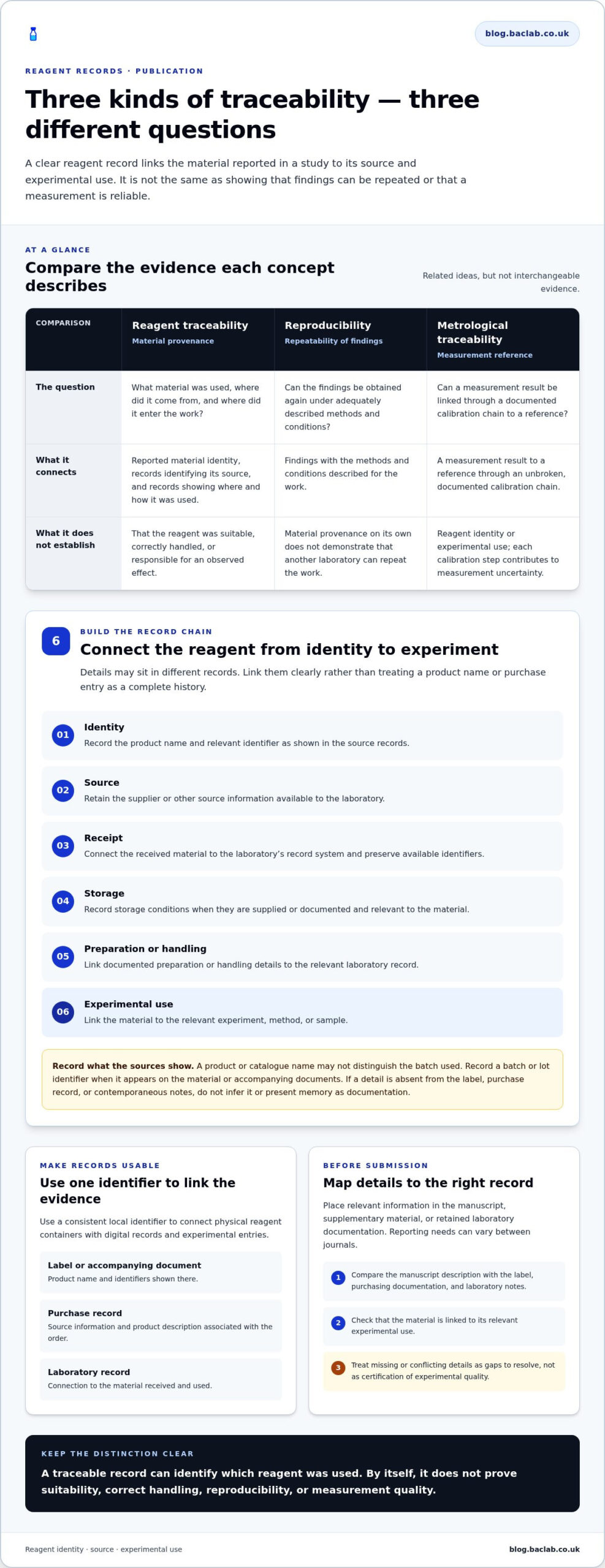
These concepts address different evidential questions. Reagent traceability connects material identity and provenance to experimental use. Reproducibility concerns whether findings can be obtained again under adequately described methods and conditions. Metrological traceability links a measurement result through a documented, unbroken calibration chain to a reference, with each step contributing to measurement uncertainty.
Traceability supports transparency but does not prove reproducibility. A complete record may establish which reagent was used without showing that another laboratory can repeat the work or obtain comparable results. Conversely, an attempt to reproduce a finding may be difficult to interpret if the original report does not identify its materials adequately. Keep these distinctions clear: provenance is not a substitute for experimental validation or measurement quality.
Which reagent details create a useful traceability chain?
A useful traceability chain brings together records created at different points: material identity, source, receipt into the laboratory, storage, preparation or handling, and experimental use. These details need not all appear on a container label. Preserve what each source actually records and link the information, rather than treating a purchase entry or product name as a complete history.
A catalogue or product name may describe a product without distinguishing the particular batch used. Where a batch or lot identifier is supplied, it can connect the laboratory material to accompanying documentation and the experiment record. If a detail is absent from the label, purchase record or contemporaneous notes, don’t infer it or fill it in from memory as though it were documented.
Capture product identity and source without ambiguity
Transcribe the reagent name and supplier or manufacturer as they appear in the source records, then add a catalogue, product or other identifier where available. Record a batch or lot identifier if it appears on the material or accompanying documents. Keep relevant product documentation with, or clearly cross-referenced to, the laboratory record so a reader can distinguish label information from purchasing information and local notes.
- Label or accompanying document: retain the recorded product name and any identifiers shown there.
- Purchase record: retain the source information and product description associated with the order.
- Laboratory record: use a consistent local identifier to connect those sources to the material received and used.
This separation matters if the order record identifies a product but the container label carries a batch detail absent from the invoice. A general overview of scientific documentation for reagents discusses fields such as lot numbers, expiry information, preparation details and storage conditions. Record these when they are supplied or documented and relevant to the material, rather than assuming every field applies to every reagent.
Link receipt, handling and experimental use
At receipt, connect the material to the laboratory’s established record system and preserve any source documents needed to identify it. Record storage or handling details according to the laboratory’s documentation practice and the information available for that reagent. If material is prepared, transferred or otherwise handled before use, link each entry to the same identifier rather than relying on an unlabelled note or product name alone.
The final link is experimental use: identify the method, experiment or sample associated with the reagent in the relevant laboratory entry. For water-based research reagents, the same distinctions around identity and handling can help frame comparisons of sterile reagent options; see this comparison of sterile reagents for research. Bacteriostatic water in a 10 ml vial is one laboratory supply that can be connected to records in this way. The product itself does not document how it was handled or used.
A practical approach to ensuring reagent traceability for scientific publication is to preserve those links as records are created, then carry only supported details into the manuscript. For this laboratory supply, BacLab offers 5 x 10 ml bacteriostatic water vials.
Building traceable reagent records: receipt to experiment
A reliable workflow assigns a consistent identifier when a reagent enters the laboratory, carries it through handling and experimental records, and uses the linked evidence when drafting the manuscript. This reduces reliance on memory and makes it easier to distinguish information observed in source documents from details that are unavailable. The process can use existing paper or digital systems, provided the links between records remain clear.
A practical sequence for recording reagent provenance
Apply the same sequence to each incoming material, adapting the fields to the information actually supplied and the laboratory’s established documentation practice.
- Record receipt. Enter the date received and transcribe the available product identity, source and batch or lot information from the label and accompanying records. Keep purchase documentation linked to this entry rather than assuming it contains every detail shown on the material.
- Assign a stable identifier. Use an existing inventory reference or create a local identifier that points to the receipt record and associated documents. Put the identifier on the physical material or its laboratory record in a way that fits local practice, without replacing the original product or batch information.
- Document storage and handling. Record relevant storage locations or handling events in the appropriate laboratory system. Link any preparation or transfer entry to the same reagent identifier. Guidance on reagent handling practices can inform how these events are considered, but the record should reflect what was actually done.
- Connect material to experimental use. At the time of use, enter the identifier in the relevant experimental record alongside the date and method, experiment or sample reference. If more than one material could fit a general description, the identifier should show which recorded item was used.
- Carry the evidence into drafting. During manuscript preparation, consult the linked records to determine which identity and source details can be reported. Don’t reconstruct an absent batch number or silently substitute a similar product description. State only what the available documentation supports, following the journal’s format.
Keep corrections and changes auditable
If a transcription or identifier error is found, preserve the original entry and record the correction in the manner used by the laboratory. Include who made the change and when, where that information is captured by the local process. Replacing an old entry without recording the change can obscure which information was available during the study and complicate later review.
Where a reagent is replaced, or a new batch is introduced during a study, retain distinct identifiers and link each one to the experimental runs in which it was used. Don’t treat a later material as interchangeable in the records merely because its product name matches. If the original documentation lacks a field, record that limitation plainly, such as “not recorded” or “not available in retained source documents”, rather than guessing. This makes the boundary between documented facts and unresolved gaps visible.
Consistent identifiers create the practical bridge from receipt to manuscript, while transparent corrections preserve the history of the record. Together, these steps make ensuring reagent traceability for scientific publication a repeatable recordkeeping process, not a retrospective attempt to fill gaps from memory.
How to report reagent traceability in a scientific paper
Manuscript reporting should make the material identifiable without reproducing the entire purchasing and laboratory history in the methods section. Use the methods to describe the reagent and its role in the procedure, then place supporting detail in supplementary material or retained laboratory records where appropriate. The journal’s instructions determine the format and level of detail; the underlying records should still let each published description be traced back to its source.
What belongs in the methods section?
Prioritise the recorded reagent name and identifiers needed to distinguish the material, such as supplier or manufacturer and catalogue or batch details where available. Include preparation or handling information when it affects interpretation or is necessary to understand the method. A concise statement might read: “[Reagent name] ([supplier or manufacturer], [product identifier], [batch or lot identifier, if recorded]) was used for [method or experimental step].” Replace each placeholder only with information supported by the study records.
If the journal permits supplementary methods or resource tables, use them for additional identifiers or details that would make the main narrative difficult to read. Cross-reference them clearly from the relevant methods statement. Don’t add fields simply to make a description look complete: an identifier absent from retained documentation should not be inferred, and a citation or catalogue number alone does not show how a reagent was handled or used.
What should remain in supporting laboratory records?
Fuller receipt and source documentation generally belongs in the laboratory’s record system rather than being copied wholesale into the manuscript. Keep the connection intact between what is reported and the original records, including the local reference that links the material to its experimental entry. For an example involving bacteriostatic water, consult this guide to comparing sterile reagents and specifications. Product information can support identification, but it does not establish a study’s procedures or findings.
The distinction can be summarised as follows:
| Manuscript text or supplementary material | Supporting laboratory records |
|---|---|
| Reagent name and relevant source or product identifiers needed to identify the material | Original label details, purchase documentation and associated product records |
| Preparation or handling information relevant to interpreting the method | Detailed preparation, handling and storage entries, where recorded |
| Connection to the method, experiment or sample | Local reagent identifier linked to dated experimental entries and source documents |
Before submission, check that names and identifiers agree across the methods, supplementary files and retained records. Where a detail cannot be verified, omit it or describe the limitation accurately rather than substituting a plausible value. Ensuring reagent traceability for scientific publication makes the report more transparent, but does not by itself validate a result or guarantee that another laboratory can reproduce it.
Shop 5 x 10 ml bacteriostatic water vials
How to assess traceability gaps before submitting a manuscript
A pre-submission review should identify gaps and inconsistencies in the available records, not certify the study or guarantee experimental quality. Its purpose is to check whether manuscript descriptions are supported by records of the materials actually used, and to make unresolved uncertainty visible before submission. A complete set of records cannot, by itself, establish that a method was appropriate or that results will be reproduced.
Which gaps deserve attention before submission?
Review each reagent description against the laboratory’s retained sources, following its identity from manuscript text to experimental entry and, where available, to the label and purchase record. Prioritise discrepancies that could make the material ambiguous: a product name that differs between records, an identifier that points to another item, or a methods description that cannot be connected to the relevant experiment.
- Identity and source: Can the reported material be linked to a retained record that supports its name, supplier or manufacturer, and any available product identifier?
- Specific material used: Do label and batch details, where recorded, agree with the documentation for the material associated with the experiment?
- Experimental connection: Does the relevant experimental note identify the material used, rather than relying only on a general reagent description?
- Uncertain fields: Are absent or conflicting details distinguished from verified information in the manuscript and supporting records?
Resolve discrepancies by consulting the original documentation and correcting the manuscript or linked records where the evidence supports a correction. If historical records are incomplete, don’t reconstruct a batch number, source or handling detail from memory and present it as fact. Record the limitation accurately and proportionately. Depending on the field and journal format, this may mean omitting an unsupported detail or explaining that the information wasn’t retained. Avoid implying that an undocumented field was checked.
This assessment also helps separate what the paper can establish from what it cannot. A reported identifier may let readers distinguish a reagent, but it does not demonstrate that the material was handled correctly, validate the experimental result or ensure that another laboratory will reproduce it. Ensuring reagent traceability for scientific publication means aligning claims with evidence, not overstating what the evidence shows.
Connect documented needs with appropriate laboratory supplies
Selecting a clearly identified supply can support recordkeeping, but it remains one part of a wider process that includes receipt, local documentation and experimental linkage. BacLab supplies bacteriostatic water in 10 ml vials for laboratory and research use. Product identity is separate from records of how any particular study received, handled or used it. Keep product information factual and don’t treat purchase as evidence of experimental outcomes.
Carry the record standard into your next study
Use the next study to establish a consistent recordkeeping practice from the outset. Decide how reagent identifiers will be captured and linked to experimental entries, and make the process part of routine laboratory documentation. This creates a stronger basis for manuscript preparation than trying to reconstruct missing details at submission. In practice, ensuring reagent traceability for scientific publication means keeping claims aligned with the records that support them.
For laboratories sourcing bacteriostatic water, BacLab supplies 10 ml bacteriostatic water vials for laboratory and research applications, with individual purchases and wholesale bundles available. The product’s identity is one element of a traceability record, not evidence of how a particular study was conducted.
Shop the 5 x 10 ml bacteriostatic water vials
Start with clear records for the next experiment, and choose BacLab’s 5 x 10 ml bacteriostatic water vials for your laboratory supply needs.
Frequently Asked Questions
Is a supplier name alone enough to make a reagent traceable?
Usually not, because a supplier may provide multiple products and a supplier name doesn’t identify which one was used. Add the recorded product name and any available catalogue, product or batch identifier. For a generic material, the method or experimental context may also help distinguish it. The appropriate level of detail depends on whether the combined records identify the particular reagent without relying on assumptions.
Can I report a reagent when its batch number is missing?
Yes. Report the identity and source details that your retained records support, and don’t invent or infer a batch number. If the batch is relevant to distinguishing the material but cannot be recovered from available documentation, describe the gap accurately where appropriate. For example, a methods statement can give the documented product name and supplier without implying that a batch identifier was recorded.
How should I record a reagent that was used across several experiments?
Use one material record for the reagent and reference it in each experiment’s entry, recording experiment-specific details separately. For example, a shared inventory entry can link to several dated run records, each noting the relevant method or sample. If the material is replaced or a different batch is introduced, make a separate material record and connect each run to the material actually used.
What should I do if the manuscript and laboratory records have different reagent names?
Pause before submission and establish whether the difference reflects an abbreviation, a documented alternate name or a genuinely different product. Compare the wording with original labels and purchase documentation, then correct the manuscript if those sources resolve the discrepancy. If they don’t, preserve the uncertainty and avoid silently treating the names as equivalent. A brief note in the laboratory record can document the basis for any correction.
Does reagent traceability prove that an experiment is reproducible?
No. Ensuring reagent traceability for scientific publication helps establish which material the records associate with an experiment, but reproducibility also depends on other methodological information and experimental conditions. A well-identified reagent cannot show that another laboratory can repeat the procedure or obtain the same findings. Treat traceability as one part of transparent reporting, not as a conclusion about the validity or repeatability of results.
Should every reagent identifier appear in the main text?
No. Include enough information in the methods to make materials relevant to interpreting the procedure distinguishable, then use supplementary files for additional detail if the journal’s format allows. Identifiers that aren’t needed in the narrative can remain in supporting records, provided the link to the reported material is retained. Check the target journal’s instructions, since reporting formats differ and may specify particular fields or tables.