
A supplier’s confident claim isn’t the same as verifiable evidence. Research buyers often find product pages that clearly describe intended use, while supporting documents, specifications and purchasing terms vary in detail. A laboratory supplier vetting checklist UK teams can apply consistently helps separate documented facts from promotional language and record why a product does or doesn’t meet a stated requirement.
Choosing a supplier isn’t simply a matter of comparing claims or selecting the lowest price. Buyers need an evidence-led method that makes documentation gaps visible without treating them as proof of failure. This guide sets out practical checks for product identity and intended use, documentation, specification fit, purchasing format and procurement records. It also shows how to apply them to a specific reagent category, including BacLab’s 10ml bacteriostatic water vial and its individual purchase, wholesale bundle and bulk discount options. The aim is a clear decision trail, not an assumption that marketing material substitutes for product evidence.
Key Takeaways
- Use a laboratory supplier vetting checklist UK buyers can apply consistently, rather than relying on reputation or promotional claims.
- Compare product identity, intended use and available documentation with your laboratory’s stated requirements.
- Assess suppliers using the same criteria for transparency, purchasing formats and procurement suitability.
- Record each check as pass, fail or not assessed, and give a written reason.
- Apply the checklist to BacLab’s 10ml bacteriostatic water vials for laboratory and research applications, choosing a purchasing format that fits your requirements.
What a UK laboratory supplier vetting checklist should establish
A laboratory supplier vetting checklist UK research buyers can use should link the laboratory’s requirements to the evidence reviewed. It isn’t a general rating of a supplier’s reputation. The assessment should identify the requirement, show what evidence was considered, flag unresolved gaps and record who made the decision.
Keep product evidence separate from promotional language. A supplier’s experience, professional presentation or positive reputation may contribute to a broader assessment, but these factors don’t establish a reagent’s identity, composition or suitability for a particular protocol. A quality claim is not evidence on its own. Record the document or product information supporting it, what it covers and any limitations.
Acceptance criteria depend on the laboratory’s protocol, quality system and intended research use. Requirements for work conducted under Good Laboratory Practice (GLP), for example, should be defined by the applicable study procedures and quality framework. A reference to GLP doesn’t by itself establish that a supplier or product is compliant. For product-specific checks, see this bacteriostatic water quality control checklist.
Set the scope before comparing laboratory suppliers
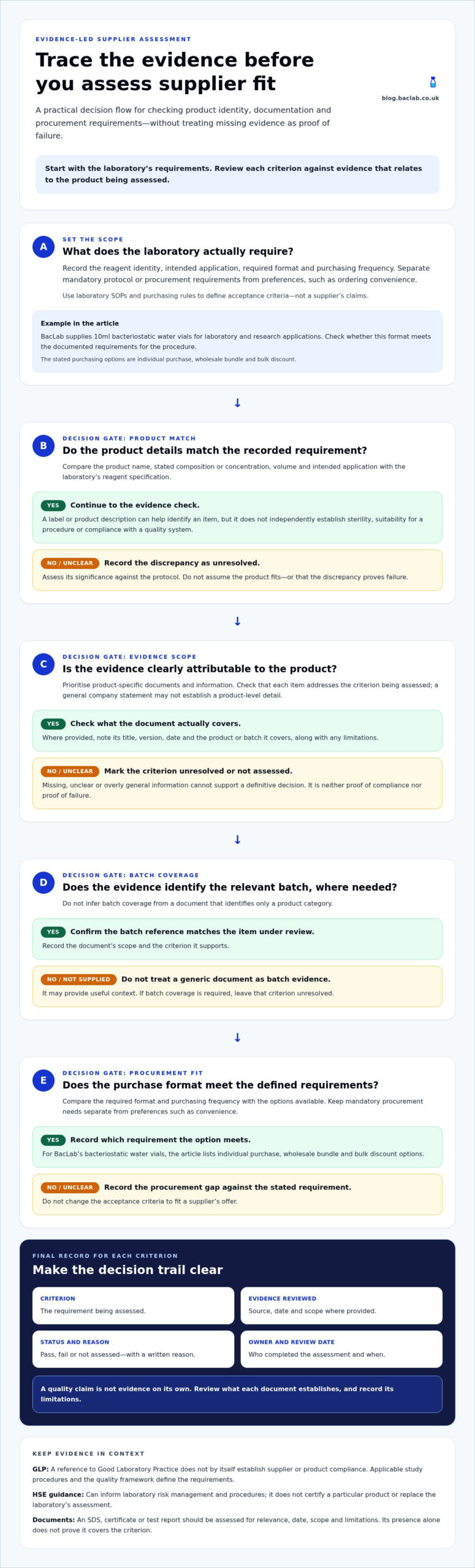
Start by defining the purchase. Record the reagent identity, intended application, required format and purchasing frequency. Separate mandatory protocol or procurement requirements from preferences, such as ordering convenience. Use the laboratory’s SOPs and purchasing rules to define acceptance criteria, rather than adjusting them to fit a supplier’s claims.
For example, a request for bacteriostatic water should specify the format required and the intended research application. BacLab supplies 10ml bacteriostatic water vials for laboratory and research applications. Assess whether that format meets the requirements documented for the procedure.
What counts as evidence in a supplier assessment?
Prioritise product-specific documents and information that can be clearly attributed to the product being assessed. Check that each item addresses the criterion in question: a general company statement may not establish a product-level detail. Where provided, record the document’s title, version, date and the product or batch it covers. Don’t infer batch coverage from a document that identifies only a product category.
Use a simple record for each criterion:
- Criterion: The requirement being assessed.
- Evidence reviewed: The document or information source, including its date and scope where provided.
- Status: Pass, fail or not assessed, with a reason.
- Owner and review date: Who completed the assessment and when.
If evidence is missing, unclear or too general to evaluate, record the criterion as unresolved. An unresolved item is neither proof of compliance nor proof of failure. It means the assessment can’t yet support a definitive decision.
Assess product identity, intended use and laboratory documentation
Before reviewing documents, confirm that the product described is the one the protocol requires. Compare its name, stated composition or concentration, volume and intended application with the laboratory’s recorded reagent specification. A label or product description can help identify an item, but it doesn’t independently establish sterility, suitability for a procedure or compliance with a particular quality system.
For bacteriostatic water, keep the assessment within the stated laboratory and research use. Check whether the product information aligns with the laboratory’s protocol. Don’t assume a product is suitable for a different application simply because its name is familiar.
Match product information to the research requirement
Compare each stated product detail with the requirement, rather than relying on a broad category match. Differences in naming, volume or composition may affect whether the item fits the protocol. Record any discrepancy as unresolved until its significance has been assessed. For a more detailed framework for examining product information, refer to the bacteriostatic water quality-control checklist.
Next, check the scope of each document. It should identify, or otherwise be clearly attributable to, the relevant product. If batch-specific evidence is provided, confirm that the batch reference corresponds to the item under review. A generic document may provide useful context, but it shouldn’t be treated as batch evidence if it doesn’t identify that batch.
Review safety and quality documents without overstating them
Assess documents according to what they actually establish. If an SDS is supplied, check that it relates to the product being purchased and note its version or issue date. The HSE guidance on laboratory management can inform the laboratory’s approach to managing risks and procedures. It doesn’t certify a particular product or replace the laboratory’s assessment.
Consider certificates and test reports only when they are supplied and clearly linked to the product, and to the relevant batch where applicable. Record each document’s title, date, scope and limitations. A supplier statement that testing or certification exists isn’t a substitute for reviewing the evidence. A document’s presence alone doesn’t prove that it covers the requirement in question.
- Product identity: Does the information match the required name, composition and volume?
- Intended use: Is the stated application consistent with the laboratory protocol?
- Documentation: Is each document relevant, identifiable and sufficiently scoped?
- Decision: Record discrepancies or missing evidence for review rather than assuming approval.
For a product-specific reference point, review the details of BacLab’s 10ml bacteriostatic water vial against your laboratory’s documented requirements.
Compare UK supplier transparency, procurement fit and evidence limits
Supplier comparisons are more useful when every option is assessed against the same requirements. A polished website, a UK-facing address or broad statements about quality shouldn’t be treated as proof of a product’s status or of a particular fulfilment arrangement. Record what is explicitly stated, what the information reviewed supports and what remains outside the assessment’s scope.
Compare like-for-like products intended for the same research application. Comparing unrelated laboratory supplies can produce a misleading result, even when their descriptions or purchasing formats appear similar. A laboratory supplier vetting checklist UK buyers can use should make differences visible without reducing them to an unsupported overall score.
Build a like-for-like supplier comparison
Use the same fields for each supplier and record the source, not just your judgement. This makes gaps traceable and gives procurement colleagues a practical basis for review. For broader purchasing context, see this overview of UK laboratory sourcing.
Criterion: Product transparency, documentation access, ordering format, stated terms or support information.
Evidence and source: Record the specific product information or document reviewed and where it was found.
Status: Mark the criterion as supported, unresolved or not applicable, with a brief reason.
Follow-up action: State what decision or review is needed to resolve an information gap.
Keep claims separate from evidence. Record a stated feature as a supplier claim; consider it substantiated only when the available information supports the precise criterion being assessed. Don’t assume that documents are accessible for every product because one document is available, or that support arrangements meet a particular response standard unless that standard is explicitly stated.
Check purchasing arrangements against laboratory demand
Compare single-unit and multi-unit formats with forecast usage, storage capacity and the laboratory’s purchasing process. A larger order may suit planned demand, but a bundle shouldn’t be preferred solely because it is available. Assess the quantity against the laboratory’s own handling and storage procedures.
BacLab offers individual 10ml bacteriostatic water vials, wholesale bundles and bulk discount options. These are purchasing formats, not evidence of product quality or suitability. Assess the product against the protocol separately. Record published terms or delivery information as stated, without inferring dispatch times, service levels or fulfilment arrangements that aren’t provided.
Distinguish product fit from procurement convenience. If the evidence supports the product requirement but purchasing details remain unclear, record these as separate findings. This keeps the decision trail transparent and shows which points are established, unresolved or outside the scope of the review.
Apply a repeatable supplier vetting checklist and document gaps
A repeatable process turns document review into a decision record that colleagues can understand and revisit. Use the same sequence for each purchase, assign a status to every criterion and keep unresolved questions visible. A laboratory supplier vetting checklist UK buyers can adapt should support internal review, not replace institutional approval, protocol authorisation or the laboratory’s quality and procurement procedures.
Use five steps for each assessment
- Define requirements: Set the product, intended research use, format and acceptance criteria from the relevant protocol, SOP and procurement rules.
- Collect evidence: Gather product information and relevant documents, noting their source, date and scope where available.
- Assess fit: Compare each item of evidence with a specific requirement. Don’t let a general supplier claim stand in for product-level support.
- Record gaps: Document missing, inconsistent or unclear information, its source and the follow-up needed.
- Approve or defer: Submit the assessment through the laboratory’s normal decision process. Defer where unresolved issues prevent a supported decision.
Use pass, fail and not assessed for each criterion, with a written reason. A pass means the reviewed evidence meets that stated criterion; a fail means it doesn’t. Use not assessed when evidence is absent or insufficient to determine the outcome. If evidence only partly addresses a requirement, explain the limitation and follow the laboratory’s procedure for deciding whether the criterion passes, fails or remains unassessed.
Make the decision traceable
Each record should identify the assessment owner and review date, alongside the criterion, evidence and status. Explain why the evidence meets or doesn’t meet the requirement. Avoid unsupported conclusions such as “approved” when the review hasn’t established that outcome. Keep unresolved items open until the responsible internal reviewer determines how to proceed.
Escalate uncertainty about product suitability or regulatory status through the laboratory’s own quality and procurement routes. A checklist organises evidence and records a recommendation; it doesn’t confer approval or replace a protocol review.
Record concerns in measured terms
Inconsistent product details, undated documents and claims without identifiable supporting evidence are reasons to flag a criterion for review. They aren’t, by themselves, proof that a supplier or product is unsuitable. Describe the discrepancy precisely, cite the source and explain what remains uncertain. This separates an evidence gap from an allegation and gives the internal reviewer a clear basis for follow-up.
If new information is reviewed, update the record with the revised evidence and review date rather than silently overwriting the earlier assessment. This preserves the basis for the decision and supports consistent purchasing reviews.
Use the checklist to assess a bacteriostatic water purchase
Applying the checklist to a defined reagent shows how to separate confirmed product information from questions that require assessment against the laboratory’s own protocol. BacLab supplies 10ml bacteriostatic water vials for laboratory and research applications. These details identify the product category, vial volume and stated application; they don’t, by themselves, establish suitability for every research method or meet every laboratory requirement.
What the BacLab product information establishes
Compare the product identity and 10ml format with the reagent specification documented in the protocol. Check that bacteriostatic water and the stated laboratory or research application align with the intended use. If the protocol requires additional composition details, documents or evidence, assess those as separate criteria rather than assuming they follow from the product name or stated application.
Keep the record precise. Note which product information was reviewed and whether it addresses each requirement. Don’t infer certifications, testing results, batch documentation or regulatory approval from a product description. If a requirement can’t be assessed using the information available to the buyer, record it as unresolved and follow the laboratory’s internal review process.
Choose a purchasing format that fits the requirement
Procurement suitability depends on demand as well as product fit. BacLab offers individual purchases, wholesale bundles and bulk discount options. Compare these formats with the laboratory’s forecast usage, storage capacity and purchasing procedures. A multi-unit option may suit planned demand, while an individual vial may fit a smaller requirement. The format selected doesn’t replace the assessment of whether the product meets the protocol.
Before approval, make sure the intended product and purchasing format match the documented requirement. Record any remaining evidence gaps and distinguish them from criteria that have been assessed and met. This grounds the decision in the information reviewed, rather than assumptions about quality or suitability.
For an evidence-led decision, confirm product identity and format against the protocol, assess available information against each criterion, and document unresolved points through the laboratory’s normal review process.
Make your next supplier decision traceable
Effective supplier vetting links each purchasing decision to the laboratory’s documented requirements and the evidence reviewed. Compare equivalent products against consistent criteria, distinguish product-specific information from promotional claims, and record gaps rather than assuming they indicate compliance or unsuitability. A clear status, written reason, assessment owner and review date make the decision easier to revisit.
A laboratory supplier vetting checklist UK research buyers can apply consistently also helps separate product fit from procurement convenience. Confirm that the product and format match the intended research requirement, then assess purchasing options against forecast demand and internal procedures. Where evidence or regulatory questions remain unresolved, use the laboratory’s own quality and procurement review processes before reaching a decision.
BacLab supplies bacteriostatic water in 10ml vials for laboratory and research applications, with individual purchases, wholesale bundles and bulk discount options. These formats provide purchasing choices to consider alongside the laboratory’s requirements, not a substitute for its evidence assessment.
View the 10ml bacteriostatic water vial
With a consistent record and a defined review process, research buyers can make more transparent, well-supported purchasing decisions.
Frequently Asked Questions
What should a laboratory supplier vetting checklist include?
A laboratory supplier vetting checklist should cover product identity, intended-use fit, relevant documentation, traceability, purchasing terms and a recorded decision. Map each criterion to the laboratory’s protocol, quality system or procurement requirements. Distinguish supplier statements from evidence specific to the product being assessed. If required information is missing or unclear, mark the criterion unresolved rather than assuming it is acceptable. The checklist supports institutional review; it doesn’t replace it.
How can a UK laboratory assess a supplier’s quality documentation?
Check each document’s title, date, product scope and, where applicable, batch reference against the item under review. An SDS provides safety-related information, whereas a certificate or test report serves a different purpose; neither automatically establishes every quality attribute. Record what each document does and doesn’t demonstrate, then follow institutional quality procedures. If interpreting a legal or regulatory requirement, verify it against current UK primary sources rather than relying on a supplier statement alone.
Is a UK-based laboratory supplier automatically compliant with every laboratory requirement?
No. A supplier’s UK location doesn’t establish that a product meets a laboratory’s protocol, quality-system requirements or procurement criteria. Assess the relevant product information and available documentation against requirements defined before purchase. Don’t infer regulatory status or fulfilment arrangements from a UK address or website. If a product or regulatory question remains uncertain, record the gap and refer it to the laboratory’s responsible quality or compliance function for review.
What happens if a supplier cannot provide a document required by our protocol?
Record which document is missing and identify the protocol criterion it relates to. Don’t mark that requirement as met by assumption. Follow the laboratory’s internal escalation and approval process before purchasing or using the product; the appropriate next step depends on the protocol and quality system. An absent document is an evidence gap, not, by itself, proof of misconduct or a definitive regulatory breach. Keep the issue open until an authorised internal reviewer decides how to proceed.
Can a laboratory use the same checklist for every reagent supplier?
A laboratory can use a common checklist structure to improve consistency, but criteria should reflect the reagent, intended research application and institutional requirements. Headings such as product identity, documentation, traceability and purchasing terms can provide a shared framework. The evidence needed under each heading may differ between products. Retain the standard structure, then document reagent-specific acceptance criteria and any additional review required by the laboratory’s SOPs.
How should a laboratory compare bacteriostatic water suppliers?
Compare product identity, stated intended application, available product-specific documentation and purchasing format with the laboratory’s documented requirements. Keep evidence separate from marketing claims, and don’t infer testing or certification unless applicable supporting information has been reviewed. BacLab supplies 10ml bacteriostatic water vials for laboratory and research applications, with individual purchasing, wholesale bundles and bulk discount options. Assess these product and purchasing details against your own protocol and procurement criteria.
Does a supplier checklist replace a laboratory SOP or compliance review?
No. A supplier checklist is a procurement aid for organising evidence and recording an assessment; it doesn’t replace a laboratory SOP, risk assessment or institutional quality review. Apply the procedures governing the relevant research activity, and refer uncertain technical or legal interpretations to the appropriate internal function. Where the laboratory’s document-control system requires it, keep the checklist version-controlled so reviewers can identify which criteria informed the decision.