
The lowest quotation is not, by itself, evidence of a reliable supplier. To decide how to choose a reliable scientific consumables supplier in the UK, compare five areas: whether the products and prices meet your requirements, what reviews indicate, the supplier’s distributor status, its shipping and returns policies, and its record of delivering the required quality on time. The strongest choice offers suitable overall value, not simply the smallest figure.
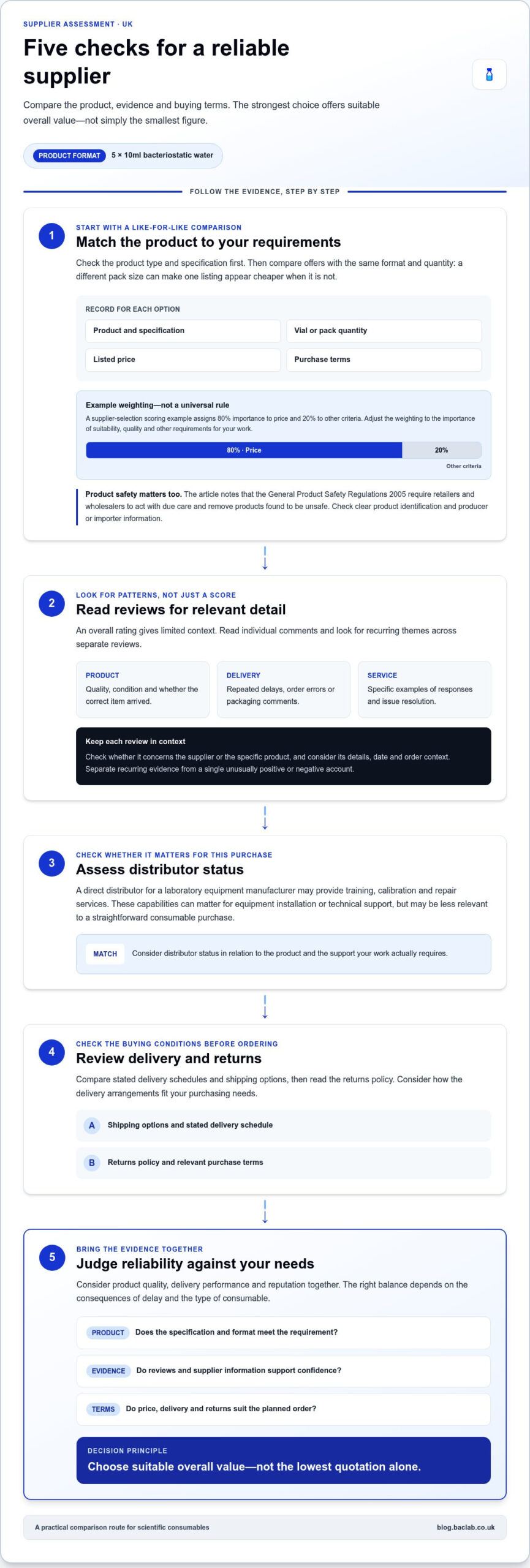
Price matters, but a low initial cost may not suit your work if the product, delivery arrangements or service do not meet your needs. Compare measurable terms, such as price and stated delivery schedules, separately from evidence that needs context, such as reviews and reputation. These five practical checks will help you weigh reliability against cost and decide what to review before ordering. The right balance depends on the consequences of delay and the type of consumable.
Key Takeaways
- Compare products against your requirements first, then weigh the quoted price alongside terms and overall value.
- Read customer reviews for recurring patterns about product quality, delivery and service rather than relying on a single opinion.
- Check whether distributor status matters for the product, particularly where manufacturer support or technical services are relevant.
- Review shipping options, delivery schedules and returns policies before placing an order.
- Assess reliability by considering quality, delivery performance and reputation together; BacLab offers 10ml bacteriostatic water vials, with wholesale bundles and bulk discounts.
1. Comparing products and prices through an online store
When deciding how to choose a reliable scientific consumables supplier in the UK, match the product listing to your laboratory’s specification before comparing prices. For bacteriostatic water, check that the product type and vial size meet your requirements. Compare like with like: a different pack quantity or specification can make one offer look cheaper when it is not.
Use the supplier’s online store to review product details, brands, pack quantities and listed terms. Search by product name or specification, then open the relevant listing and compare its description with your requirements. A catalogue may include a broad selection, but the useful range is the one that includes the consumable and format your laboratory needs. A laboratory consumables catalogue can help organise that product comparison.
Compare quotations on an equivalent basis. Record the product, quantity, listed price and terms for each option. Supplier-selection scoring examples sometimes assign 80% importance to price and 20% to other criteria. This is an example, not a universal rule. The right weighting depends on whether product suitability, quality or other purchasing requirements carry greater importance for your work.
For bacteriostatic water, compare the available vial format with the quantity required for your research purchasing. A single vial and a multi-vial format represent different quantities, so assess their terms accordingly. Choose the option that fits the planned order rather than assuming the lowest headline price offers the best value. The same principle applies to consumables sold in different pack sizes.
Product safety also belongs in supplier assessment. The General Product Safety Regulations 2005 implemented the EU General Product Safety Directive in the UK, according to the UK legislation register. Retailers and wholesalers must act with due care on product safety requirements and remove products found to be unsafe. Clear product identification and supplier information are therefore relevant alongside price and range.
Check the product information for details about the supply chain. The UK legislation register states that when a producer is based outside the country, the importer is responsible for the product safety requirement. Reviewing the producer or importer information can clarify which parties are associated with the product.
For a practical purchasing decision, record the required specification, vial or pack format, listed price and purchase terms together. This applies how to choose a reliable scientific consumables supplier in the UK to an actual order. It keeps the decision focused on product suitability and buying conditions, rather than catalogue size or headline price alone.
2. Checking online customer reviews
Online reviews can help you assess a laboratory supplier, but an overall rating offers limited detail. Read individual comments for specifics about product quality, order accuracy, delivery and customer service. A review that describes the correct item arriving in suitable condition is more useful than a rating without context. Treat feedback as one source of evidence, not a replacement for checking product specifications.
Look for recurring themes across separate reviews. If several customers describe similar delivery delays or errors, note how that pattern relates to your purchasing priorities. Comments about clear product information or helpful responses to order problems may point to strengths worth considering. Multiple detailed experiences over time provide more context than one unusually positive or negative account.
Check whether a review concerns the supplier generally or the specific product you plan to buy. A supplier may sell different consumables, so feedback about one item might not reflect another item’s quality or handling. For example, comments about packaging may inform expectations about fulfilment, while a review of another product’s performance may have little relevance to your order.
Look for verifiable details in the review. Useful comments identify the issue, explain what happened and describe the supplier’s response. “Excellent service” offers little evidence unless the reviewer explains what service they received. If a review reports a damaged delivery, consider the details of the communication and resolution rather than assuming every customer would have the same outcome.
Review dates and context matter. Older feedback may relate to an earlier product range or service experience, so compare it with recent comments. Note whether the review concerns a one-off purchase, repeat orders or a particular delivery. These details help you judge whether the experience is relevant to your laboratory’s requirements.
As you read, keep a simple evidence note: record the review topic, its specific details and its relevance to your order. Separate comments about product condition from feedback on delivery or support. This prevents a general impression from obscuring a recurring issue. If reviews conflict, compare their details and dates instead of reducing them to a single average conclusion.
For bacteriostatic water, consider product information alongside customer feedback, so the review context matches the item being assessed. The 5 x 10ml bacteriostatic water bundle is one product listing to assess using the same criteria: relevant details, order experience and suitability for the intended laboratory use.
3. Direct manufacturer distributors
A direct distributor for a laboratory equipment manufacturer may provide training, calibration and repair services. These capabilities can matter when equipment needs installation, routine calibration or technical support, but may be less relevant to a straightforward consumable purchase. Match the distributor’s role to the product and the support your laboratory needs.
First establish whether the supplier is a direct distributor or an independent reseller. Then compare its product range with the manufacturer’s information and your purchasing specification. A direct relationship may clarify which products the distributor handles, but does not automatically make every listing suitable. Check the model, configuration and intended application against your requirements.
Compare support arrangements. For equipment, check whether the distributor provides training, calibration or repair services, and which services are included in the offer. A laboratory buying an instrument that needs calibration may value access to that service. A team purchasing routine consumables may give greater weight to product suitability and fulfilment.
Buying through an unauthorised online dealer may leave you without access to training or repair support later. This can influence equipment selection when continued operation depends on technical assistance. Compare the supplier’s status and support arrangements before ordering, rather than treating a lower quotation as the only relevant difference.
Use the same comparison record for each distributor. Note the manufacturer and product, the distributor’s relationship with the manufacturer, the services offered and any exclusions in the quotation. Separate product supply from optional services to reflect what your laboratory will receive. If offers differ, record whether the difference concerns the equipment or its accompanying support.
- Product: record the manufacturer, model and required configuration.
- Distributor: note whether it is direct or an independent reseller.
- Support: list training, calibration and repair services separately.
- Offer: compare the quotation’s scope and stated exclusions.
This framework also helps distinguish equipment procurement from consumables purchasing. A laboratory sourcing an instrument may need to assess technical support alongside product suitability. For recurring consumables, a distributor’s equipment services may have little bearing on the decision. Keep the criteria proportionate to the order, and use the UK supplier-vetting framework to structure wider due diligence.
Direct distribution is one factor in assessing reliability, not a verdict. Compare the supplier’s relationship, product suitability and available support with the operational demands of the purchase. A distributor offering calibration may suit an instrument order, while another supplier may better fit a consumables requirement. Choose according to the product and support needed.
4. Reviewing shipping options and policies
Shipping terms affect whether an order fits your laboratory’s schedule, so review them before buying. Compare available delivery options, stated schedules and shipping policies. Where dispatch information and expected arrival are listed separately, distinguish between them. For example, an order needed before a planned experiment requires a delivery schedule that supports the work, not just an appealing product listing.
Record delivery information for each quotation in the same format. Include the stated schedule, shipping choices, any conditions attached to those choices and the returns policy. This makes differences easier to spot. If one policy explains how returns work and another gives little detail, note that distinction rather than assuming the terms are equivalent.
Consider how delivery timing affects your work. A consumable needed for scheduled research may be more urgent than an item held as routine stock. Review expected use and current stock before choosing a shipping option. This links the supplier’s delivery schedule to an actual requirement instead of relying on a general estimate unrelated to the work.
- Delivery schedule: note the stated timing and whether it fits the planned use.
- Shipping options: compare the choices available for the order.
- Returns: read the policy and record its stated process.
- Order terms: compare these details with the quotation and purchase conditions.
A supplier-selection example scores delivery time on a scale from 1 to 3, with 3 representing the most optimal delivery date. This provides a structured way to compare schedules, but the score should reflect your laboratory’s needs. A date that works for routine replenishment may not suit an order required for a time-sensitive research schedule.
Consider shipping and returns policies together. If an order arrives incorrectly or the goods are unsuitable, the returns policy sets out the next steps. Read it carefully and note the conditions that apply to your purchase. Before ordering, compare the policy with the delivery options, schedule and quotation terms. This gives procurement staff a clear record of the terms relevant to the order.
For recurring supplies, compare delivery arrangements with your laboratory’s ordering routine. A schedule aligned with stock reviews can help staff plan replenishment and avoid unnecessary urgency. Record the chosen delivery option and its stated schedule with the purchase documents. Later, compare the expected arrangement with the actual arrival and use your order history to improve future decisions.
5. Supplier reliability
Supplier reliability means consistently providing products or services that meet requirements and arrive on time. A late delivery can disrupt schedules, while substandard goods can increase costs and weaken customer trust. Assess reliability against your laboratory’s operational needs: a consumable essential to scheduled work has different consequences from routine stock.
Assess the supplier’s reputation, experience, delivery capability, customer service and adherence to quality standards. Where available, review documented performance, including order accuracy, the condition of goods on arrival and complaint handling. A supplier evaluation can also consider financial background, staffing, quality controls and capacity to meet required quantities. Weight each criterion according to the work the supplier will support.
Compare written terms for returns, warranties, product recalls and customer support. Record eligibility, reporting steps, responsibility for incorrect deliveries, recall notifications and available support channels. Clear terms make it easier to compare how suppliers handle the same problem.
To assess certifications and quality controls, check the certificate’s scope, holder, issuing body and validity, then confirm it covers the relevant supplier activity or site. Review documented inspection procedures, quality records and how deviations are managed. A certificate alone does not show that every product or process meets your laboratory’s requirements.
For traceability, check whether product records identify the batch or lot and link it to the relevant documentation. Find out how batch certificates are matched to supplied goods, how reconstituted research compound shelf life is considered alongside expiry dates, and how records support collection and delivery tracking. On receipt, compare the product label and accompanying documents before adding the consumable to laboratory stock.
Before opening a business account, establish which products and quantities it can supply, the account and payment terms, and how orders are tracked. Clarify how to report incorrect deliveries, access product documentation, raise quality concerns and receive recall information. Written terms are easier to assess against your procurement procedures.
Review reliability after ordering, too. Record product quality, whether the delivery met its schedule, complaint handling and the condition of the goods on arrival. A small initial order can help you assess responsiveness and fulfilment before making a larger commitment. Use the results to update your supplier assessment and identify recurring performance issues.
View the 5 x 10ml bacteriostatic water bundle
BacLab: Bacteriostatic Water, 10ml vial
BacLab supplies 10ml vials of bacteriostatic water as a sterile reagent for professional laboratory and research use. For laboratories assessing a suitable consumable, the product listing provides a specific item to evaluate against their application, order requirements and supplier criteria.
Individual vials are available alongside a bundle of five 10ml vials, wholesale bundles and bulk discounts. These options support different purchasing quantities; select the format that aligns with your laboratory’s requirements.
To review the product, visit the 10ml vial listing. For further information, visit the BacLab blog.
Put your supplier decision into practice
Turn your selection criteria into a short procurement record that colleagues can use consistently. Note which requirements are essential, who reviews supplier evidence and where the final decision is recorded. This makes it easier to explain why a supplier suits a particular research need, especially when purchasing responsibilities are shared.
To apply how to choose a reliable scientific consumables supplier in the UK, use the same assessment for your next planned order. Record any new information from the purchase and refine your internal criteria. This process can guide future decisions without relying solely on past assumptions.
For laboratories sourcing bacteriostatic water, BacLab’s product page provides a direct place to review the 10ml vial offering against your requirements.
A clear purchasing process gives your team a practical basis for its next decision.
Frequently Asked Questions
What criteria indicate a reliable scientific consumables supplier in the UK?
Reliable suppliers consistently meet your required specifications, quantities and quality standards. Before approval, define essential requirements as pass-or-fail criteria, then compare preferences such as flexibility or suggested substitutes. Consider whether the supplier’s capacity and staffing can meet your purchasing needs. After an initial order, record whether the goods matched the specification and how any discrepancies were handled. This creates evidence for future procurement decisions.
Which UK suppliers offer the widest range of laboratory consumables and brands?
The most useful range is the catalogue that covers your laboratory’s required product categories and brands, not necessarily the one with the most listings. List the items you need and compare how each supplier covers those categories. A broad catalogue can simplify purchasing if it meets several needs, but it does not mean every listed product suits your work. Assess product suitability separately from catalogue breadth.
What UK regulations apply to purchasing and shipping laboratory chemicals, biological materials and hazardous consumables?
Requirements depend on the product and its classification, so distinguish general product safety from material-specific handling and transport conditions. The General Product Safety Regulations 2005 implemented the EU General Product Safety Directive in the UK, according to the UK legislation register. The same register states that an importer is responsible for the product safety requirement when the producer is based outside the country. Review relevant product documentation and shipping conditions for each item.
How do UK scientific consumables suppliers compare on prices, discounts and minimum order values?
Compare quotations using the same product specifications and quantities. Record each supplier’s stated discounts, minimum order values, payment terms and delivery charges. A discount improves value only if the order quantity and products match your needs. Compare the total terms for a planned order rather than judging unit price alone. The right choice depends on required stock levels, order frequency and budget.
What are typical delivery times, shipping costs and cold-chain options from UK lab suppliers?
Delivery schedules, shipping charges and temperature-controlled options vary by supplier and order. Compare the stated schedule and charges for the specific basket, and determine whether the product requires temperature-controlled transport. If cold-chain handling is necessary, include the required temperature conditions and handover arrangements in your assessment. For routine items, align delivery with stock planning so replenishment fits laboratory use without assuming a standard delivery timeframe.
What risks arise from counterfeit, substandard or non-compliant laboratory consumables?
Counterfeit or substandard goods may fail to meet the specified quality, disrupt planned work and increase costs. Late deliveries and poor-quality products can also delay production and damage customer trust. On receipt, check product identification and accompanying documents against the order, and record any discrepancies. If a product is identified as unsafe, UK retailers and wholesalers must remove it from the market. These checks help limit the impact of unsuitable goods on laboratory operations.
How do supplier returns, warranties, product recalls and customer support policies compare?
Before ordering, review each supplier’s returns policy, warranty terms, delivery schedule, complaint handling and customer service. Also assess whether the supplier accepts responsibility for incorrect deliveries or mistaken orders.