
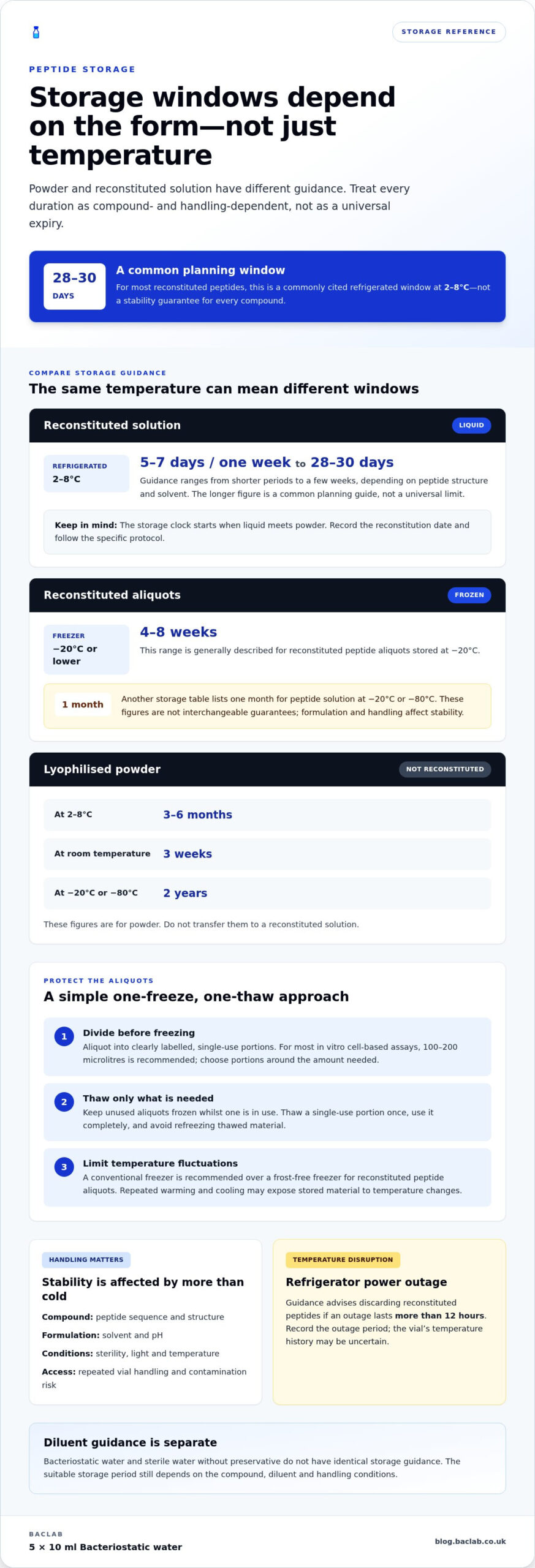
A reconstituted vial has no single shelf-life that applies to every compound. For most reconstituted peptides, 28-30 days refrigerated at 2-8°C is a common planning window, but extending the shelf life of reconstituted research compounds depends on the compound, diluent and handling conditions. Temperature control matters, but it cannot compensate for contamination or repeated freeze-thaw cycles.
It’s reasonable to expect refrigeration to preserve a solution, but storage time alone cannot show that it remains usable. Light, moisture and repeated access to a vial can also affect stability, so careful handling matters from reconstitution onwards.
This article explains how temperature, aliquoting, light protection, moisture control and sterile technique affect a reconstituted vial’s usable period. It also compares refrigerated storage with frozen aliquots and explains why guidance varies between compounds, so you can make informed decisions without treating general advice as a universal rule.
Key Takeaways
- Use 28-30 days at 2-8°C as a common planning window for reconstituted peptides, not a universal stability guarantee.
- Aliquoting helps limit repeated freeze-thaw cycles; thaw only the amount needed and avoid refreezing thawed material.
- Protect reconstituted solutions from light and moisture, as well as from unnecessary temperature changes.
- Sterile handling and careful vial access help reduce contamination risks during storage and use.
- The suitable storage period depends on the compound, diluent and handling conditions, so general guidance may not fit every solution.
Aliquoting and avoiding repeated freeze-thaw cycles
Aliquoting limits how often a reconstituted peptide solution is exposed to thawing. The benefit depends on the compound, solvent and handling.
Yes, reconstituted peptide solutions may be frozen at −20°C or lower for longer storage. Plan one freeze and one thaw per aliquot; avoid refreezing it.
Aliquoting reconstituted solutions
Aliquoting means dividing a reconstituted solution into separate, smaller portions for individual use. Each portion can then be thawed independently, leaving the remaining stock frozen. For most in vitro cell-based assays, aliquots of 100 to 200 microlitres are recommended. The appropriate volume depends on the amount needed for an experiment, so plan portions around actual use rather than repeatedly sampling one large vial.
Use clearly labelled, single-use portions, and keep the unused aliquots frozen whilst one is in use. A conventional freezer is recommended over a frost-free freezer for reconstituted peptide aliquots. The repeated warming and cooling associated with a frost-free cycle may expose stored material to temperature changes. For related considerations, BacLab’s bacteriostatic water storage and shelf-life guidance addresses the diluent separately from peptide-solution stability.
Freezing and thawing effects
Freezing slows some degradation processes, but it does not establish a universal stability period for every reconstituted compound. Peptide sequence, solvent, pH, sterility, temperature and light exposure all influence stability. Reconstituted peptide aliquots stored at −20°C are generally described as stable for 4 to 8 weeks. Treat that range as a planning guide, not a shared expiry period for every peptide.
Thaw only the portion needed for the experiment, then use it completely. Thawing a single-use aliquot just once avoids refreezing the same solution. A laboratory can divide a stock before freezing, then use one portion while keeping the rest frozen. This reduces unnecessary handling of the bulk solution.
Repeated freeze-thaw exposure
Repeated freeze-thaw exposure means freezing a solution, thawing it, then freezing it again. Each cycle can stress the peptide solution and shorten its usable storage window. There is no single cycle limit for every compound. As a practical approach, prepare single-use aliquots, thaw each only once and discard it after use.
For longer storage, freeze aliquots at −20°C or lower soon after preparation, following the compound’s applicable protocol. A storage table lists one month for peptide solution kept at −20°C or −80°C, whilst other guidance describes 4 to 8 weeks at −20°C. These periods are not interchangeable guarantees: formulation and handling affect stability. Avoiding repeated thawing helps preserve the intended storage conditions, but cannot reverse degradation that has already occurred.
Peptide storage durations by form and temperature
Storage conditions for peptides change after reconstitution, so powder and solution require different care. Refrigeration is common for short-term storage, while freezing is used for longer storage.
Refrigerated storage after reconstitution
Refrigerated storage means keeping reconstituted peptide solution at 2-8°C to slow degradation during short-term use. Guidance ranges from several days to a few weeks, depending on peptide structure and solvent. A conservative planning figure is 28-30 days, although some storage guidance gives shorter periods, including 5-7 days or one week. These differences show why a single duration cannot be applied to every compound.
Keep the vial consistently cold and avoid storing it where routine door opening causes temperature fluctuations. The storage clock starts when liquid meets powder, not when the vial is first accessed. Record the reconstitution date and the storage limit specified by the relevant protocol so you can track elapsed time.
Freezing is used for longer storage, but the applicable period still depends on formulation and handling. Reconstituted peptide aliquots stored at −20°C are generally described as stable for 4 to 8 weeks. By contrast, lyophilised powder has different storage guidance: a table lists 3-6 months at 2-8°C, three weeks at room temperature, and two years at −20°C or −80°C. These figures apply to different forms, so don’t transfer powder durations to a reconstituted solution.
Compound-specific storage considerations
Compound-specific storage considerations include the effects of peptide structure, solvent, concentration and research conditions on stability. Aqueous solutions can behave differently from lyophilised powder, and peptides may respond differently to the same temperature. Follow guidance for the specific compound rather than treating a general table as a universal limit. A commonly cited refrigerated planning figure does not override a shorter compound-specific instruction.
Solvent also matters: bacteriostatic water and sterile water without preservative do not have identical storage guidance. For work requiring bacteriostatic water, bacteriostatic water for research is one option to consider when selecting a reconstitution diluent.
A refrigerator power outage introduces uncertainty about the solution’s temperature history. Guidance advises discarding reconstituted peptides if the outage lasts more than 12 hours. The duration matters because a closed refrigerator may warm differently from one opened repeatedly; record the outage period and avoid assuming the vial remained within its intended range.
For practical peptide storage, distinguish powder from reconstituted solution, maintain the specified temperature and record preparation dates. Cold storage does not give different compounds the same shelf life. Follow the relevant protocol’s storage duration and record any temperature excursions.
Light and moisture protection
Light, moisture, air contact and contamination can affect peptide-solution stability after reconstitution. Protect the vial during storage and minimise unnecessary exposure when handling it.
Protection from light exposure
Protecting a solution from light means limiting exposure to direct light, especially for light-sensitive peptides. Store the vial in an opaque container or wrap it in foil when appropriate. This limits exposure during refrigerator storage and handling. Avoid leaving peptide solutions on a laboratory bench under direct lighting while preparing samples.
Temperature and light exposure are separate storage factors. Refrigeration at 2-8°C does not remove the need to shield a light-sensitive solution. Return the vial promptly to its protected storage place after use, rather than leaving it beside equipment or near a window. A covered secondary container can reduce incidental exposure when the original vial is transparent.
Light protection should not compromise clean technique. For example, avoid repeatedly unwrapping and rewrapping a vial if doing so leads to unnecessary contact with its closure. Keep the outside dry and intact, and shield the solution from light without opening the container. These steps address separate risks: foil limits light exposure, while careful access helps reduce contamination.
Limiting air contact and moisture
Limiting air and moisture exposure means keeping the vial closed and its external seal intact between uses. Moisture can enter exposed lyophilised powder, while air exposure may contribute to changes in stored material. Where appropriate, seal the cap and vial body with sealing film, and keep the closure clean during handling.
Condensation is another source of moisture. A cold lyophilised vial opened before it reaches room temperature can collect condensation on the powder. Let a cold vial warm gradually before opening or reconstitution. For frozen vials, gradual warming in a drying box with fresh desiccant can reduce moisture exposure. Keep the vial closed as it warms; opening it early removes that protection.
Temperature changes can affect moisture control as well as peptide stability. For example, moving a cold vial directly into a humid room and opening it immediately can expose the contents to condensation. Keep the container sealed until it reaches room temperature, then follow the relevant sterile handling procedure. This applies whether the protocol specifies sterile water or another solvent.
After reconstitution, protect the solution from light and keep the vial closed between draws. Each opening creates another opportunity for air exposure and contamination. Access the vial only as needed for the procedure, then return it to the specified storage conditions. These steps limit avoidable exposure, but they cannot reverse degradation caused by unsuitable temperature, light or moisture.
Reconstitution technique and sterile handling
In UK research settings, follow the laboratory’s risk assessment and the compound-specific protocol. Sterile technique, controlled vial access and the correct diluent help limit contamination during reconstitution.
Sterile handling and contamination prevention
Sterile handling means using clean, sterile equipment and minimising opportunities for microorganisms to enter the vial. Disinfect the stopper with alcohol before each puncture, then use a sterile syringe and needle. Use a fresh sterile needle for every draw from a research peptide vial. These steps reduce contamination risk, but they do not prevent chemical degradation such as oxidation or aggregation.
Keep the vial closed except when adding diluent or withdrawing solution, and organise materials before starting. This reduces the time the stopper is exposed and limits unnecessary vial access. Seal integrity may weaken after 10-15 punctures, so repeated access is a relevant handling consideration. Record preparation and access details in the laboratory’s usual records, particularly when several samples are handled in the same session.
Water choices and vial handling
Bacteriostatic water and sterile water without preservative are different diluents, and the compound protocol determines which is appropriate. Bacteriostatic water contains 0.9% benzyl alcohol as a preservative; bacteriostatic solvents may help reduce microbial growth in certain research settings. That preservative does not prevent hydrolysis, oxidation or aggregation, so it cannot replace temperature control or sterile technique.
For reconstitution, add sterile liquid slowly down the inside wall of the vial. This limits direct force on the material. Swirl gently rather than shaking vigorously, since agitation can cause foaming or stress some peptide solutions. If the protocol specifies a sterile buffer for frozen storage, its pH range matters: guidance describes pH 5-7 for this purpose.
Temperature before opening also affects vial handling. Allow a cold lyophilised vial to reach room temperature before opening, which helps prevent condensation forming on the powder. One stated handling interval is 5 to 10 minutes before reconstitution. Keep the vial closed during this period, then disinfect its stopper with alcohol before puncturing.
Match reconstitution technique to the research peptide, solvent and intended storage conditions. For example, a sterile buffer suitable for frozen storage may not be interchangeable with another diluent. Filtration is sometimes proposed as an additional processing step, but it is not a substitute for sterile preparation and should only be used when supported by the protocol. A controlled method limits contamination opportunities while distinguishing microbial control from chemical stability.
How Long Does a Reconstituted Vial Last?
For many reconstituted peptides, refrigerated storage at 2-8°C is planned around 28-30 days. That is a general planning period, not a universal limit across peptide categories.
Typical refrigerated shelf life
Typical refrigerated shelf life is the period a reconstituted peptide is stored cold before planned use. Guidance commonly places this period at 28-30 days for many peptides, while some solutions are described as stable for several days to a few weeks. The practical limit depends on the compound and its diluent. Record the reconstitution date, then follow the applicable storage protocol.
Temperature alone does not define stability. Peptide sequence, solvent, concentration, pH, sterility, light exposure and handling all contribute. Bacteriostatic water contains a preservative that may limit microbial growth, but it does not prevent hydrolysis, oxidation or aggregation. Sterile water without preservative has a shorter refrigerated guidance period, commonly 3-7 days maximum. Cloudiness, visible precipitate formation or a colour change are signs of a problem, not evidence that the solution remains usable.
Factors affecting peptide stability
Factors affecting peptide stability include the chemical and handling conditions that influence a solution after reconstitution. Changes in concentration or solvent can alter the environment around the peptide; temperature shifts, light exposure and contamination add further variables. As a result, two solutions in the same refrigerator may not have the same usable period. A clear appearance alone cannot establish chemical stability.
Storage periods are research guidance, not medical directions or evidence of suitability for human use. Do not interpret a stated peptide shelf life as a medical expiry date. For research, follow the compound-specific method and record storage conditions, including any temperature excursion. If a refrigerator power outage lasts more than 12 hours, guidance advises discarding reconstituted peptides.
Shelf life across peptide categories
Shelf life across peptide categories compares guidance for particular compounds rather than assigning one duration to all peptides. For example, refrigerated guidance gives up to 28 days for IGF-1 LR3, up to 45 days for BPC-157, and 45-60 days for TB-500. These figures differ by compound, so a longer period for one peptide should not be transferred to another.
Form also changes the comparison. Sealed, lyophilised research peptides are typically described as stable for 24 months at −20°C, while reconstitution starts a different storage period. Powder guidance cannot be applied to solution. Keep the sealed powder dry, and reconstitute only when required by the research plan. This preserves the distinction between shelf life before and after liquid meets the powder.
BacLab: Bacteriostatic Water, 10ml vial
BacLab’s 5x 10ml Bacteriostatic Water offers a practical supply option for laboratory and research workflows that specify bacteriostatic water as the diluent. The selected diluent does not determine a compound’s storage period; follow the relevant research protocol and product guidance.
For laboratories sourcing bacteriostatic water in the UK, BacLab also offers individual 10ml vials, wholesale bundles and bulk discounts. Choose the supply format that suits your research requirements.
Contact BacLab with questions about its bacteriostatic water offerings.
Make the next preparation part of a reliable workflow
A disciplined approach to extending the shelf life of reconstituted research compounds starts before the next preparation. Match the diluent to the research protocol, and keep the relevant product information with the laboratory’s preparation and storage records. This makes the choices behind each experiment easier to interpret and reproduce.
Where bacteriostatic water is specified for research use, choose a supply that fits your laboratory workflow. BacLab offers Bacteriostatic Water, 10ml vial, as well as UK supply and wholesale bundles. The appropriate option depends on your research requirements and purchasing needs.
Use the same considered approach for each new preparation, keeping your research workflow clear, consistent and purposeful.
Frequently Asked Questions
Does a colour shift or a preservative change this timeline?
A colour shift is a warning sign, and a preservative does not reset a solution’s storage timeline. Cloudiness, visible particles or a change from the original colourless appearance can indicate a problem. Do not assume the solution is acceptable based on its storage date alone. Bacteriostatic preservatives can limit microbial growth in certain settings, but they do not prevent chemical changes such as oxidation, hydrolysis or aggregation.
How long do reconstituted research compounds remain stable?
There is no single duration for all reconstituted research compounds. For many peptides, guidance uses 28-30 days refrigerated at 2-8°C as a conservative planning period, whilst other guidance gives shorter windows. Guidance on extending the shelf life of reconstituted research compounds starts with the relevant compound and diluent instructions, not a generalised timeline. Record the preparation date so the elapsed storage period is traceable.
How do solvent, pH, concentration and compound type affect stability after reconstitution?
Solvent, pH, concentration and compound type shape a solution’s chemical environment and influence degradation. A peptide’s sequence can affect its behaviour in a particular solvent, while pH can alter its stability. Concentration also matters: the same compound may behave differently across formulations. For example, a protocol specifying a buffered solution for frozen storage should not be assumed suitable for another peptide or research application.
What storage temperature is recommended for reconstituted research compounds?
For many reconstituted peptides, refrigerated storage at 2-8°C is used for short-term storage. Frozen storage at −20°C or lower is described for longer storage, particularly when the solution is divided into single-use aliquots. Temperature recommendations depend on the compound and formulation, so follow the relevant research protocol. Record temperature excursions, since a storage log helps interpret whether the solution experienced conditions outside its planned range.
Should reconstituted compounds be stored protected from light, oxygen or moisture?
Yes. Protect light-sensitive solutions from direct light by using an opaque container or wrapping the vial in foil when appropriate. Keep the container closed between uses to limit air and moisture exposure. Before opening a cold lyophilised vial, let it reach room temperature while sealed to reduce condensation on the powder. Include these precautions in the laboratory’s handling procedure.
How can aliquoting reduce degradation and freeze-thaw damage?
For extending the shelf life of reconstituted research compounds, aliquoting separates a stock into portions sized for individual experiments, so unused material remains stored whilst one portion is thawed. For many in vitro cell-based assays, guidance suggests 100-200 microlitre aliquots. Thaw each portion once, use it completely and avoid refreezing it. This limits repeated freeze-thaw exposure to the main stock, while compound-specific storage guidance still applies.
How do sterility and microbial contamination affect storage life?
Microbial contamination can compromise a solution independently of chemical degradation. Sterile syringes and needles, disinfecting the stopper with alcohol and minimising vial access help reduce contamination opportunities. Bacteriostatic water contains a preservative that may limit microbial growth in certain research settings, but it does not make contaminated material sterile or prevent chemical degradation. Use sterile handling throughout reconstitution and sampling, and follow the compound’s storage protocol.
How can degradation be detected using appearance, potency assays or analytical testing?
Visible changes such as cloudiness, particles, precipitate or a colour shift can signal deterioration, but appearance alone cannot establish potency. A suitable potency assay can assess biological activity against an appropriate reference, while analytical testing can examine characteristics such as purity or degradation products. Choose a method suited to the compound and research question. Compare results with an established baseline and document the sample’s storage and handling history.