
Could a failed experiment point to a handling step rather than a faulty protocol? When results vary, it can be difficult to distinguish reagent contamination from biological or technical variation. Preventing experimental failure due to reagent contamination starts with identifying likely sources before changing the method.
Repeating an experiment without narrowing down the cause can use time and materials without resolving the problem. Compare results with appropriate controls, and record the reagent lots, preparation and handling linked to each outcome. This gives you a practical basis for investigating suspected contamination.
A repeatable workflow for storage, labelling and aseptic handling also helps, provided it follows the requirements of the assay. Where a protocol calls for bacteriostatic water, BacLab supplies 10 ml vials for laboratory and research applications. Choosing an appropriate reagent is one part of contamination control, not a substitute for it.
Key Takeaways
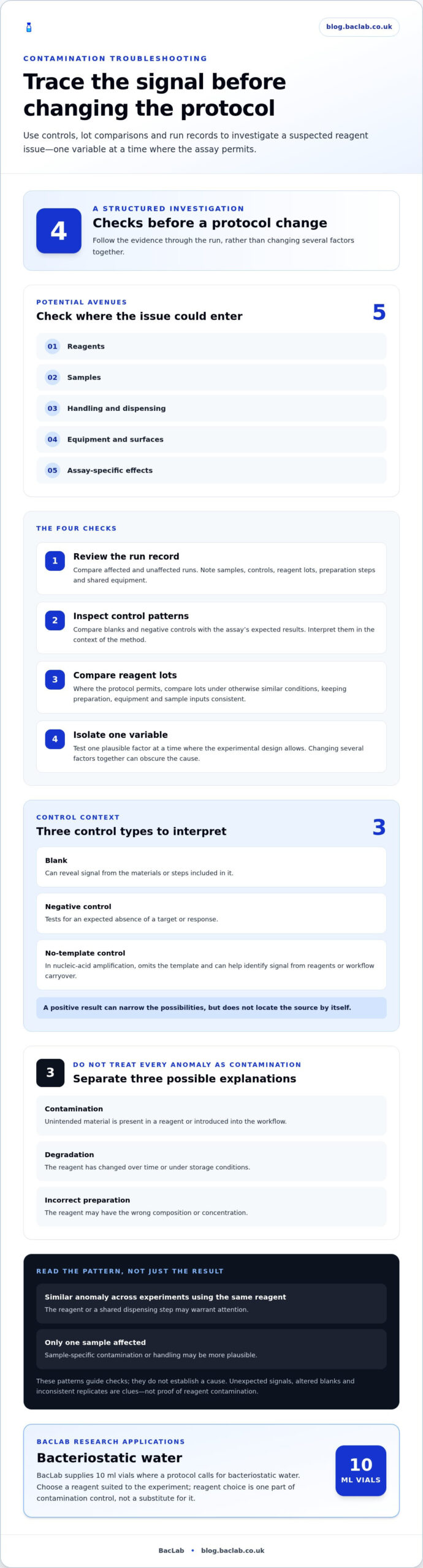
- Consider possible contamination sources across reagents, samples, handling, equipment and assay-specific effects before changing the protocol.
- Compare controls and reagent lots, isolating variables one at a time where the experimental design permits.
- Use the pattern of results to choose the next useful check rather than repeating the experiment without a specific hypothesis.
- Make workspace preparation, reagent handling, aliquoting and documentation repeatable, following the assay requirements.
- Preventing experimental failure due to reagent contamination relies on a documented process and reagents suited to the experiment. BacLab supplies bacteriostatic water in 10 ml vials for research applications.
How reagent contamination can undermine experimental results
Reagent contamination is the unintended presence of material in a reagent, or its introduction into an experimental workflow through that reagent, where it may affect the procedure or results. This distinguishes contamination carried into the experiment from contamination originating in a sample. The broader concept of contamination includes unwanted material entering a system; in laboratory work, its significance depends on where it enters and how the method responds.
Contamination may be present before a reagent is opened or introduced later during dispensing, transfer, or contact with equipment and surfaces. Sample contamination is different: the unwanted material is in the sample itself, although it may then spread into reagents or other parts of the workflow. Degradation and incorrect preparation are also distinct possibilities. A degraded reagent has changed over time or under storage conditions; an incorrectly prepared one may have the wrong composition or concentration. Neither necessarily involves foreign material.
What counts as reagent contamination in a laboratory?
Contamination need not be visible. In a nucleic-acid assay, unintended DNA or RNA in a reagent may contribute signal or affect interpretation, depending on the assay’s design and sensitivity. Other methods may be affected by particulates, microbes, chemical residues or carryover from previous work. A clear solution can still contain material that alters a sensitive measurement.
The point of entry matters when investigating a problem. If separate experiments using the same reagent show a similar anomaly, the reagent or a shared dispensing step may warrant attention. If only one sample is affected, sample-specific contamination or handling may be more plausible. These patterns guide checks but do not establish a cause. A documented vial-handling workflow can help distinguish contamination introduced during use from a problem already present in the material.
Why contamination can look like an experimental failure
An unexpected signal, an altered blank or inconsistent replicates may be clues, but none proves that a reagent is contaminated. Similar results can arise from sample carryover, equipment, handling, assay-specific artefacts, degradation or preparation error. Compare the result with controls and expected assay behaviour before treating it as a diagnosis.
The effect depends on the contaminant’s identity and concentration, as well as the assay’s sensitivity and detection principle. A trace amount may matter in a highly sensitive amplification assay but be immaterial in another method. A contaminant may also suppress a signal rather than increase it. Preventing experimental failure due to reagent contamination therefore means treating contamination as one testable hypothesis, not the default explanation. This keeps troubleshooting focused without overlooking biological or technical variation.
How to trace contamination through reagents, equipment and workflow
Investigate suspected contamination in a controlled sequence rather than replacing several reagents or changing the protocol at once. Start with the evidence available, then use controls and comparisons to test whether the pattern fits a reagent, sample, equipment or environmental source. Findings may support an attribution, but rarely prove a source in isolation.
- Review the run record. Note which samples, controls, reagent lots, preparation steps and equipment were shared by affected and unaffected runs. Record when the anomaly first appeared and whether it followed a change in material or handling.
- Inspect control patterns. Compare blanks and negative controls with the assay’s expected results. If the assay uses a no-template control, assess it alongside sample results rather than treating it as a stand-alone verdict.
- Compare reagent lots. Where the protocol permits, compare the suspect lot with a previously used lot under otherwise similar conditions. Keep preparation, equipment and sample inputs consistent.
- Isolate a variable. Test one plausible factor at a time where the experimental design allows. Changing several factors together may remove the anomaly without identifying its cause.
Which controls help identify reagent contamination?
A blank can reveal signal from the materials or steps included in it; a negative control tests for an expected absence of a target or response. In nucleic-acid amplification, a no-template control omits the template and can help identify signal arising from reagents or workflow carryover. A positive result narrows the possibilities but does not locate the source by itself. Control composition and interpretation must fit the assay and validated laboratory protocol.
Look at the pattern across controls. Similar unexpected signals across multiple controls may point towards a shared reagent or process, while an isolated signal may fit local handling or sample carryover. These are clues, not rules: control placement, sensitivity and assay design affect what a result can establish.
How lot comparisons and records narrow the investigation
For each run, record reagent identity, lot or batch, preparation date and run identifier, together with relevant equipment and handling details. This makes it easier to compare results across runs and see whether an anomaly coincides with a particular material or procedural change. A reagent traceability workflow can help link materials and results consistently.
Lot comparisons are most informative when other influential variables are controlled as far as practicable. If the suspect and comparison lots are tested with different sample preparations or equipment, the difference may have more than one explanation. Record expected and unexpected outcomes, including results that do not support the initial hypothesis. This makes preventing experimental failure due to reagent contamination an evidence-led process rather than guesswork.
Where a research protocol specifies bacteriostatic water, BacLab supplies it in 10 ml vials for laboratory and research applications. See the 5 x 10 ml bacteriostatic water vials as one reagent option within a documented workflow. Product selection alone cannot identify the source of an anomaly or guarantee experimental results.
How to distinguish reagent contamination from handling or assay problems
A result may raise suspicion about contamination without confirming it. One abnormal replicate or control is not enough to assign a cause. Consider whether the pattern recurs, which samples and controls are affected, and whether it tracks a shared reagent, handling step, equipment item or assay feature.
What patterns suggest a reagent-related issue?
A recurring control change across runs that share a reagent is a reason to investigate that reagent, particularly when other materials and steps differ. A contrast between lots may add evidence, but only if the runs are sufficiently comparable. Treat the result as support for a hypothesis, then choose a check that can distinguish it from alternatives.
Observed pattern
Plausible source
Next discriminating check
Similar control changes across runs sharing one reagent
A reagent or shared preparation step
Compare a relevant lot or preparation while keeping other conditions consistent.
An isolated affected sample, with other controls behaving as expected
Sample carryover or sample-specific contamination
Review sample transfers and compare the affected sample with appropriately designed controls.
Irregular changes linked to transfer order or operator steps
Handling or workspace carryover
Review the sequence of transfers and repeat the relevant step under the validated protocol.
Several samples affected after using shared equipment
Equipment contamination or residue
Assess the equipment and its cleaning or preparation process using an assay-appropriate check.
A signal confined to a particular assay condition
An assay-specific artefact
Review the method’s expected behaviour and test the relevant condition or control.
In PCR, amplification in a no-template control can prompt investigation of reagent contamination or carryover, but it is not a universal diagnostic rule. Depending on the chemistry, primer-dimer formation may also produce a signal. A sporadic control result may reflect contamination introduced during loading, while repeated patterns across comparable runs may justify examining shared materials. Neither pattern alone establishes the source.
When the evidence points to handling or assay artefacts
Transfer steps, workspace separation and equipment are distinct routes to investigate, not evidence against a reagent-related cause. Map affected samples to shared contacts or steps, then test the most plausible route without changing several factors together. If you are reviewing vial access or withdrawal technique, this vial-handling and contamination guidance can help you assess the handling hypothesis.
When preventing experimental failure due to reagent contamination, give more weight to recurring, well-controlled patterns than to one anomalous well or replicate. Confirm a source only when an assay-appropriate test distinguishes it from credible alternatives. Until then, record the conclusion as provisional.
A repeatable workflow for reducing reagent contamination risk
A repeatable workflow makes contamination-control steps explicit and keeps them aligned with the assay protocol. Specify how the workspace is prepared, how reagents are accessed and transferred, and what information is recorded. Sterilisation, decontamination and carryover-control methods depend on the method: a step suitable for one assay may be ineffective or incompatible with another.
- Prepare the workspace. Follow the protocol’s requirements for cleaning and arranging the work area. Separate contamination-sensitive activities, such as reagent preparation and sample processing, where the assay requires distinct areas or stages. Keep materials for each activity identifiable to reduce unintended crossover.
- Select and check reagents. Confirm that each reagent suits the validated experiment and that its documented specifications align with the method. Record identity and lot details before use. Product sterility or intended use does not guarantee contamination-free handling or experimental success.
- Standardise access and transfer. Write down how to open, dispense from and close containers. Use clean, appropriate consumables, and do not return unused material to the stock container. Aliquot only where the protocol and reagent properties support it, using labelled containers and a defined process.
- Document and review. Record reagent details, preparation or aliquoting, relevant handling steps and any deviation from the procedure. If an anomaly occurs, link it to the materials and steps used in that run before changing the method.
How to standardise reagent handling
Written instructions should make container access reproducible between users. Describe how to open a vial, transfer material, close the container and label it after preparation. Set out how to select and dispose of clean consumables, and prevent unused dispensed material from going back into stock. Practical vial-handling guidance can help make transfer practices consistent, while the assay protocol remains the basis for the procedure.
How to document corrective actions and prevent recurrence
For each investigation, record the suspected source, observations that support or weaken the hypothesis, corrective action and outcome of the subsequent run. Separate confirmed changes from tentative explanations. This helps show whether an intervention addressed a plausible route or simply coincided with a different result.
Update procedures when the evidence supports a change relevant to the method. If you introduce a step, document its purpose and assess its effect using the assay’s established controls. Avoid generic decontamination steps that overlook material compatibility, workflow order or the possibility of adding another source of variability. Consistent records make it easier to see whether a revised procedure changes the pattern over time.
Reagent choice is one part of this workflow. BacLab supplies bacteriostatic water in 10 ml vials for laboratory and research applications. Select it only where it suits the documented experimental requirements. Reagent choice does not replace controlled handling, appropriate controls or assay-specific procedures.
View 5 x 10 ml bacteriostatic water
Choosing a suitable research reagent as part of contamination control
Choose reagents according to the validated experiment: their identity and documented specifications must match the protocol’s requirements and intended use. A reagent described as sterile or intended for research cannot guarantee experimental success or contamination-free handling. Selection is one control within a wider process that includes suitable storage, handling and traceability.
What to assess when selecting a reagent for a method
Before use, compare the reagent’s stated specifications with the protocol, including its intended purpose and any requirements that could affect the method. Record its identity and relevant documentation so it can be traced to the experimental run. A broader sterile-reagent comparison guide can help identify which specifications matter when evaluating research reagents.
A practical selection review can consider:
- Protocol fit: Does the reagent match the method’s stated identity and use?
- Documented specifications: Are the available product details consistent with the experiment’s requirements?
- Traceability: Can you record the reagent identity and lot or batch alongside the run?
- Handling requirements: Can you store, prepare and use the reagent in accordance with its documentation and laboratory procedure?
If a specification matters to the assay but is absent from the documentation available to you, do not assume that a similar product name establishes equivalence. Use the protocol and relevant product documentation as the basis for selection, and record your rationale. This supports preventing experimental failure due to reagent contamination without suggesting that reagent choice alone can eliminate contamination risk.
Where BacLab bacteriostatic water fits
BacLab supplies bacteriostatic water intended for laboratory and research applications. Consider it where the documented method specifies a suitable reagent of this type, but do not assume it is compatible with every assay. It is not a decontaminant or a substitute for aseptic technique, validated handling steps or appropriate experimental controls.
Use the product information and experimental protocol to determine whether the reagent fits the method, then include its identity in routine records. Selection does not confirm the cause of an anomalous result or guarantee a successful, contamination-free experiment. Those conclusions depend on the method, controls and handling conditions.
For protocols that specify bacteriostatic water, view BacLab 5 x 10 ml bacteriostatic water for laboratory and research use.
Make the next run more informative
Use the next experimental run to strengthen the link between each reagent, handling step and observed result. A consistent record of materials and deviations gives future troubleshooting a clearer basis, while keeping changes tied to evidence rather than assumption. This is a practical step in preventing experimental failure due to reagent contamination: make the workflow reproducible enough to investigate an unexpected result, not merely repeat it.
Choose reagents according to the method’s documented requirements. BacLab supplies bacteriostatic water in 10 ml vials for laboratory and research applications, with individual and wholesale purchasing options. As with any reagent, selection is part of the workflow, not a substitute for appropriate handling or experimental controls.
With a defined procedure and traceable records, each run can contribute useful evidence towards more reliable research.
Frequently Asked Questions
Can a no-template control detect reagent contamination?
Yes. In an assay such as PCR, a no-template control omits the target template and can reveal unexpected signal. A positive result may indicate contamination in a reagent or material introduced during setup, but it does not identify the source by itself. Interpret it against the assay’s expected control behaviour, and consider assay-specific effects such as primer-dimer formation before attributing the result to contamination.
How can I tell whether a reagent is contaminated or degraded?
Appearance alone may not distinguish contamination from degradation. Compare the reagent’s storage and handling history with its documented requirements, then assess performance using an appropriate assay control or validated test. A change in response after a storage deviation may raise concern about degradation, while unexpected signal in a relevant blank may prompt a contamination investigation. Neither pattern is conclusive without method-specific evidence.
Does sterile reagent guarantee that an experiment will remain uncontaminated?
No. Sterility describes the reagent’s condition as supplied, not every event after opening or during experimental use. Contamination can be introduced through contact with a dispensing tool, vessel, workspace or sample. Follow the method’s handling instructions and maintain control steps throughout the procedure. A sterile reagent is one component of contamination control, not a guarantee that the complete workflow or its results will remain unaffected.
What should I do if several negative controls show unexpected signals?
Pause interpretation of the affected run and preserve its records, including control positions, reagent identities and setup order. Check whether the signals share a plate region, transfer sequence or reagent exposure, then follow the assay’s troubleshooting procedure before repeating the work. Do not discard or selectively omit abnormal controls to make results fit expectations. If the pattern persists, use an assay-appropriate test to distinguish among plausible sources.
Can reagent contamination affect results even when the reagent looks normal?
Yes. Contaminants may be invisible yet still affect a sensitive measurement. A clear solution therefore provides no reliable evidence that it is free of assay-relevant material. If results change despite normal appearance, assess control behaviour and compare the reagent’s documented history with its performance in the method. The relevant test depends on the suspected contaminant and the assay’s detection limits.
Why is reagent lot tracking important when troubleshooting failed experiments?
Lot tracking helps you test whether an unexpected pattern coincides with a change in reagent batch, rather than relying on memory or product names alone. Record the lot alongside the run identifier and preparation details. If a later run uses a different lot, those records help frame a controlled comparison and interpret results over time, especially when several reagents or operators are involved.
Should I replace every reagent after an experiment fails?
No. Replacing every reagent at once can make the next run harder to interpret because several variables have changed. First identify which materials and steps were shared by affected samples or controls, then prioritise checks based on the evidence and protocol. Preventing experimental failure due to reagent contamination is more systematic when you test suspected causes selectively. Replace or exclude a reagent when its history, documentation or assay-appropriate testing supports that decision.