
The lower-cost option on paper can become the more expensive one in practice. A fair cost analysis of in-house vs pre-made sterile solutions compares the total cost per usable unit, not the price of raw materials with the purchase price of a ready-made reagent.
In-house preparation can appear economical when labour, equipment use, quality checks, documentation and batch wastage are left out of the calculation. These costs, along with staff time and quality responsibilities, affect what each usable unit actually costs. Pre-made solutions shift preparation work outside the laboratory, but still need to be assessed against purchasing requirements, pack size and intended research use.
This article sets out a repeatable comparison for UK research labs, explains which costs and responsibilities sit with each option, and shows how to assess the trade-offs without assuming healthcare compounding guidance applies to research reagent procurement. For laboratories considering ready-made bacteriostatic water, BacLab supplies five-vial packs of 10ml vials for laboratory and research use. Include the pack in your assessment, but compare total costs rather than assuming a particular pack size is automatically cheaper.
Key Takeaways
- The cost analysis of in-house vs pre-made sterile solutions should compare equivalent research-use specifications, not treat research reagents as patient-specific sterile medicines.
- Calculate in-house cost per unit by dividing attributable preparation costs by usable units produced, accounting for batch losses.
- Match the sourcing model to demand: frequent, stable requirements may call for a different assessment from occasional or variable use.
- Set out the required specification and quality documentation before comparing options, so the calculation reflects actual procurement needs.
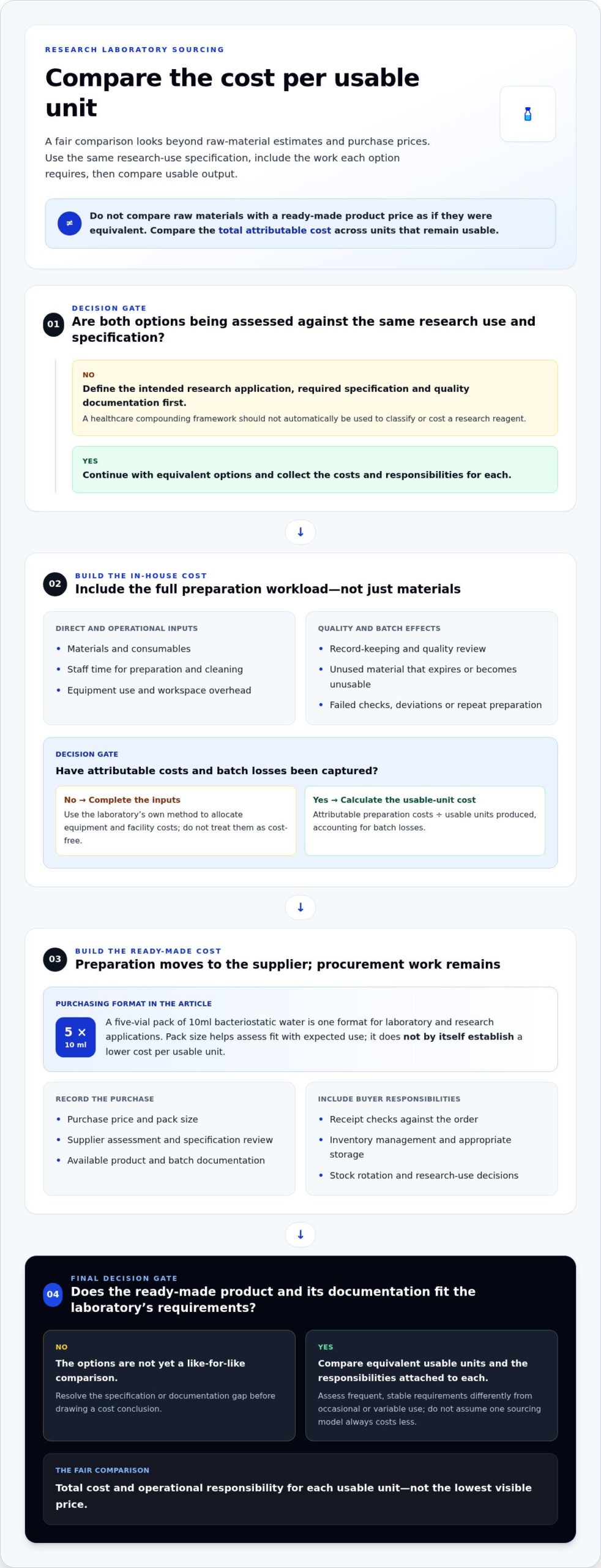
- Follow a consistent decision sequence: define the specification, collect internal cost inputs, compare usable-unit costs and assess quality fit.
In-house vs pre-made sterile solutions: what is being compared?
The comparison is between two laboratory sourcing models: preparing a solution within the research organisation or buying it ready-made from a supplier. The useful question is not simply which option has the lower visible price. A cost analysis of in-house vs pre-made sterile solutions compares the total cost and operational responsibility for each usable unit, using the same intended research application and required specification for both options.
Total cost of ownership for a laboratory reagent is the full attributable cost of acquiring or preparing, documenting, handling and using it, allocated across the units that remain usable. This prevents a raw-material estimate from being compared as though it were equivalent to a supplier’s purchase price.
What counts as in-house preparation in a research laboratory?
In-house preparation means laboratory personnel carry out the relevant preparation work as part of an internal workflow. The cost model may include staff time, workspace, equipment use and documented quality checks, as well as materials consumed. Specific tasks and checks depend on the laboratory’s process and the reagent specification; this comparison does not prescribe a sterile-production protocol. General information on sterilisation methods provides background on different approaches, but does not establish which method is appropriate for a particular reagent.
This is a sourcing distinction, not an assumption that routine research reagent preparation is equivalent to regulated pharmaceutical compounding. Research reagents and patient-specific sterile medicines are different categories: their intended use, procurement context and applicable requirements may differ. A healthcare compounding framework should not automatically be used to classify or cost a laboratory reagent.
What does buying a pre-made sterile research solution change?
Purchasing a ready-made solution transfers preparation tasks to the supplier, but not every quality responsibility. The laboratory still needs to assess whether the product and its documentation fit the intended research use and meet its requirements. A structured comparison of sterile reagent specifications can help define what to review before procurement.
For bacteriostatic water, a pre-made 10ml vial or a five-vial pack of 10ml vials is a purchasing format for laboratory and research applications. Pack size affects how well an order matches expected use; it does not, by itself, establish a lower cost per usable unit.
The comparison of laboratory water sourcing also considers differences between general laboratory reagents and specialist supply, including this analysis of laboratory water reagents and specialist bacteriostatic suppliers. Define the required specification first, then compare equivalent usable units and record which preparation, documentation and quality tasks remain with the laboratory under each model.
Which costs and quality responsibilities differ between the two approaches?
A useful comparison separates the resources consumed during preparation from the controls used to establish whether a reagent suits the laboratory’s work. In-house preparation concentrates these activities within the organisation. Buying pre-made shifts preparation to the supplier, while the laboratory remains responsible for procurement and use decisions. The cost analysis of in-house vs pre-made sterile solutions should capture both financial inputs and the work needed to maintain the laboratory’s quality system.
A purchase price is the amount paid to acquire a product; a fully loaded preparation cost includes the attributable labour, materials, equipment, workspace and quality activities required to produce usable units. This distinction matters because shared costs can be overlooked or allocated inconsistently.
Which costs are easy to miss when preparing solutions in-house?
Start with direct materials and consumables, then add staff time for preparation, cleaning, record-keeping and quality review. Include equipment use and facility overhead using the laboratory’s own allocation method rather than assuming a universal hourly rate. This makes the estimate traceable and avoids treating existing equipment or workspace as cost-free.
Batch size also affects the result. If a prepared quantity exceeds demand, unused material may expire or otherwise become unusable before it is needed. A failed check, deviation or repeat preparation can add materials and staff time. Record these costs when they occur, so the calculation reflects actual usable output rather than theoretical yield.
What responsibilities remain when purchasing pre-made solutions?
Buying a ready-made reagent reduces internal preparation work, but procurement still involves supplier assessment, specification review, receipt checks and inventory management. On arrival, staff may need to verify that the delivered item matches the order and review its accompanying documentation against the laboratory’s research quality system. Appropriate storage and stock rotation also remain part of the buyer’s workflow.
Documentation is useful when it supports the laboratory’s intended use and internal records. Reviews may include matching product identity and available batch information to the purchase record, then recording receipt and storage in the inventory system. The checks should reflect the laboratory’s procedures and the reagent specification, not an assumed healthcare compounding model. A laboratory quality-control checklist can help teams consider how reagent controls relate to contamination risk and experimental integrity.
For either model, assign each cost and quality task to a workflow and retain the source of each estimate. Include purchasing administration and storage for purchased products, just as you include preparation records and equipment allocation for in-house work. Laboratories assessing ready-made bacteriostatic water for research can include BacLab’s five-vial 10ml bacteriostatic water pack in the same specification-led comparison. Its purchase price is one input, not the full cost of use.
How to calculate the real cost per usable unit
Compare like with like: the same solution specification, unit volume, intended research use and accounting period. Then calculate the cost of the quantity that remains usable, rather than dividing expenditure by theoretical output. A cost analysis of in-house vs pre-made sterile solutions is meaningful only when both options use the same unit of comparison and local laboratory records supply the inputs.
Build a like-for-like cost comparison
List attributable costs for each model, using records such as staff time logs, equipment schedules, purchasing records, quality documentation and stock data. Keep one-off investment separate from recurring costs. If capital equipment is allocated across a period or volume of work, record the chosen amortisation method and apply it consistently. Do not count the full purchase cost in one model while spreading an equivalent cost in the other.
| Cost category | Data input | In-house | Pre-made |
|---|---|---|---|
| Materials or purchase | Materials consumed, or supplier invoice | Materials | Purchase |
| Labour and administration | Preparation, cleaning, records, ordering and receipt time | Preparation and review | Procurement and receiving |
| Equipment and workspace | Local allocation for equipment use and facility overhead | Preparation equipment and space | Storage space, where attributable |
| Quality activities | Checks, testing and documentation review recorded by the lab | Preparation-related checks | Receiving and specification review |
| Losses and storage | Rejected output, unused stock, expiry and disposal records | Unusable prepared output | Unusable purchased stock |
Use these formulas, with costs recorded in pounds sterling and the same accounting period:
- In-house cost per usable unit = attributable preparation costs ÷ usable units produced.
- Pre-made cost per usable unit = purchase costs plus attributable procurement costs ÷ usable units received and retained for use.
Enter actual costs as £[amount] and count only units that meet the laboratory’s defined usability criteria. A rejected batch reduces the in-house denominator; unused or expired purchased stock reduces the pre-made denominator. Do not assume a loss rate in advance for either model.
Which assumptions can change the result?
Run low, typical and high usage scenarios using the laboratory’s own demand history. A batch size that matches predictable demand may produce a different unit cost from one that leaves substantial unused output. Staff availability can also change the labour allocation, while usable yield affects how many units share the attributable costs. Treat these as scenario inputs, not fixed rates.
Keep each scenario’s assumptions visible, including demand, batch size, usable yield and the treatment of one-off investment. Recalculate when those inputs change. The comparison can show which model appears less costly under stated conditions, but it cannot establish that in-house preparation or pre-made supply is universally cheaper or more reliable.
When does in-house preparation or pre-made supply make more sense?
Neither sourcing model is automatically less costly. The decision depends on how consistently the laboratory needs the solution, whether it has suitable internal capability, how documentation fits its research quality system, and what the like-for-like cost comparison shows. Frequent, stable demand may call for a different assessment from occasional or variable use, but volume alone does not establish an advantage.
Demand pattern
- Frequent and predictable: assess whether established internal capacity can meet the recurring requirement without creating excess output.
- Intermittent or variable: consider whether buying closer to actual need limits unused stock and avoids maintaining preparation capacity for sporadic work.
Capability and quality system
- Internal preparation: assess trained staff, suitable facilities, documented processes and established quality oversight. Do not assume ordinary laboratory space is suitable for sterile preparation.
- Pre-made supply: assess whether the product specification and supplier documentation fit the research workflow, and whether the laboratory can maintain appropriate receiving, storage and inventory controls.
Total cost
- Internal preparation: consider it further where actual records show that attributable costs per usable unit compare favourably, including staff and facility resources.
- Pre-made supply: compare purchase and attributable procurement costs with the complete internal cost, not raw-material expenditure alone.
Conditions that may favour internal preparation
Further analysis of in-house preparation may be worthwhile where demand is consistent and the laboratory already has suitable internal capability, trained personnel, appropriate facilities and established quality systems. These conditions may reduce the need to establish new capacity, but do not prove a cost advantage. Use recorded expenditure, staff allocation and usable output to establish whether internal preparation is economical under the laboratory’s operating conditions.
Conditions that may favour pre-made procurement
Pre-made supply may fit a workflow with intermittent demand, variable volumes or limited internal preparation resources. The key question is whether the product specification and supplier documentation meet the research need, and whether the laboratory’s receiving and storage arrangements support its use. For bacteriostatic water, compare pack size with expected use; a guide to sterile reagent specifications for research can inform the product-fit assessment. BacLab’s five-vial pack of 10ml vials is one purchasing format to include in the comparison, not proof of a lower unit cost.
Pre-made solutions can appear more expensive when judged only by purchase price, just as in-house preparation can appear cheaper when staff time and quality work are omitted. Compare the complete costs and responsibilities for the same research requirement, then record the assumptions behind the result. Reassess if demand, staffing or internal capability changes.
View the five-vial 10ml bacteriostatic water option
A practical procurement decision for research teams
Use a documented, four-stage review to decide whether internal preparation or a ready-made reagent better fits the laboratory’s research requirements. The cost analysis of in-house vs pre-made sterile solutions should inform the decision alongside specification fit, operational capacity and the quality records the laboratory needs to maintain.
- Define the specification. Record the solution identity, required format and volume, intended research application and documentation requirements. This establishes what each option must meet.
- Collect internal cost inputs. Use local records for materials, staff time, equipment and facility allocation, quality activities, purchasing administration, storage and losses. Keep the accounting period consistent.
- Compare usable-unit costs. Apply the same unit definition and demand assumptions to both models. Account for output or stock that cannot be used instead of relying on theoretical yield or purchase price alone.
- Review quality and operational fit. Consider internal capability, supplier documentation, receiving and storage arrangements, and whether each option fits the laboratory’s research workflow.
Use a short decision record to document the choice
Keep the decision auditable. Record the compared specification, calculation period, demand assumptions, cost categories and data sources. State the financial result separately from quality and operational considerations. This makes trade-offs visible: a lower calculated cost does not, on its own, establish that an option meets the laboratory’s requirements.
Set a review point for changes that could affect the comparison, such as a shift in demand, staffing or supplier requirements. If the inputs change, update the calculation rather than carrying forward an outdated conclusion. A concise record also helps purchasing and research staff use the same assumptions when evaluating future orders.
Assess a ready-made option against your research requirements
BacLab supplies bacteriostatic water for laboratory and research use. Include it as a research reagent in the procurement assessment, and compare the product information with the laboratory’s defined needs and internal quality processes. Pack size is a practical input: the five-vial 10ml bacteriostatic water option may suit a purchasing plan when the quantity aligns with expected research demand, but pack size alone does not establish that it is cheaper.
For a like-for-like review, retain the same unit basis and account for any stock that may remain unused. Then assess whether the available product information and the laboratory’s receiving and storage procedures fit the intended workflow. This keeps procurement decisions grounded in research requirements rather than assumptions based solely on sourcing model.
Make your next procurement decision evidence-led
Use your comparison as a working procurement record, not a permanent verdict. Revisit it when research demand, internal capacity or purchasing requirements change, so the sourcing decision reflects current conditions rather than historical assumptions. The cost analysis of in-house vs pre-made sterile solutions is most useful when its inputs and rationale can be reviewed alongside the laboratory’s changing needs.
BacLab is a UK-based specialist supplier of bacteriostatic water for laboratory and research applications, with 10ml vials available individually and in wholesale bundles. Compare pack format with expected use and the laboratory’s defined requirements rather than assuming one purchasing quantity suits every workflow.
A clear record makes the next review more straightforward. Choose the option that fits your evidence, then reassess when the underlying assumptions change.
View the five-vial 10ml bacteriostatic water option for laboratory research
Frequently Asked Questions
Is it always cheaper to prepare sterile solutions in-house?
No. In-house preparation may look less expensive if the estimate counts only ingredients, but the result can change once staff time, facility resources and usable output are included. The cost analysis of in-house vs pre-made sterile solutions should use the laboratory’s own records and a consistent accounting period. For example, compare annual demand with the resources actually assigned to preparation rather than assuming existing staff capacity has no cost.
How do laboratories calculate the cost per usable unit?
Divide the costs attributable to an option by the number of units that meet the laboratory’s usability criteria. Define the unit first, such as a specified volume, and use the same definition for both sourcing models. Reconcile the calculation with purchasing, stock and preparation records for the same period. This helps show whether an apparent difference comes from the cost inputs or the number of units available for use.
What costs are commonly missed in an in-house sterile solution calculation?
Costs can be missed when work is spread across several roles or recorded under general laboratory overhead. Review time spent on setup, cleaning, records, quality review and resolving deviations, as well as equipment use and disposal. One practical method is to sample relevant staff activities over a representative period and document the allocation basis. Include repeat work or unusable output when supported by the laboratory’s records.
Can pre-made sterile solutions reduce laboratory workload?
Yes. They can reduce preparation tasks performed by laboratory staff, although procurement and handling work remain. A team may avoid scheduling internal preparation but still need to process an order, check the delivery, review documentation and manage stock. Whether that shift is useful depends on what staff time is freed for and whether the purchased solution fits the laboratory’s documented research requirements.
When might in-house preparation be worth evaluating?
Evaluate it when recurring research demand is predictable enough to support a meaningful comparison, particularly if the laboratory already has relevant internal capability. A change in project volume or an established workflow may justify updating the cost model. Before drawing a conclusion, assess whether trained staff, appropriate facilities and quality processes are available, then test the calculation against actual records rather than an assumed saving.
Is bacteriostatic water the same as every pre-made sterile solution?
No. “Pre-made sterile solution” describes a broad procurement category, not one interchangeable reagent. Bacteriostatic water is a specific laboratory product, and another solution may differ in composition, intended research application or stated specification. Identify the exact material required by the experiment and compare product information with that requirement. A shared descriptor such as “sterile” alone is not enough to establish that two solutions are suitable substitutes.
Does buying a pre-made solution remove quality-control responsibilities?
No. Supplier preparation does not determine whether a product is appropriate for a particular research workflow. The laboratory still needs to follow its purchasing and receipt procedures, assess relevant product information and retain records that support its quality system. If a delivery or its documentation does not align with the order or internal acceptance criteria, the laboratory’s procedures should guide how that discrepancy is recorded and handled.
How should a laboratory compare suppliers with in-house preparation?
Use one defined specification and compare each supplier’s offer with the internal option on the same unit and time basis. For supplier comparisons, record quoted purchase terms separately from attributable ordering, receipt, storage and stock-management costs. Review available product information against the laboratory’s research needs, and note differences in pack format or ordering quantity. This separates price variation from differences in product fit and procurement workload.