
The chemical preservative engineered to guarantee sterility across multi-draw laboratory vials is frequently the precise factor that invalidates an enzymatic assay. Determining the viability of bacteriostatic water for molecular biology workflows requires resolving an acute tension between microbiological stability and biochemical interference. Most researchers understand the frustration of balancing reagent longevity against experimental fidelity, particularly when repeated sampling risks microbial contamination if unpreserved, yet threatens complete assay inhibition if prepared with the wrong diluent.
This technical guide delivers an authoritative assessment of benzyl alcohol interactions within molecular protocols, defining the exact biochemical boundaries that separate preserved solutions from DEPC-treated and nuclease-free grades. You’ll examine empirical enzymatic tolerance thresholds, determine which specific in vitro procedures tolerate preserved diluents, and implement standardised multi-draw protocols to safeguard reagent stability without compromising downstream reproducibility.
Key Takeaways
- Delineate the precise physicochemical profile of 0.9% benzyl alcohol solutions, contrasting their antimicrobial mechanisms against DEPC-treated and nuclease-free formulations.
- Assess the thermodynamic pathways through which aromatic compounds interfere with enzyme active sites, identifying specific polymerase and endonuclease vulnerabilities.
- Establish unambiguous protocol thresholds to determine when bacteriostatic water for molecular biology is technically viable and when unpreserved reagents are non-negotiable.
- Implement standardised aseptic handling frameworks for multi-entry vials to minimise elastomeric coring and preserve sterility across 28-day operational windows.
- Apply rigorous procurement benchmarks for UK research facilities, focusing on pharmacopoeial documentation, batch-specific analytical certification, and volume optimisation.
Physicochemical Specifications of Bacteriostatic Water in Laboratory Contexts
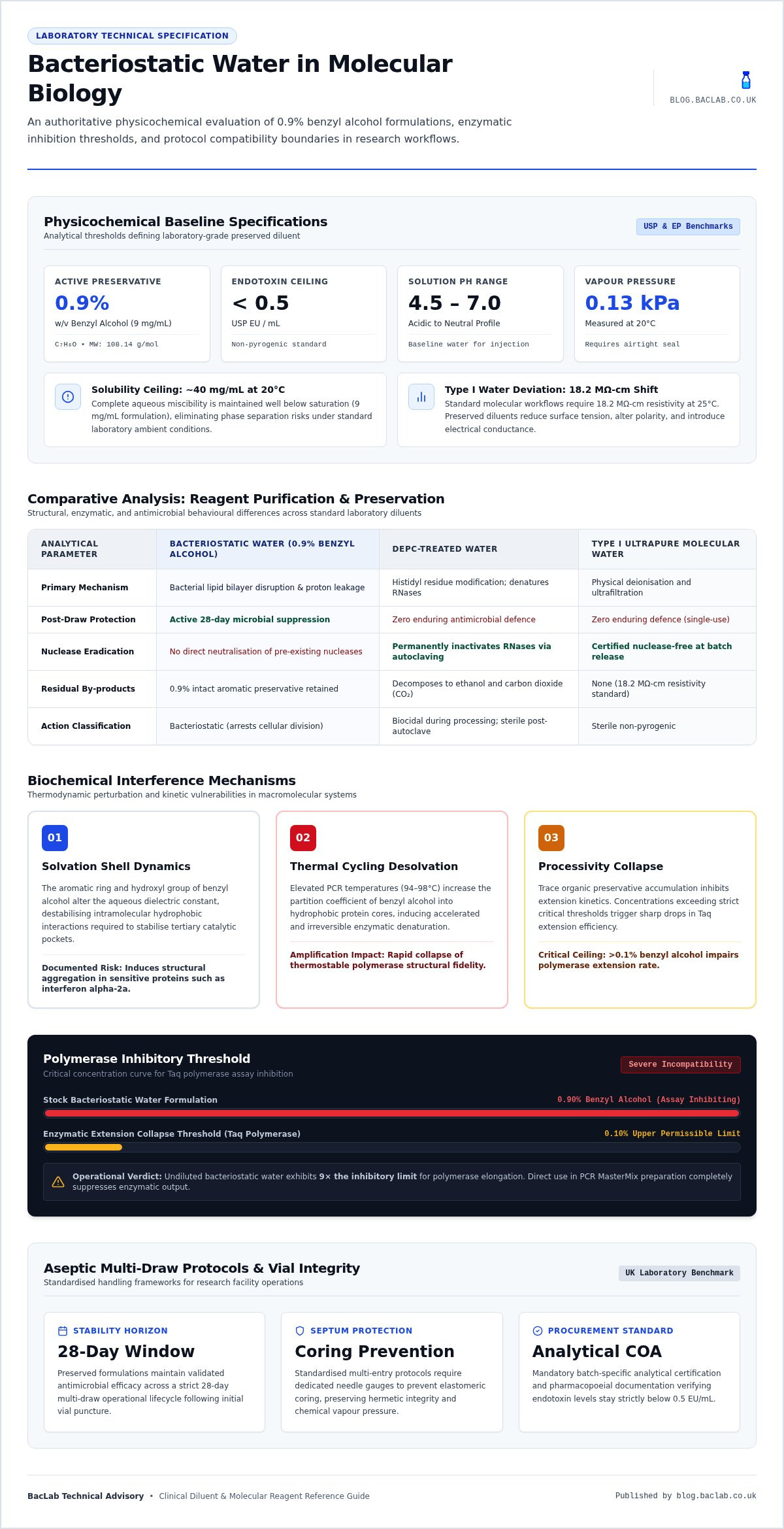
Bacteriostatic water is non-pyrogenic water formulated with 0.9% (w/v) benzyl alcohol (C7H8O; molecular weight 108.14 g/mol). Derived from sterile Water for injection, the solution maintains an endotoxin ceiling below 0.5 USP Endotoxin Units (EU) per mL and an acidic-to-neutral pH profile spanning 4.5 to 7.0. While standard molecular assays demand Type I ultrapure water with a resistivity threshold of 18.2 MΩ-cm at 25°C, dissolving an aromatic preservative dramatically alters baseline solution properties. Adding 9 mg/mL of benzyl alcohol reduces surface tension, shifts solvent polarity, and introduces measurable electrical conductance that deviates sharply from deionised matrices. Assessing bacteriostatic water for molecular biology therefore begins with quantifying these physicochemical trade-offs.
Chemical Composition and the Role of 0.9% Benzyl Alcohol
The antimicrobial action of benzyl alcohol operates primarily through membrane perturbation rather than immediate chemical lysis. Due to its lipophilic aromatic ring, the compound partitions into bacterial lipid bilayers, disrupting structural packing and inducing passive proton leakage. At a 0.9% concentration, its activity is strictly bacteriostatic rather than bactericidal; it arrests cellular division without precipitating rapid mass cellular destruction. Benzyl alcohol exhibits complete aqueous miscibility below its saturation limit of roughly 40 mg/mL at 20°C, remaining stable under standard laboratory storage. Its relative volatility and vapour pressure (0.13 kPa at 20°C) require sealed storage to prevent concentration drift across extended multi-draw use.
Bacteriostatic Water versus Molecular-Grade and DEPC-Treated Water
Standard molecular-grade reagents undergo specialised purification cascades to eliminate biomacromolecules. Diethyl pyrocarbonate (DEPC) treatment modifies histidyl residues to permanently denature ribonucleases (RNases), followed by mandatory autoclaving to decompose residual DEPC into ethanol and carbon dioxide. Crucially, DEPC treatment confers zero enduring antimicrobial defence; autoclaved DEPC water permits rapid bacterial proliferation once exposed to ambient microbes. Conversely, preserved diluents inhibit post-draw microbial colonization without actively neutralising pre-existing nucleases. Researchers can review what is bacteriostatic water to examine baseline chemical thresholds, or consult our comparative analysis of bacteriostatic water vs sterile water regarding single-use non-preserved controls. When evaluating bacteriostatic water for molecular biology protocols, this lack of certified nuclease eradication remains a pivotal constraint.
Enzymatic Compatibility: Assessing Benzyl Alcohol in Biochemical Reactions
Enzyme kinetics rely upon precise thermodynamic balances within the aqueous solvation shell. When examining bacteriostatic water for molecular biology, investigators must account for the chemical behaviour of benzyl alcohol. The preservative’s aromatic ring and hydroxyl moiety alter the dielectric constant of the solvent, directly perturbing intramolecular hydrophobic interactions. These hydrophobic forces preserve the catalytic pockets of macromolecular complexes. Trace concentrations can destabilise tertiary peptide architectures, prompting local unfolding or promoting aggregation. For instance, empirical studies demonstrate that benzyl alcohol induces structural aggregation in sensitive proteins like interferon alpha-2a and selectively inhibits specific membrane transport systems, such as renal D-glucose carriers.
Impact on Thermostable DNA Polymerases and Amplification Fidelity
Thermostable polymerases exhibit pronounced vulnerability to organic additives during PCR amplification cycles:
- Thermal Cycling Desolvation: Elevated temperatures during denaturation steps (94-98°C) increase the partition coefficient of benzyl alcohol into hydrophobic protein interiors, exacerbating irreversible enzymatic denaturation.
- Processivity Collapse: Benzyl alcohol concentrations exceeding 0.1% typically diminish Taq polymerase extension rates, inducing premature chain termination and truncated amplicons.
- Misincorporation Rates: Distortions within the nucleotide-binding pocket reduce discriminatory fidelity, elevating base substitution frequencies in high-fidelity enzymes.
Consequently, reaction chemistries for quantitative real-time PCR (RT-qPCR) and digital PCR strictly exclude aromatic diluents from master mix preparations.
Interference with Restriction Endonucleases and Modifying Enzymes
Restriction endonucleases depend upon rigid steric alignment to execute sequence-specific phosphodiester cleavage. Organic cosolvents frequently disrupt this geometric specificity, inducing non-canonical cleavage patterns known as star activity. The insertion of benzyl alcohol between non-polar amino acid residues can alter loop flexibility around catalytic sites, reducing cutting efficiency for enzymes like EcoRI and BamHI. Researchers evaluating diluent choices can reference technical protocols comparing bacteriostatic water vs sterile water to determine whether unpreserved alternatives are required to maintain strict kinetic specificity.
For assays where preservation against bacterial contamination is appropriate, sourcing verified reagents such as a bacteriostatic water 10ml vial ensures consistent preservative concentration across controlled in vitro preparations.
Protocol Boundaries: Compatible versus Incompatible Molecular Applications
Molecular laboratories manage procedures spanning extreme disparities in biochemical sensitivity. Establishing definitive protocol boundaries prevents ruined workflows while maximising efficiency during non-critical assay stages. The viability of bacteriostatic water for molecular biology depends entirely on whether a reaction involves enzymatic amplification, photometric quantification, or simple non-reactive physicochemical transfer. Assays requiring ultra-pure Type I conditions fail when exposed to organic additives, whereas stable storage workflows often benefit from preservative protection.
Contraindicated Protocols: Sequencing, qPCR, and Nucleic Acid Solubilisation
Aromatic additives create severe artefacts across core nucleic acid protocols. Benzyl alcohol exhibits strong ultraviolet absorbance between 250 nm and 270 nm, overlapping directly with the 260 nm maximum of purine and pyrimidine rings. Consequently, spectrophotometric instruments (such as NanoDrop platforms) produce wildly inflated concentration calculations and skewed A260/A280 purity ratios. Beyond optical disruption, preserved diluents pose physical risks to genetic material:
- Capillary Electrophoresis and NGS: Residual aromatic traces foul capillary matrices and disrupt microfluidic droplet formation in next-generation library preparations.
- Precipitation Interference: The altered dielectric constant of alcohol-preserved matrices impedes quantitative ethanol or isopropanol precipitation of low-yield templates.
- Enzymatic Halting: Reverse transcriptases, ligases, and quantitative polymerase mixtures suffer catastrophic catalytic inhibition when exposed to preserved solvents.
Permissible In Vitro Applications: Reagent Dilution and Solid-Phase Washes
Conversely, non-enzymatic analytical workflows tolerate organic preservation without losing functional performance. Reconstituting stable biochemical standards, non-enzymatic protein markers, and blocking reagents represents a primary use case. Where solutions face multiple needle penetrations over weeks of benchwork, a preserved diluent stops bacterial overgrowth that could otherwise digest synthetic peptides or metabolise buffer substrates.
Solid-phase washes in affinity chromatography, enzyme-linked immunosorbent assay (ELISA) non-substrate washing stages, and immunohistochemical blocking buffers also tolerate 0.9% benzyl alcohol without altering antibody-epitope affinity. In these contexts, bacteriostatic water for molecular biology facilities serves as a practical, sterile diluent for non-reactive intermediate reagents. Protocols requiring precise multi-entry chemical profiles can reference technical frameworks via technical specifications and research applications of bacteriostatic water 10ml vials to maintain reproducible baseline parameters across bench procedures. Laboratories working across both molecular and measurement-based workflows should also consult the method-led guidance on bacteriostatic water for analytical chemistry to assess how preservative composition, pH, and batch documentation interact with instrument response and analyte recovery.
Contamination Control, Vial Integrity, and Laboratory Handling Standards
Preserved multi-dose vessels rely on physical closure integrity as much as chemical bacteriostasis. While 0.9% benzyl alcohol prevents bacterial proliferation within the liquid phase, it provides no protection against airborne particulate accumulation, chemical leeching, or exogenous nuclease introduction. In multi-entry laboratory settings, physical contamination vectors bypass antimicrobial chemistry entirely. Maintaining consistent reagent performance across repeated samplings requires strict mechanical protocols to prevent container failure and solvent evaporation.
Septum Dynamics and Aseptic Withdrawal Protocols
Chlorobutyl and bromobutyl elastomeric stoppers provide self-sealing barriers against atmospheric exchange. However, repeated needle entries inflict progressive mechanical trauma. Using large-bore transfer needles creates non-recoverable channels through shear deformation, a failure mode known as rubber coring. These microscopic fragments contaminate the diluent and allow volatile solvent loss. To mitigate physical breach, technical standards require specific handling practices:
- Needle Calibre Selection: Technicians must employ high-gauge needles (25-gauge to 27-gauge) with bevelled tips to displace elastomeric polymers rather than cutting physical plugs from the core.
- Aseptic Decontamination: Sanitise the outer septum face with a sterile 70% isopropanol wipe and allow complete evaporative drying for 30 seconds prior to needle insertion to avoid alcohol transfer.
- Variable Puncture Mapping: Avoid entering the exact geometric centre continuously; distribute puncture coordinates evenly across the accessible septum face.
Researchers can examine the physical closure metrics detailed in technical specifications of 10ml vials to review mechanical tolerance data across repeated access cycles.
Environmental Storage Parameters and Preservative Volatility
Storage conditions govern the longevity of bacteriostatic water for molecular biology storage routines. The solution must remain between 15°C and 30°C. Refrigeration below recommended ranges risks reducing benzyl alcohol solubility, whereas temperatures exceeding 30°C accelerate oxidative degradation. Over extended timeframes, dissolved oxygen and ultraviolet exposure oxidise benzyl alcohol into benzaldehyde and subsequently benzoic acid, shifting baseline solution pH downwards.
Laboratories should implement a strict 28-day post-puncture disposal protocol. Even when the preservative remains chemically active, cumulative needle entries degrade the physical septum, elevate micro-particulate counts, and increase the risk of introducing environmental RNases that benzyl alcohol cannot neutralise.
Reagent Sourcing and Procurement Criteria for UK Research Facilities
Procuring baseline aqueous reagents across the United Kingdom demands strict alignment between vendor documentation and laboratory compliance benchmarks. British Pharmacopoeia (BP) and European Pharmacopoeia (Ph. Eur.) monographs establish exacting criteria for sterile solvent manufacture, yet the classification of research-grade materials varies widely across suppliers. Facilities evaluating bacteriostatic water for molecular biology support protocols must scrutinise quality assurance systems rather than relying on generic catalogue purity statements. Sourcing decisions directly dictate baseline variability across repeated experimental series.
Evaluating Technical Dossiers, Certificates of Analysis, and Purity
Rigorous procurement begins with a forensic review of batch-specific Certificates of Analysis (CoA). Research facilities should systematically verify three primary analytical parameters:
- Endotoxin Quantification: Documentation must confirm an endotoxin ceiling below 0.5 EU/mL, verified via kinetic chromogenic Limulus Amebocyte Lysate (LAL) or validated recombinant Factor C assays.
- Assay of Preservative Content: High-performance liquid chromatography (HPLC) or gas chromatography datasets must demonstrate benzyl alcohol concentration strictly bounded between 0.8% and 1.0% (w/v), confirming the 9 mg/mL target.
- Sub-Visible Particulate Verification: Batches must undergo light obscuration or polarised light examination to certify the complete absence of insoluble matter and fibres.
Reagents lacking lot-specific testing records risk introducing undefined chemical trace artefacts that confound downstream assay validation. Facilities that also conduct measurement-based or chromatographic procedures should cross-reference these documentation requirements against the method-specific verification criteria outlined in the reference guide on bacteriostatic water for analytical chemistry, which addresses how composition, pH, and batch records interact with instrument response and analyte recovery across defined analytical methods.
Optimising Reagent Footprint with 10ml Multi-Dose Formats
Container architecture dictates reagent stability and physical contamination risks. Large-volume carboys or 30ml bottles present an excessive surface area and necessitate dozens of punctures, substantially increasing rubber coring probability and atmospheric exposure over time. Conversely, the 10ml Type I borosilicate glass format represents an optimal balance for research laboratories. This volume aligns closely with standard laboratory reagent prep cycles, ensuring the solution is exhausted well within the empirical 28-day stability window.
Dividing solvent inventory across smaller, sealed 10ml units limits the impact of accidental breach to a single container rather than compromising a master reservoir. UK research groups can source verified 10ml bacteriostatic water vials configured with elastomeric closures engineered specifically for multi-draw in vitro research stability. Systematically matching procurement specifications to assay tolerance criteria protects molecular biology workflows from unforced diluent-mediated failure.
Standardising Reagent Selection for Reproducible Molecular Research
Deploying bacteriostatic water for molecular biology demands rigorous discrimination between vulnerable enzymatic assays and stable in vitro preparation workflows. Whilst the thermodynamic footprint of benzyl alcohol precludes direct polymerase amplification and ultraviolet nucleic acid quantification, it delivers indispensable antimicrobial security for multi-entry washing matrices, blocking solutions, and robust non-enzymatic protein standards.
Maintaining continuous analytical reproducibility across UK research facilities depends upon pairing disciplined aseptic needle protocols with fully traceable baseline reagents. Specifying sterile solutions formulated with 0.9% BP/USP-grade benzyl alcohol in dedicated 10ml Type I borosilicate glass vials with tamper-evident seals mitigates mechanical coring risks. Supported by fully compliant UK-wide distribution adhering to rigorous reagent storage and handling standards, these closed systems ensure dependable multi-dose stability across the 28-day window.
Adopting these empirical thresholds enables research teams to prevent solvent-mediated assay inhibition whilst safeguarding daily laboratory stock integrity.
Frequently Asked Questions
Is bacteriostatic water suitable for PCR and RT-qPCR master mix preparation?
No, bacteriostatic water is fundamentally unsuitable for PCR and RT-qPCR master mix assembly. Benzyl alcohol denatures thermostable DNA polymerases such as Taq, disrupting processivity and nucleotide incorporation. The organic additive also shifts reaction kinetics and reduces amplification fidelity. Quantitative assays risk elevated cycle threshold values, severe fluorescence quenching, or total amplification failure. Molecular amplifications mandate certified nuclease-free, preservative-free water.
What is the primary difference between bacteriostatic water and nuclease-free water?
The primary distinction lies in chemical formulation and target purification standards. Bacteriostatic water contains 0.9% benzyl alcohol to inhibit bacterial proliferation in multi-entry containers, but it isn’t certified free of active RNases or DNases. Conversely, nuclease-free water undergoes DEPC treatment or sub-micron ultrafiltration to eliminate nucleic acid-degrading enzymes entirely, containing zero chemical preservatives. Using bacteriostatic water for molecular biology enzymatic steps introduces unwanted aromatic compounds.
How does 0.9% benzyl alcohol interfere with spectrophotometric nucleic acid quantification?
Benzyl alcohol directly distorts spectrophotometric readings by absorbing ultraviolet radiation within the 250 nm to 270 nm spectrum. Because nucleic acids exhibit peak absorbance at 260 nm, dissolved aromatic rings produce substantial false-positive optical density signals. Microvolume spectrophotometers interpret this background absorbance as concentrated nucleotide material, inflating yield estimates. The preservative also skews standard A260/A280 purity ratios, masking underlying protein or reagent contamination.
Can bacteriostatic water be utilised for long-term storage of reconstituted RNA or DNA?
No, bacteriostatic water shouldn’t be used for the long-term archival storage of RNA or DNA pellets. Benzyl alcohol doesn’t neutralise ambient ribonucleases, meaning trace environmental enzymes can progressively hydrolyse nucleic acid backbones. Over time, the organic preservative slowly oxidises into benzaldehyde and benzoic acid, lowering solution pH and encouraging acid-catalysed depurination in stored DNA strands. Stable genetic archival requires buffered, unpreserved nuclease-free media.
Why does the presence of benzyl alcohol cause cellular or enzymatic toxicity in bioassays?
Benzyl alcohol exerts cytotoxic and inhibitory effects by destabilising hydrophobic interactions within lipid bilayers and protein structures. In cellular bioassays, the aromatic ring inserts into plasma membranes, fluidising the lipid bilayer, compromising osmotic regulation, and inducing cytolysis. In enzymatic assays, the preservative interferes with hydrophobic residue packing near active sites, prompting partial denaturation, allosteric inhibition, or irreversible protein aggregation in delicate macromolecular complexes.
What steps should be taken if a bacteriostatic water vial experiences septum coring?
A vial exhibiting elastomeric coring must be decommissioned and discarded immediately. Coring introduces insoluble rubber particulates into the solvent, creating physical contaminants that clog narrow analytical fluidics. More critically, physical fragmentation breaks the hermetic seal of the septum, accelerating atmospheric oxidation and solvent evaporation whilst creating pathways for microbial ingress that surpass preservative capacity. Technicians should transition to a fresh vial and utilise higher-gauge needles.
Does bacteriostatic water prevent contamination from RNase and DNase enzymes?
No, bacteriostatic water possesses zero inherent activity against RNase and DNase enzymes. Benzyl alcohol functions exclusively as a static antimicrobial agent that arrests bacterial metabolic proliferation. It doesn’t alter, cleave, or denature catalytic nucleases that enter via airborne particulates or unsterile pipette tips. Assays requiring complete protection against nucleic acid degradation demand certified nuclease-free water or dedicated ribonuclease inhibitors rather than bacteriostatic solutions.
What regulatory standards govern the use of bacteriostatic water in laboratory research?
In the United Kingdom, research-grade bacteriostatic water is evaluated against British Pharmacopoeia (BP) and European Pharmacopoeia (Ph. Eur.) monographs. While regulated clinical preparations operate under Medicines and Healthcare products Regulatory Agency (MHRA) oversight, research facilities must verify that laboratory diluents feature lot-specific Certificates of Analysis confirming 0.9% benzyl alcohol content, endotoxin levels under 0.5 EU/mL, and sterile processing. Sourcing verified bacteriostatic water for molecular biology intermediate prep maintains compliance across institutional audits.