
Does the initial sterility of a reagent guarantee the integrity of your research after the first needle puncture? Whilst laboratory protocols often prioritise the purity of unopened supplies, the introduction of atmospheric contaminants and microbial flora during repeated access remains a critical, yet frequently underestimated, variable in experimental reproducibility. Maintaining sterile water multi-dose vials requires more than just basic aseptic technique; it demands a comprehensive understanding of preservative efficacy and the physical limitations of elastomeric closures. This article provides a rigorous, objective analysis of multi-dose vial mechanics, specifically focusing on the biochemical role of antimicrobial preservatives like benzyl alcohol and the technical frameworks required to maintain reagent stability within UK laboratory environments.
We’ll evaluate the efficacy of bacteriostatic agents, clarify regulatory ambiguity regarding post-puncture shelf-life, and establish precise protocols for maintaining vial integrity across multiple withdrawal cycles. By examining the intersection of biochemical stability and administrative compliance, researchers can better mitigate the risks of reagent degradation and ensure the longitudinal accuracy of their data sets. This dossier serves as a technical guide for those seeking to align their laboratory practices with the highest standards of research integrity and UK safety regulations.
Key Takeaways
- Understand the biochemical mechanism of 0.9% benzyl alcohol and its role in inhibiting microbial proliferation through the disruption of cellular division.
- Learn the technical parameters of the 28-day rule, established to ensure reagent integrity and safety after the initial puncture of the vial septum.
- Identify the structural requirements of sterile water multi-dose vials, specifically the self-sealing capacity of elastomeric closures during repeated access.
- Master the aseptic protocols and sanitisation techniques necessary to prevent the introduction of contaminants into multi-dose systems.
- Evaluate the logistical and transparency standards required when sourcing laboratory-grade reagents from specialist suppliers within the United Kingdom.
Defining Sterile Water Multi-Dose Vials in Laboratory Research
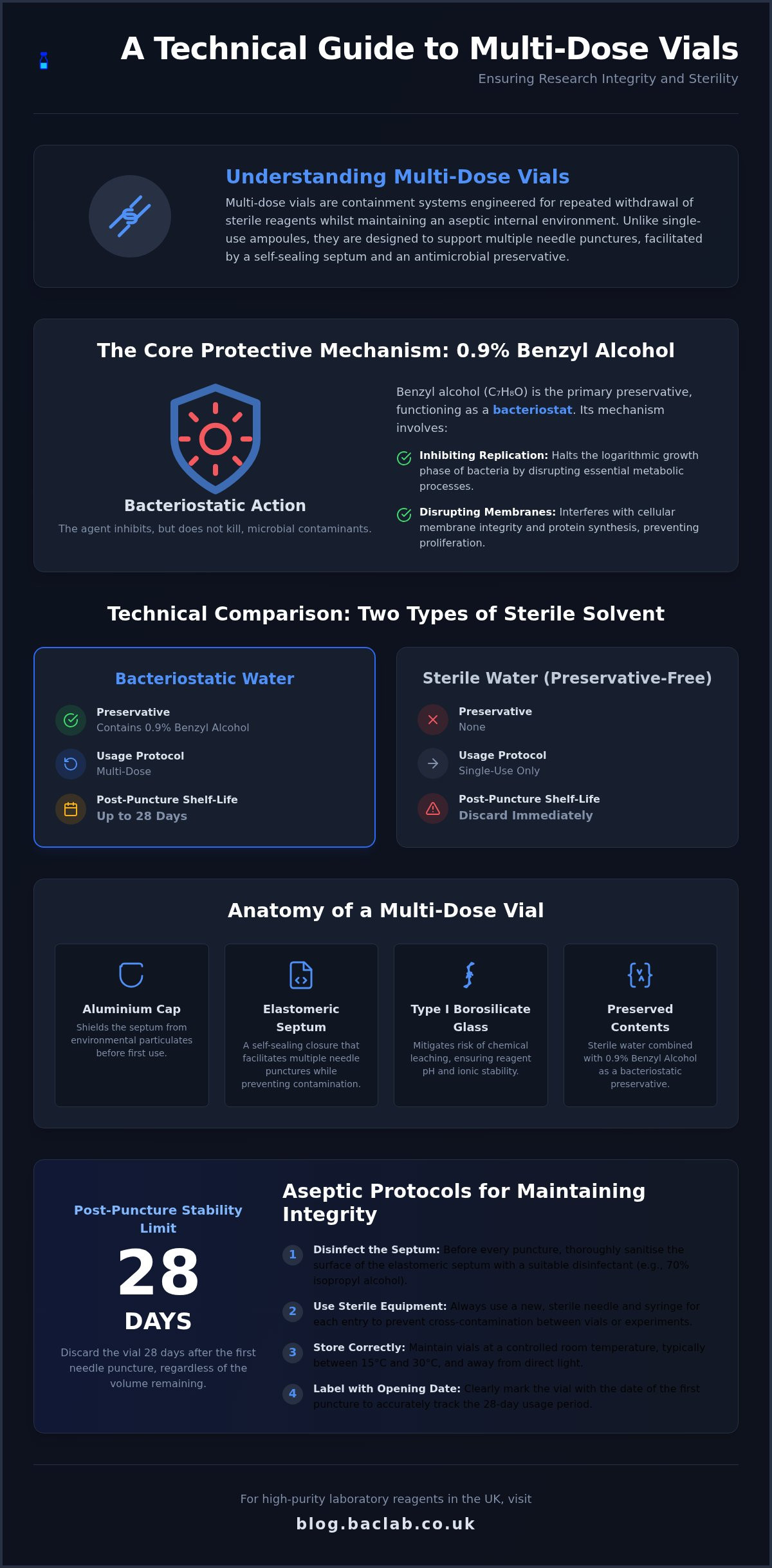
In laboratory environments, sterile water multi-dose vials are categorised as containment systems engineered for repeated withdrawal whilst maintaining a sterile internal environment. Unlike single-use ampoules, these vials are designed to support multiple needle punctures, a requirement facilitated by the integration of specific antimicrobial agents and specialised closure mechanisms. The primary utility of this format lies in its capacity to provide a consistent solvent source for longitudinal research, where the stability of the reagent must be preserved over several days or weeks. The structural role of the elastomeric septum is central to the vial’s utility, as it facilitates needle penetration and subsequent resealing to prevent atmospheric ingress or microbial contamination after the needle is withdrawn.
A critical distinction exists between initial sterility, defined as the absolute absence of viable microorganisms, and bacteriostasis, which refers to the inhibition of microbial proliferation. Whilst a vial may be sterile upon manufacture, the act of entering the container introduces a risk of contamination. Multi-dose systems mitigate this risk through the inclusion of bacteriostatic agents, such as 0.9% benzyl alcohol, which prevent the growth of any bacteria that might be introduced during the withdrawal process. Within UK research institutions, the adoption of these formats is often driven by the requirements of cost-efficiency and experimental consistency, particularly when calibrating sensitive analytical equipment or preparing serial dilutions.
Anatomy of a Multi-Dose Reagent Vial
The physical architecture of a multi-dose vial is designed to withstand the rigours of repeated laboratory access. Aluminium flip-off caps serve a secondary but necessary protective function, shielding the primary elastomeric seal from environmental particulates prior to the first puncture. High-purity reagents require Type I borosilicate glass to mitigate the risk of chemical leaching, which can alter the pH or ionic concentration of the solvent. The 10ml standard is frequently utilised in UK laboratories because it aligns with typical throughput needs whilst respecting the 28-day stability threshold recognised for preserved reagents. You can find more detail on these specific measurements in our guide on technical specifications for 10ml vials.
Single-Use vs Multi-Dose: Regulatory Definitions
UK regulatory frameworks distinguish between single-dose ampoules, which are typically preservative-free, and multi-dose containers. Single-use sterile water lacks the chemical defence required to neutralise microbes introduced during needle entry, meaning any volume remaining after the initial opening must be discarded immediately. For a deeper technical comparison, researchers often consult the analysis of bacteriostatic water vs sterile water. Attempting to repurpose single-dose reagents for multi-day protocols introduces significant contamination risks, potentially compromising the validity of experimental results and leading to inconsistent data in sensitive in vitro models.
The Mechanism of Bacteriostatic Agents in Multi-Dose Systems
The primary antimicrobial preservative utilised in sterile water multi-dose vials is benzyl alcohol (C7H8O), typically prepared at a concentration of 0.9%. Unlike bactericidal agents that actively destroy existing microbial populations, benzyl alcohol functions as a bacteriostat. This mechanism is defined by the inhibition of metabolic processes necessary for bacterial replication rather than immediate cell lysis. By disrupting cellular membranes and interfering with protein synthesis, the preservative effectively halts the logarithmic growth phase of any microorganisms introduced during the withdrawal process. This ensures that the reagent remains viable for longitudinal studies where repeated access is required.
Aqueous solutions containing these bacteriostatic agents demonstrate significant stability at controlled room temperatures, typically ranging from 15°C to 30°C. However, researchers must evaluate the potential for chemical interactions between the preservative and sensitive research compounds. Whilst benzyl alcohol is compatible with a wide array of laboratory reagents, certain proteins or complex peptides may exhibit sensitivity to its aromatic structure or its influence on the solution’s osmotic properties. In some instances, this can lead to subtle changes in molecular conformation or aggregation, particularly if the reconstituted compound is stored beyond the recommended 28-day window.
The Chemistry of 0.9% Benzyl Alcohol
Benzyl alcohol exhibits moderate solubility in water and maintains a consistent pH profile within 10ml aqueous environments. This concentration is precisely calibrated to ensure that preservative efficacy is maintained across multiple septum punctures without significantly altering the chemical signature of the reagent. For laboratory reagents, the bacteriostatic threshold for 0.9% benzyl alcohol is established as the minimum inhibitory concentration required to suppress the proliferation of standard microbial contaminants under normal laboratory conditions. This stability is a prerequisite for any multi-entry system used in sensitive experimental protocols.
Impact on Reagent Integrity
The role of the bacteriostat is to serve as a secondary fail-safe against environmental exposure. Even with rigorous aseptic techniques, the risk of introducing atmospheric contaminants during needle entry is never zero. The preservative inhibits the proliferation of these contaminants, thereby protecting the integrity of the underlying reagent. Detailed chemical analysis of bacteriostatic water benzyl alcohol reveals that its efficacy remains robust provided the vial is stored correctly. For researchers managing complex reconstitution schedules, utilising a certified 10ml bacteriostatic water vial provides the necessary chemical defence to maintain experimental consistency.
Sterile Water vs Bacteriostatic Water: A Technical Comparison
The selection between non-preserved sterile water and bacteriostatic water is a fundamental decision in laboratory reagent management. It’s a matter of stability. Whilst non-preserved water is sterile at the point of manufacture, it lacks the chemical capacity to inhibit microbial replication once the atmospheric seal is breached. This makes it a single-use reagent. In contrast, sterile water multi-dose vials are specifically formulated with 0.9% benzyl alcohol to facilitate repeated access over an extended duration. The primary technical differentiator is the post-puncture shelf life; non-preserved water must be discarded immediately after the first entry, whereas preserved versions maintain integrity for up to 28 days.
Risk assessment protocols in UK laboratories must account for the potential of a microbial bloom in non-preserved systems. Without a bacteriostatic agent, any microorganisms introduced via needle entry or atmospheric exposure can proliferate rapidly in the aqueous environment. This risk is particularly acute in longitudinal research where the same solvent source is accessed daily. From an economic perspective, the cost per ml of non-preserved water often exceeds that of preserved alternatives during a 30-day study. Discarding 9ml of a 10ml ampoule after a single 1ml withdrawal represents a significant inefficiency in both procurement budgets and resource management.
When to Use Single-Dose Sterile Water
In specific experimental contexts, the presence of 0.9% benzyl alcohol may introduce undesirable variables. This is particularly relevant in sensitive cellular assays where the preservative’s antimicrobial properties could interfere with cell viability, signaling pathways, or metabolic activity. For a deeper analysis of these biochemical trade-offs, researchers should consult our guide on bacteriostatic water vs sterile water. Protocols that require immediate disposal of any remaining solvent, such as high-precision analytical chemistry measurements, are better suited to single-dose ampoules to avoid the chemical footprint of bacteriostatic agents.
When Multi-Dose Bacteriostatic Water is Mandatory
For longitudinal studies that span several weeks, the use of a preserved reagent is practically essential. Maintaining consistent reagent concentration across multiple sessions is difficult with single-use formats due to the variability inherent in frequent vial changes. Multi-dose formats also align with laboratory sustainability goals by reducing the volume of plastic and glass waste generated during high-throughput research. Reconstituting proteins or peptides for multi-day protocols necessitates the chemical defence provided by a bacteriostat to prevent degradation from microbial ingress. It’s the only way to ensure the solvent remains a neutral variable throughout the study’s duration.
Maintenance of Multi-Dose Vial Integrity and Sterility Protocols
The 28-day rule serves as the definitive temporal boundary for the utility of sterile water multi-dose vials in UK research environments. This protocol dictates that any multi-dose container must be discarded exactly 28 days after its initial puncture, regardless of the remaining reagent volume. This limit is established because the antimicrobial efficacy of the 0.9% benzyl alcohol is not infinite. Cumulative exposure to atmospheric elements and the mechanical degradation of the elastomeric septum from repeated needle entries can eventually compromise the vial’s internal environment. Adherence to this timeframe is a prerequisite for maintaining the integrity of longitudinal data and preventing the introduction of confounding biological variables.
Sanitisation of the vial septum with 70% isopropyl alcohol is a non-negotiable step in every withdrawal cycle. The alcohol must be allowed to air-dry completely to ensure the neutralisation of surface contaminants before the needle penetrates the seal. Visual inspection remains a critical component of these protocols. Researchers must examine the solution for signs of cloudiness, particulates, or any shift in colour. Any deviation from a completely transparent, aqueous state suggests that the bacteriostatic properties have been overwhelmed or that chemical leaching has occurred from the glass or stopper.
Step-by-Step Puncture Protocol
Maintaining a sterile field is essential for protecting the reagent. Every withdrawal should follow a disciplined sequence to minimise the risk of cross-contamination. Researchers seeking a comprehensive reference for each stage of vial access should consult the bacteriostatic water handling protocols laboratory guide, which separates general aseptic principles from product-specific requirements and covers preparation, documentation, and deviation response. The following steps constitute the standard operating procedure for vial access:
- Workstation Preparation: Sanitise the laminar flow hood or bench surface with a suitable disinfectant before placing the vial in the work area.
- Septum Sanitisation: Swab the rubber stopper with a fresh isopropyl alcohol wipe and allow the surface to dry for at least 30 seconds to ensure efficacy.
- Needle Selection: Use a new, sterile needle and syringe for every entry. Reusing equipment, even within the same study, is a primary source of reagent failure.
- Compliance Labelling: Record the date and time of the first puncture clearly on the vial label to ensure the 28-day discard threshold is visible to all laboratory personnel.
Storage and Shelf Life Considerations
The chemical stability of the bacteriostatic solution is highly dependent on environmental conditions. Vials should be stored at controlled room temperatures, typically between 15°C and 30°C, to prevent the crystallisation or degradation of the preservative. Exposure to ultraviolet light can accelerate the breakdown of benzyl alcohol into benzoic acid and benzaldehyde, which may alter the pH and reactivity of the solvent. For a comprehensive breakdown of these environmental factors, refer to our dossier on bacteriostatic water storage shelf life. Researchers responsible for procurement and compliance documentation should also review the bacteriostatic water safety data for their specific product, as the SDS provides critical guidance on hazard identification, handling procedures, and exposure controls that directly inform safe storage practices.
Sourcing High-Purity Bacteriostatic Water Vials in the UK
Sourcing sterile water multi-dose vials within the United Kingdom necessitates a rigorous evaluation of supplier transparency and logistical infrastructure. For research institutions, the reliability of the supply chain is as critical as the chemical purity of the reagent itself. Procurement from domestic suppliers mitigates the risks associated with international transit, such as temperature fluctuations during customs delays or the ambiguity of foreign regulatory standards. A transparent supplier must provide explicit data regarding chemical composition, specifically the precise 0.9% concentration of benzyl alcohol, to ensure the reagent performs consistently across longitudinal studies. This level of detail allows researchers to account for every variable in their experimental design, from the ionic profile of the solvent to the potential for leachables from the container material. Institutions should also ensure they can access and interpret the relevant bacteriostatic water safety data sheet for each product, as the SDS provides essential information on composition, hazard classification, and handling requirements that supports informed procurement decisions.
The choice between single vials and wholesale bundles often depends on the scale of the laboratory operation and the specific throughput requirements of the research project. Institutional procurement teams typically favour wholesale models to ensure batch consistency, which is vital for reducing inter-assay variability. It’s essential that these reagents are classified as laboratory-grade to meet the precision requirements of modern biochemistry. When sourcing from UK-based specialists, labs can verify that the products comply with national standards for reagent purity and administrative documentation, providing a level of intellectual honesty that’s often absent in generic marketplaces.
BacLab Laboratory Solutions
BacLab specialises in the distribution of 10ml bacteriostatic water vials, a volume specifically selected to balance research throughput with the 28-day stability rule established in previous sections. These vials are engineered for multi-dose applications, featuring elastomeric septa that maintain seal integrity across multiple entries and Type I borosilicate glass to prevent chemical leaching. For large-scale facilities and institutional laboratories, we provide wholesale bundles and bulk discounts to ensure a continuous supply of high-purity reagents whilst reducing procurement overheads. Researchers can access a bacteriostatic water 10ml single vial for initial protocol validation or pilot studies. This flexibility in procurement allows for more precise resource allocation within fixed research budgets.
National UK Distribution and Compliance
Timely delivery is essential to maintain experimental schedules and prevent the expiration of reconstituted compounds. BacLab’s national distribution network is designed to meet the specific requirements of UK laboratory shipping regulations, ensuring that reagents arrive in optimal condition and within established lead times. This logistical precision allows labs to manage inventory with greater accuracy, reducing the need for excessive stockpiling which can lead to reagent waste. Maintaining a secure and domestic UK supply chain is a fundamental prerequisite for ensuring uninterrupted research continuity and experimental reproducibility across all phases of a study. By choosing a specialist UK supplier, institutions can ensure their sterile water multi-dose vials meet the stringent purity standards required for modern biochemical analysis.
Optimising Experimental Reproducibility through Reagent Integrity
The maintenance of experimental reproducibility depends on the rigorous application of aseptic protocols and a technical understanding of reagent stability. The utility of sterile water multi-dose vials is governed by the biochemical efficacy of 0.9% benzyl alcohol and the adherence to the 28-day puncture threshold. Researchers must prioritise the structural integrity of elastomeric seals and the environmental conditions of storage to prevent microbial proliferation or chemical degradation. These factors are essential for ensuring that the solvent remains a neutral variable in complex biochemical assays.
Selecting a specialist UK-based supplier ensures that reagents meet the necessary purity standards whilst providing logistical continuity for longitudinal studies. By integrating these technical requirements into standard laboratory operating procedures, institutions can mitigate contamination risks and uphold the highest standards of professional responsibility.
Adhering to these documented standards provides the necessary foundation for reliable data acquisition and long-term research success.
Frequently Asked Questions
Can I use a multi-dose vial of sterile water without preservatives?
No, sterile water without preservatives is strictly for single-use applications. Once the seal of a non-preserved vial is breached, the aqueous environment is susceptible to rapid microbial proliferation. Sterile water multi-dose vials must contain a bacteriostatic agent, such as 0.9% benzyl alcohol, to inhibit the growth of bacteria introduced during repeated access. Using non-preserved water for multiple entries compromises research integrity and violates standard laboratory safety protocols for reagent stability.
Why must bacteriostatic water vials be discarded after 28 days?
The 28-day discard threshold is established because the antimicrobial efficacy of the bacteriostatic agent is not infinite. Over time, the concentration of 0.9% benzyl alcohol may fluctuate due to atmospheric exposure, and the elastomeric septum undergoes mechanical degradation from repeated needle entries. This increases the risk of contamination and reagent instability. Adherence to this timeframe ensures that the solvent remains a controlled variable in longitudinal studies and aligns with UK laboratory standards.
How many times can I puncture the septum of a 10ml multi-dose vial?
There is no fixed numerical limit on punctures, but the physical integrity of the elastomeric septum dictates the vial’s utility. Each entry increases the risk of “coring,” where small fragments of the rubber seal are sheared into the solution. Researchers should use the smallest gauge needle appropriate for the protocol and monitor the septum for visible signs of damage. Regardless of the number of punctures, the vial must be discarded 28 days after the initial entry.
Does 0.9% benzyl alcohol affect the pH of the reconstituted reagent?
Yes, the inclusion of 0.9% benzyl alcohol can result in a slightly more acidic pH compared to pure sterile water. Whilst this shift is often negligible for many experimental protocols, it can be a critical factor in sensitive analytical chemistry or when reconstituting pH-sensitive proteins. Researchers must account for this aromatic alcohol’s chemical footprint during experimental design. If the research requires an absolute neutral pH, single-use, preservative-free reagents may be more appropriate for that methodology.
What is the correct storage temperature for a multi-dose vial after its first use?
After the initial puncture, sterile water multi-dose vials should be stored at controlled room temperatures, typically between 15°C and 30°C. It’s essential to protect the vials from direct ultraviolet light, which can accelerate the chemical breakdown of the bacteriostatic agent into benzoic acid. Whilst some protocols suggest refrigeration, researchers should verify that cold storage doesn’t cause the precipitation of the reconstituted compound. Maintaining a consistent temperature environment is vital for ensuring the reagent’s biochemical stability.
Are multi-dose vials suitable for all types of laboratory research?
No, multi-dose vials are not universally applicable to all research methodologies. The presence of antimicrobial preservatives can interfere with certain in vitro cellular assays, potentially altering cell viability or metabolic responses. Similarly, high-precision analytical chemistry may be sensitive to the chemical signature of benzyl alcohol. Researchers must evaluate the compatibility of the bacteriostatic agent with their specific compounds and biological models before selecting a multi-dose format over a single-use ampoule.
What should I do if I notice cloudiness in my multi-dose vial?
If any cloudiness, discolouration, or visible particulates are observed, the vial must be discarded immediately. These physical changes are primary indicators of microbial contamination or chemical degradation of the reagent. Reusing a compromised vial can lead to inconsistent data and the failure of experimental protocols. A clear, transparent appearance is a prerequisite for the use of any aqueous reagent. Regular visual inspection before every withdrawal is a fundamental component of maintaining laboratory research integrity.
Is bacteriostatic water the same as sterile water for injection?
No, bacteriostatic water and sterile water for injection are distinct reagents with different regulatory classifications. Sterile water for injection is a single-dose reagent that contains no antimicrobial agents and must be discarded after one use. Bacteriostatic water is specifically formulated for multi-dose applications, containing 0.9% benzyl alcohol to suppress microbial growth. Understanding this distinction is critical for UK researchers when managing solvent supplies for longitudinal studies versus short-term, high-sensitivity analytical measurements.