
The integrity of a multi-dose reagent isn’t a variable state; it’s a function of precise chemical inhibition where the margin between stability and contamination resides within a strict 0.9% concentration threshold. Researchers frequently face ambiguity whilst distinguishing between simple sterile diluents and preserved solutions, a confusion that often compromises the long-term viability of laboratory reagents and leads to uncertainty regarding UK-specific compliance. This technical analysis provides a comprehensive reference regarding the biochemical properties and antimicrobial mechanisms of bacteriostatic water 0.9 benzyl alcohol, ensuring clarity for those managing complex multi-dose protocols in a research environment.
We’ll examine the specific molecular behaviour of benzyl alcohol as a bacteriostatic agent, contrast its profile with established UK reagent standards, and detail the stability parameters required for 10ml vial maintenance. By addressing the biochemical “how” and “why” behind microbial suppression, this dossier equips laboratory professionals with the data necessary to maintain rigorous standards of intellectual and experimental honesty whilst navigating the technical nuances of reagent-grade supplies. The following sections provide a structured evaluation of the chemical stability and antimicrobial efficacy essential for maintaining protocol integrity.
Key Takeaways
- Understand the biochemical mechanism by which benzyl alcohol disrupts bacterial cell membrane integrity and induces protein denaturation at a 0.9% concentration.
- Evaluate the critical distinctions between multi-dose bacteriostatic solutions and single-use sterile water to ensure protocol compliance in longitudinal laboratory studies.
- Access a detailed chemical profile of bacteriostatic water 0.9 benzyl alcohol, including its formulation with Water for Injection (WFI) and its classification as a non-pyrogenic reagent.
- Identify precise stability protocols, including optimal temperature maintenance between 20°C and 25°C and the mitigation of UV-induced chemical degradation.
- Analyse UK procurement standards for reagent-grade supplies, focusing on why it’s advantageous to use 10ml vials for maintaining reagent freshness and minimising laboratory waste.
Defining Bacteriostatic Water 0.9% Benzyl Alcohol as a Research Reagent
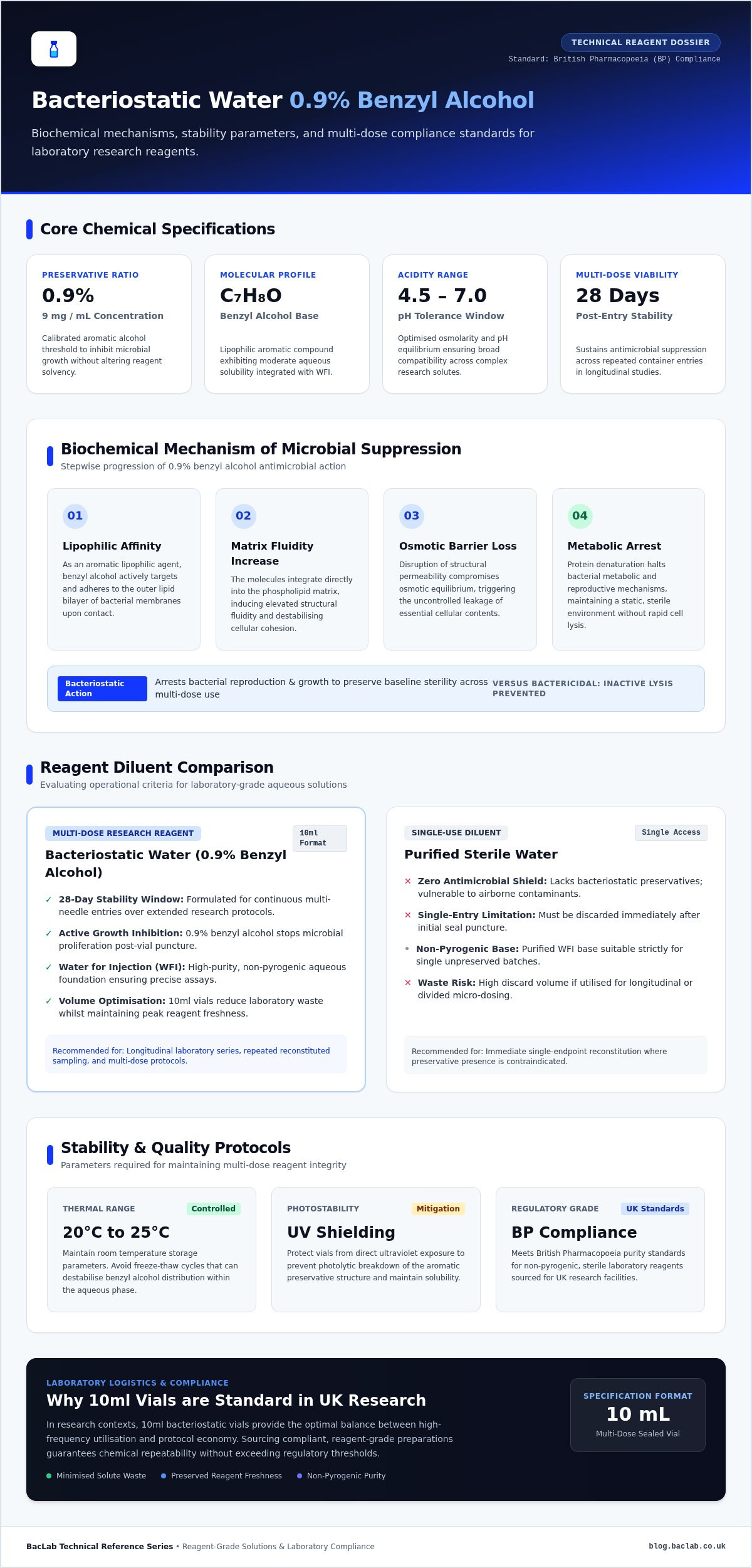
Bacteriostatic water 0.9% benzyl alcohol is a specialised laboratory reagent designed for multi-dose applications where maintaining the sterility of the aqueous environment is paramount. This sterile, non-pyrogenic preparation is engineered to support longitudinal research by preventing microbial proliferation within the solvent. Unlike single-use diluents, this solution consists of Water for Injection (WFI) integrated with 0.9% (9mg/mL) benzyl alcohol. This specific concentration serves as an aromatic alcohol preservative that maintains the integrity of the solution after the initial vial entry. It’s a critical component in protocols that demand repeated access to a single container without compromising the biochemical baseline of the experiment.
The distinction between bacteriostatic and bactericidal actions is a fundamental principle of laboratory hygiene. A bacteriostatic agent, such as the 0.9% benzyl alcohol found in these solutions, functions by arresting the metabolic and reproductive processes of bacteria. This differs from bactericidal agents which are designed to cause immediate cell death. In a research setting, the objective isn’t typically to sterilise a contaminated sample but to maintain the existing sterile state of the WFI through repeated needle punctures. This makes bacteriostatic water 0.9 benzyl alcohol an indispensable tool for researchers who require a stable medium for multi-dose applications over a standard 28-day period.
Chemical Properties and Molecular Structure
The molecular formula of benzyl alcohol is C7H8O. It exhibits moderate solubility in aqueous media, making it an ideal candidate for preserving WFI without altering the fundamental solvent characteristics required for sensitive research. Most laboratory-grade solutions maintain a pH range between 4.5 and 7.0, ensuring compatibility with a wide array of solutes. The osmolarity of a 0.9% benzyl alcohol concentration is carefully calibrated to minimise interference with the biological assays being conducted. For a rigorous analysis of how these molecular parameters influence solute-solvent interactions, researchers should consult the detailed reference on bacteriostatic water chemical properties, which examines the theoretical osmolarity and oxidative stability pathways in depth. The benzyl alcohol antimicrobial properties are derived from its ability to disrupt the cellular membrane of invading organisms, a mechanism that is explored in detail in our comprehensive guide on bacteriostatic water. This preservative function is the primary reason why 10ml vials are preferred in multi-dose contexts.
Regulatory Classification in the United Kingdom
In the United Kingdom, bacteriostatic water is classified primarily as a laboratory reagent rather than a clinical medication when intended for research environments. It must comply with the British Pharmacopoeia (BP) standards for sterile reagents to ensure high-purity outcomes. UK research facilities must follow specific administrative requirements for procurement, ensuring that the reagents are sourced from established suppliers like BacLab. This distinction is critical; whilst clinical-grade products exist, the laboratory-grade variant is specifically optimised for the precision and repeat-entry requirements of biochemical research. Understanding the technical specifications of 10ml vials helps researchers select the correct format for their specific protocol needs without violating UK regulatory frameworks.
The Biochemical Mechanism of Benzyl Alcohol as an Antimicrobial Preservative
The antimicrobial efficacy of bacteriostatic water 0.9 benzyl alcohol is predicated on its ability to penetrate and destabilise microbial structures. As a lipophilic aromatic alcohol, benzyl alcohol exhibits a high affinity for the lipid bilayers that constitute bacterial cell membranes. Upon contact, the molecule integrates into the phospholipid matrix; this induces a state of increased membrane fluidity and permeability. This physical disruption compromises the osmotic barrier of the cell. It leads to the uncontrolled leakage of essential intracellular components, such as potassium ions and ATP, whilst simultaneously allowing the influx of external solutes that interfere with metabolic homeostasis.
Beyond membrane perturbation, the 0.9% concentration facilitates the denaturation of cytoplasmic proteins. This concentration (9mg/mL) is sufficient to induce conformational changes in the secondary and tertiary structures of enzymes critical for bacterial replication. Whilst these mechanisms are potent against Gram-positive organisms, such as Staphylococcus aureus, they also demonstrate efficacy against Gram-negative species like Pseudomonas aeruginosa. The 0.9% threshold is specifically selected to maintain a balance between antimicrobial efficacy and chemical stability within the aqueous medium. It’s this precise calibration that allows for multiple needle penetrations without the immediate risk of microbial proliferation.
Threshold Efficacy and Concentration Gradients
Industry standards dictate that the 0.9% concentration represents the minimum inhibitory concentration (MIC) required to sustain bacteriostatic conditions throughout a standard 28-day puncture cycle. Dilution below this threshold significantly reduces the preservative’s capacity to inhibit growth; this potentially renders the reagent susceptible to contamination. Maintaining the integrity of bacteriostatic water 0.9 benzyl alcohol ensures that the antimicrobial effect remains consistent, even as small volumes of air or trace contaminants are introduced during repeated use of a 10ml vial. The chemical consequences of dilution are severe, as a sub-threshold concentration fails to achieve the necessary protein denaturation required for effective preservation.
Interaction with Solutes and Reagents
Benzyl alcohol’s role extends beyond preservation; it also functions as a mild co-solvent in many laboratory protocols. Its presence can influence the solubility of various research compounds, particularly those with hydrophobic regions. Whilst generally compatible with a wide range of biochemical compounds and proteins, researchers must account for the impact of the preservative on the final osmolarity of the solution. Factors such as molecular weight and the presence of ionic groups in the solute can influence how research compounds behave in bacteriostatic media. For high-precision experiments requiring a reliable multi-dose medium, sourcing a certified 10ml bacteriostatic water vial ensures that the concentration remains within the required technical specifications for these complex interactions.
Comparative Analysis: 0.9% Benzyl Alcohol Solutions versus Purified Sterile Water
The selection between preserved and non-preserved aqueous media is a foundational decision that dictates the protocol’s longitudinal stability. Whilst both substances are sterile and non-pyrogenic, their biochemical profiles diverge significantly regarding their suitability for multi-dose applications. The following table delineates the primary technical differences between these two reagents:
| Specification | Bacteriostatic Water 0.9% Benzyl Alcohol | Sterile Water for Injection |
|---|---|---|
| Preservation Agent | 0.9% Benzyl Alcohol | None (Preservative-free) |
| Vial Classification | Multi-dose (typically 10ml) | Single-use |
| Post-entry Stability | 28 days | Immediate disposal required |
| Microbial Inhibition | Active bacteriostasis | None |
Sterile water for injection is strictly limited to single-use applications because it lacks the chemical safeguards necessary to inhibit microbial growth once the container’s seal is breached. In longitudinal studies, this creates a significant limitation; any volume remaining after the initial withdrawal must be discarded to prevent the risk of contamination. Conversely, bacteriostatic water 0.9 benzyl alcohol provides a distinct operational advantage by allowing for repeated access. For an extended evaluation of these differences, researchers can consult our Bacteriostatic Water Vs Sterile Water technical comparison. The economic and practical benefits of 10ml multi-dose vials are particularly evident in high-frequency reconstitution protocols where reagent waste must be minimised.
Multi-dose Vial Integrity
The integrity of a multi-dose reagent depends on the synergistic relationship between the physical barrier of the rubber stopper and the chemical action of the preservative. Every needle puncture introduces a microscopic risk of environmental contamination. In a non-preserved medium, even a single rogue microbe can proliferate rapidly, compromising the entire batch. The presence of benzyl alcohol is a critical necessity for reagents intended for repeated access, as it provides the sustained antimicrobial inhibition required to offset the introduction of environmental contaminants during successive needle entries. Standardised protocols for multi-entry vials require both aseptic technique and the presence of a validated bacteriostatic agent to maintain the reagent’s biochemical baseline.
Research Application Suitability
Whilst the use of bacteriostatic water 0.9 benzyl alcohol remains the standard for most multi-dose research, certain high-sensitivity assays may require preservative-free media. In vivo research or specific in vitro cell culture studies can be sensitive to the presence of aromatic alcohols. Benzyl alcohol can occasionally induce toxicity in delicate cell lines or interfere with high-sensitivity analytical assays that detect trace organic compounds. Researchers must evaluate the threshold of their specific biological models to determine if the 0.9% concentration will impact the experimental outcome. If the protocol involves highly sensitive metabolic pathways, the trade-off between the convenience of a multi-dose vial and the chemical purity of a single-use sterile vial must be carefully weighed.
Stability and Integrity Protocols for Multi-Dose Research Vials
Maintaining the biochemical equilibrium of bacteriostatic water 0.9 benzyl alcohol requires strict adherence to environmental controls. The concentration of the preservative is sensitive to thermal and radiative stress. Laboratory standards dictate that these solutions should be stored within a controlled temperature range of 20°C to 25°C. Deviations from this range can accelerate the degradation of the aromatic alcohol; this potentially reduces its antimicrobial efficacy before the projected expiry. UV light exposure represents another significant risk factor. It can initiate photochemical reactions that compromise the chemical integrity of the 10ml vial. Detailed storage data can be found in our Technical Analysis of Bacteriostatic Water Shelf Life and Stability.
Environmental Factors and Degradation
Extreme temperature fluctuations often lead to the precipitation of solutes or the degradation of the preservative matrix. Researchers should regularly inspect vials for visible signs of failure. Cloudiness, discolouration, or the presence of particulate matter are definitive indicators that the reagent’s integrity is compromised. For bulk laboratory supplies, storage should be organised in a dark, climate-controlled environment to mitigate these risks. If the solution appears altered in any way, it must be discarded immediately. The biochemical baseline of the experiment is no longer verifiable once the preservative’s stability is in question.
Handling and Aseptic Technique
Aseptic handling is the secondary line of defence in maintaining the integrity of bacteriostatic water 0.9 benzyl alcohol after the seal is breached. The vial septum must be sanitised with 70% isopropyl alcohol before every entry. Researchers should minimise air exchange during reagent withdrawal. Excessive air introduction can introduce environmental contaminants and potentially oxidise the solution. Using specialised laboratory-grade syringes ensures precise volume measurement and reduces the risk of coring the rubber stopper. This meticulous approach is essential for preserving the 28-day shelf life established after the initial puncture.
Disposal of Expired Reagents
UK standards for the disposal of laboratory reagents are rigorous. Once a vial exceeds its 28-day post-puncture limit or its printed expiry date, it is classified as chemical waste. Disposal protocols must comply with local environmental regulations regarding benzyl alcohol neutralisation and glass recycling. This often involves specific waste stream categorisation to prevent environmental contamination. All disposal actions should be documented in lab logs to maintain a clear chain of custody and reagent tracking. This level of administrative discipline ensures that only viable reagents are used in active research, upholding the intellectual honesty of the laboratory’s output.
Procurement Standards for Bacteriostatic Reagents in the United Kingdom
Procuring bacteriostatic water 0.9 benzyl alcohol within the UK requires a methodical evaluation of supplier standards to ensure experimental reproducibility. Researchers must scrutinise the technical provenance of the reagent to ensure it meets the requisite standards for laboratory application. The 10ml vial format is particularly significant for maintaining reagent freshness; it’s optimised for research precision by aligning the volume with the standard 28-day stability window. Using larger volumes often results in unnecessary chemical waste as the preservative efficacy diminishes post-puncture. For institutional buyers, establishing wholesale procurement strategies is essential for sustaining continuous research operations. These strategies typically leverage bulk discount structures to manage costs whilst ensuring a consistent supply of high-purity reagents.
Accessing reliable procurement channels is straightforward through established specialists. Researchers can obtain a Bacteriostatic Water 10ml Single Vial or engage in larger scale acquisition through wholesale bundles to meet project demands without compromising on batch consistency.
Quality Assurance and Batch Testing
Quality assurance is the cornerstone of reagent procurement. Every batch of bacteriostatic water must be accompanied by a Certificate of Analysis (CoA) that documents the exact chemical profile. This documentation serves as verification that the 0.9% benzyl alcohol concentration is accurate and that the solution remains non-pyrogenic. Independent testing is often necessary to confirm these parameters, especially for sensitive biochemical assays where trace contaminants can skew data. Ensuring that the reagent’s free from metabolic by-products and endotoxins is a non-negotiable requirement for maintaining high-level research integrity. Laboratories seeking to align their documentation with empirical molecular data can reference the technical dossier on bacteriostatic water chemical properties, which details the absence of buffering capacity and the oxidative pathways relevant to batch verification.
Logistics and Supply Chain Reliability
The reliability of the supply chain directly impacts the continuity of laboratory work. UK-based suppliers provide a logistical advantage by reducing transit times and simplifying the regulatory hurdles associated with international reagent shipping. Product integrity during transit is maintained through robust packaging that protects the 10ml vials from thermal stress and physical damage. Managing inventory requires a proactive approach; researchers should track batch numbers and expiry dates within lab logs to prevent protocol interruptions. A stable supply chain ensures that critical reagents are available exactly when needed, upholding the methodological rigour of the facility.
Advancing Laboratory Standards through Reagent Precision
The technical evaluation of bacteriostatic water 0.9 benzyl alcohol confirms its status as a fundamental reagent for multi-dose laboratory applications. Its efficacy isn’t merely a product of its composition but is derived from the precise maintenance of chemical thresholds and rigorous adherence to environmental stability standards. By understanding the biochemical mechanisms of antimicrobial inhibition and the specific logistical requirements of UK procurement, researchers can ensure the long-term integrity of their experimental data. These protocols mitigate the risks of contamination and chemical degradation that often compromise longitudinal research.
Maintaining these standards requires consistent access to reagents that meet exact quality specifications. As a UK-based specialist supplier, BacLab provides 10ml vials specifically optimised for laboratory precision, ensuring that researchers can maintain a strict 28-day puncture cycle without excessive waste. Institutional buyers can also leverage bulk and wholesale pricing structures to support continuous operations in high-volume research environments.
Upholding these rigorous standards ensures that every reconstitution protocol remains consistent and reliable for the duration of the study. This commitment to technical excellence supports the intellectual honesty required in modern biochemical research.
Frequently Asked Questions
What is the specific role of 0.9% benzyl alcohol in bacteriostatic water?
It acts as an antimicrobial preservative by disrupting bacterial cell membranes and denaturing essential proteins. This specific concentration (9mg/mL) ensures that the solution remains sterile after multiple entries by inhibiting the reproduction of bacteria. It’s essential for multi-dose vials where environmental contaminants might be introduced during successive punctures. Without this agent, the water for injection would support rapid microbial proliferation once the container’s seal is breached.
How long does bacteriostatic water remain stable after the first puncture?
The standard stability window for bacteriostatic water 0.9 benzyl alcohol is 28 days after the initial vial entry. This timeframe is established based on the preservative’s efficacy in maintaining a sterile environment within a 10ml vial under controlled conditions. Once this period expires, the concentration of the aromatic alcohol may no longer be sufficient to inhibit microbial growth. Researchers should record the date of first access to ensure protocol compliance.
Can bacteriostatic water be used for all types of laboratory research?
It’s suitable for most multi-dose reconstitution protocols, yet it isn’t universally applicable to every research model. Specific in vitro cell cultures or highly sensitive analytical assays might be compromised by the presence of aromatic alcohols. Benzyl alcohol can induce toxicity in delicate biological systems or interfere with trace organic detection. Researchers must evaluate the chemical compatibility of the 0.9% concentration with their specific solutes and biological targets before implementation.
Why is 0.9% the standard concentration for benzyl alcohol in these solutions?
The 0.9% threshold represents the minimum inhibitory concentration required to achieve effective bacteriostasis whilst maintaining the chemical stability of the aqueous medium. This specific ratio (9mg per mL) is calibrated to balance antimicrobial potency against potential solute interference. Lower concentrations fail to provide sustained protection against Gram-positive and Gram-negative organisms. Conversely, higher concentrations could lead to excessive protein denaturation or solubility issues within complex laboratory reagents.
Is bacteriostatic water 0.9% benzyl alcohol legal for research use in the UK?
Yes, it’s entirely legal for procurement and use as a laboratory reagent within the United Kingdom. BacLab operates as a specialist supplier providing bacteriostatic water 0.9 benzyl alcohol to the UK research community. It’s classified as a professional laboratory supply rather than a clinical medication. Facilities must ensure they source their reagents from reputable UK-based suppliers that provide appropriate documentation, such as Certificates of Analysis, to confirm batch purity and concentration accuracy.
What are the storage requirements for 10ml bacteriostatic water vials?
Vials must be stored in a climate-controlled environment between 20°C and 25°C to maintain the integrity of the preservative. Exposure to extreme temperatures or direct UV light can degrade the chemical structure of the benzyl alcohol. It’s best to keep the 10ml vials in their original packaging to protect them from light-induced oxidation. Proper storage ensures the reagent remains non-pyrogenic and effective throughout its stated shelf life and post-puncture window.
How does bacteriostatic water differ from sterile water for injection?
The primary distinction lies in the presence of an antimicrobial agent; bacteriostatic water contains 0.9% benzyl alcohol whilst sterile water is preservative-free. This allows bacteriostatic solutions to be used in multi-dose formats for up to 28 days. Sterile water for injection is strictly a single-use reagent that must be discarded immediately after the seal is breached. Choosing the correct medium depends on whether the protocol requires repeated access to the same container.
What should I do if my bacteriostatic water appears cloudy or contains particles?
Any visible change in the solution’s clarity, such as cloudiness, discolouration, or the formation of precipitate, indicates chemical or microbial degradation. The vial must be discarded immediately in accordance with UK laboratory waste standards. These physical changes suggest the preservative matrix has failed or the solution has reacted with environmental contaminants. Using compromised reagents can invalidate experimental results and introduce uncontrolled variables into sensitive biochemical research protocols.