
The largest advertised discount may be the least economical choice if the order exceeds documented laboratory demand or leaves key product details unclear. When comparing bacteriostatic water bulk discounts, look beyond the headline saving. The useful comparison is the cost per vial, considered alongside the product information and the quantity your laboratory plans to use.
Unclear quantity tiers, bundle contents and per-vial costs make offers difficult to compare. Storage guidance and product documentation matter too. A low unit price is not enough if you cannot confirm what is supplied or assess whether the stock fits your purchasing plan.
This guide explains how to compare quantities on a consistent per-vial basis, check bundle contents and match an order to documented demand. It also covers the product and supplier information to review before purchase. BacLab supplies 10 ml bacteriostatic water vials for laboratory and research applications, with individual and wholesale purchasing options. Check current tiers, bundle availability, ordering terms and listing information before placing an order.
Key Takeaways
- Check the current listing for qualifying quantities and terms, as bacteriostatic water bulk discounts can vary.
- Use the confirmed vial count and listed total to calculate a comparable per-vial price.
- Review vial volume, stated specifications and available product documentation for each supplier.
- Set the order quantity from approved laboratory requirements, then compare it with the options currently available.
- BacLab is a UK-based specialist supplier of 10 ml bacteriostatic water vials, with individual and wholesale purchasing options.
Bacteriostatic water bulk discounts: what buyers should compare first
A bulk discount is a supplier’s price reduction for buying a larger quantity. It may appear as a lower unit price, a multi-vial bundle or a discount triggered when an order reaches a stated quantity. Qualifying quantities and terms differ, so check the current product listing rather than assuming that suppliers use the same tiers. Price per vial is one measure of value, but the order must also fit the laboratory’s requirements and provide the product information needed for procurement.
This section focuses on UK research procurement of BacLab’s 10 ml bacteriostatic water vials. BacLab offers individual and wholesale purchasing options. Check the relevant listing for current discount tiers, bundle availability and any minimum order requirements. The term “bacteriostatic” refers to inhibiting bacterial growth; a general explanation of a bacteriostatic agent can clarify the terminology, but does not establish the specifications of a particular vial.
What does a bacteriostatic water bulk discount mean?
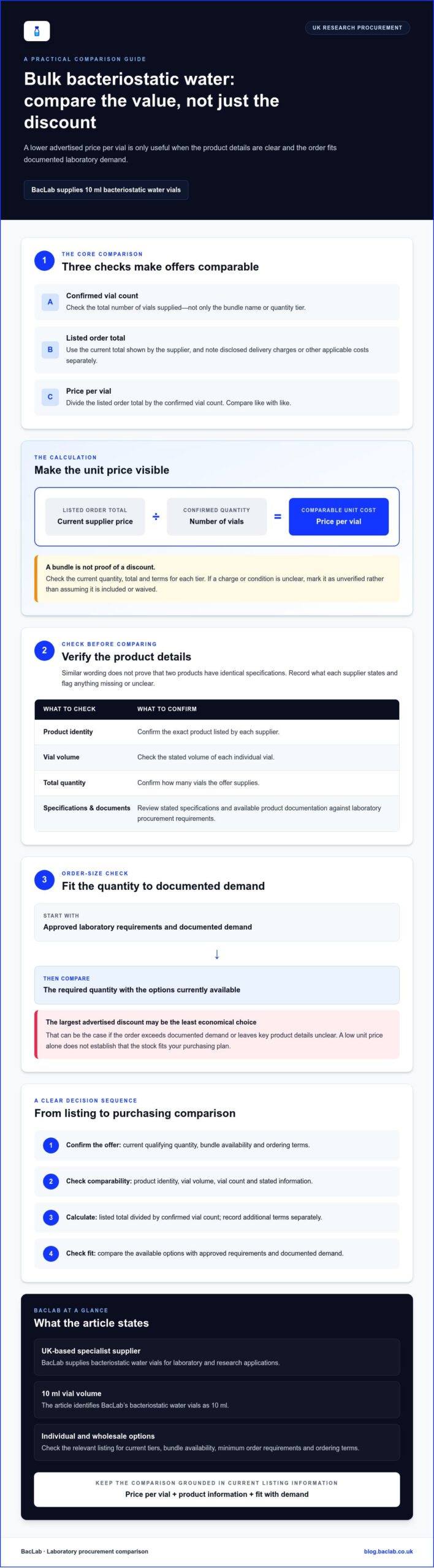
Suppliers may list single vials and multi-vial bundles separately. A bundle presentation alone does not show that the price is discounted. Divide the listed total by the confirmed vial count to see whether the per-vial price is lower. Do not assume a standard percentage, minimum order or continuing promotion across suppliers. Confirm the current offer, qualifying quantity and any stated conditions before ordering.
Which details should buyers establish before comparing offers?
Start by confirming that the products are comparable. Check each listing for the exact product identity, volume per vial and total number of vials. Then compare the stated specifications and available documentation with your laboratory’s procurement requirements. Similar wording does not prove that two products have identical specifications. Record what each supplier states and flag anything missing or unclear.
- Vial volume: confirm the stated volume of each individual vial.
- Quantity: check the total number of vials supplied, not just the bundle name.
- Product information: compare the stated specifications and documentation with your research procurement requirements.
For a more detailed reference, see bacteriostatic water vial specifications. Readers who need a foundational explanation can also review what bacteriostatic water is. Establish these details before comparing prices so that an unclear bundle is not mistaken for a comparable offer.
How to calculate whether bulk bacteriostatic water offers value
Use the current listing to identify three figures: the number of vials supplied, the listed order total and the resulting price per vial. This provides a consistent way to compare quantity options, but it measures price, not overall suitability. A lower unit price does not confirm that the product meets laboratory requirements or that the offer represents a saving against another supplier’s terms.
How to compare the effective price per vial
Divide the listed order total by the confirmed number of vials. Compare products with the same stated vial volume and relevant specifications. If these differ, the calculation may give a misleading impression of value. Record any disclosed delivery charge or other applicable order cost separately, then check the current delivery terms to understand how they affect the total procurement cost.
A simple comparison record should include:
- Quantity: the confirmed number of vials in the order.
- Listed total: the current order price shown by the supplier.
- Unit calculation: the listed total divided by the vial count.
- Additional terms: disclosed delivery charges and conditions that affect the order.
Use current listing information for each figure. If a charge or condition is not clearly stated, mark it as unverified instead of assuming it is included or waived.
How to interpret bundle tiers without assuming savings
For each tier, check the listed quantity and current total, then calculate the per-vial price using the same method. Confirm whether a discount applies automatically or depends on an order condition, such as selecting a qualifying quantity. A saving can only be assessed against a stated comparison price and its terms. Promotional wording alone does not establish the amount saved.
For UK research purchasing, compare the figures with documented laboratory requirements and the relevant procurement process. The UK bacteriostatic water procurement guide provides further context for assessing supply information. Base your comparison on the current listing, product details and order conditions, not assumptions about a supplier’s pricing structure.
Once you have set your comparison criteria, review the BacLab 10 ml single-vial listing alongside any current multi-vial options. Verify live prices, availability and terms before calculating value. Do not assume a discount tier or saving in advance.
Compare bulk bacteriostatic water suppliers beyond the discount
A discount does not establish product suitability. For UK laboratory procurement, first compare product information and supporting documentation with the requirements of the intended research application, then consider price. A supplier’s general reputation or claims about other catalogue items cannot establish the specifications of its bacteriostatic water.
Use the same fields for each current listing. This makes differences easier to identify without treating promotional wording as equivalent to product documentation:
- Product identity: record the exact product description and confirm that it refers to bacteriostatic water.
- Vial volume and quantity: note the stated volume per vial and the number supplied.
- Specifications: record the product-specific details in the listing and mark missing information as unconfirmed.
- Documentation: note which documents are provided or identified, and whether they address your laboratory’s procurement requirements.
- Availability and terms: check current availability and any conditions that affect the order.
These fields help distinguish comparable offers from listings that only appear similar. If a listing omits information relevant to your purchasing criteria, seek clarification or record the gap rather than assuming the product matches another supplier’s.
Which product and supplier details belong in a comparison?
Compare like-for-like products using their stated volume, supplied quantity and relevant specifications. Check that the product identity and intended laboratory application align with your procurement requirement, and note whether suitable documentation is available. Recheck listing details before purchase because availability and offer terms can change. A bundle name or discount message does not confirm what is included.
How should buyers evaluate evidence and claims?
Treat statements about quality, sterility or purity as claims to check against product-specific information and documentation. Evidence relating to a supplier’s unrelated products does not substantiate the characteristics of its bacteriostatic water. For example, analytical testing claims about another catalogue category should not be applied to a water product unless the supplier provides relevant evidence for that product.
Keep the distinction clear: promotional language describes an offer, while product documentation supports an assessment of the item. The bacteriostatic water quality-control checklist can help structure the information your laboratory reviews. Before ordering, check product identity, intended application, documentation and current availability against your requirements. This provides a more useful comparison than ranking bacteriostatic water bulk discounts by headline reduction alone.
Choose a bulk order size that fits demand and stock controls
Choose an order quantity based on planned laboratory use and the product’s storage instructions, not simply the tier with the lowest listed unit price. Start with approved purchasing plans and documented consumption. Account for stock already held, then compare the remaining requirement with the quantities currently offered. This helps avoid tying up budget in stock the laboratory may not use as planned.
How can a laboratory estimate an appropriate order quantity?
Review usage records and procurement schedules for a planning period relevant to the work. Subtract usable inventory already in stock from the planned requirement, then check whether the estimate aligns with an available bundle quantity. Do not add speculative future demand just to reach a discount tier. If requirements are uncertain, consider the smallest listed quantity that meets the approved plan, subject to current availability and procurement procedures.
- Planned requirement: use approved purchasing plans and recorded usage, rather than an unsupported forecast.
- Existing stock: check inventory so you do not duplicate supply already available.
- Order fit: compare the net requirement with current bundle quantities and any applicable order conditions.
This gives you a clearer basis for assessing bacteriostatic water bulk discounts. A lower unit price may not represent better procurement value if the order exceeds planned use or conflicts with the laboratory’s stock controls.
What storage and stock records should be checked?
Check storage conditions and product-specific handling instructions against the current listing or accompanying documentation. Do not assume a shelf life or post-opening period unless the product information supports it. On receipt, record the details required by your laboratory’s inventory process, such as product identity and receipt date. Apply documented stock-rotation controls so stock can be traced and managed consistently.
For further context, consult this bacteriostatic water storage guidance, then verify the instructions for the specific product being procured. BacLab supplies 10 ml bacteriostatic water vials for laboratory and research applications, with individual and wholesale purchasing options. Check current bundle availability and product information before deciding whether an order fits demand and stock controls.
Order bacteriostatic water from BacLab with clear expectations
A sound purchasing decision involves three checks: compare equivalent vials, calculate unit value from current listing information and choose a quantity that fits documented laboratory demand. A discount tier is relevant only when its contents and terms are clear and the quantity can be managed under laboratory stock controls. BacLab is a UK-based specialist supplier of 10 ml bacteriostatic water vials for laboratory and research applications, with individual and wholesale purchasing options. Confirm current availability and discount terms before ordering.
What to verify on the product listing before ordering
Check that the product description and stated vial volume match the laboratory requirement. Review current availability, disclosed order conditions and the product information available for procurement review. Use only details the supplier states. Do not infer specifications, documentation or bundle contents from a product name or promotional wording. If the listing does not address a requirement, treat it as unconfirmed before proceeding.
When should buyers consider individual or larger-quantity purchasing?
An individual purchase may be more appropriate when product suitability or future requirements remain unconfirmed. Consider a larger quantity only after comparing current wholesale options with planned use, existing inventory, storage instructions and documented stock controls. The lowest calculated unit price may not be the best fit if it results in excess stock. Recheck the listing terms before deciding, as availability and qualifying conditions can change.
Apply the same criteria to any bacteriostatic water bulk discounts: verify the product, compare the stated quantity and unit value, then check whether the order fits approved demand. This keeps the decision grounded in available evidence rather than an assumed saving. If key product information or ordering conditions are unclear, resolve that gap before committing to a larger quantity.
Make your next order fit the evidence
Assess bacteriostatic water bulk discounts by comparing vial volumes, confirmed quantities and current product information, not just the headline reduction. Calculate the listed price per vial, then weigh it against documented laboratory demand, existing stock and the supplier’s stated terms. A lower unit price is useful only when the product and order quantity meet procurement requirements.
BacLab is a UK-based specialist supplier of 10 ml bacteriostatic water vials for laboratory and research applications, with individual purchasing and wholesale options. Before ordering, check the listing for current availability, bundle conditions and relevant product information. This keeps the order aligned with planned use without relying on unverified savings or specifications.
A consistent comparison and demand-based order plan provide a clear basis for procurement. Review the BacLab listing to check the current product information and available purchasing options before placing an order.
Frequently Asked Questions
Are bulk discounts available for bacteriostatic water in the UK?
UK suppliers may offer bulk purchasing options, but qualifying quantities and discount terms depend on each supplier’s current listing. BacLab is a UK-based specialist supplier of 10 ml bacteriostatic water vials, with individual purchasing and wholesale options. Check current product information for available quantities, ordering conditions and relevant documentation. Do not assume a particular discount tier or saving applies unless it is stated for the offer you are considering.
How do I compare bulk bacteriostatic water prices fairly?
Compare like-for-like products by confirming the product identity, vial volume and total quantity first. Divide the listed order total by the number of vials to calculate a per-vial figure, then record any disclosed delivery charges or order conditions separately. Check that the stated specifications and available documentation meet your laboratory’s purchasing requirements. Unit price is useful, but it does not establish product suitability or full procurement value on its own.
Is buying bacteriostatic water in bulk always better value?
No. A larger order may have a lower listed price per vial, but it is not necessarily better value if it exceeds documented demand or creates stock-management difficulties. Compare the total order cost, any disclosed charges and the quantity your laboratory expects to use under approved purchasing plans. Check storage instructions and existing inventory before selecting a bundle. The appropriate order fits both laboratory requirements and stock controls.
What should I check before ordering a bulk bacteriostatic water bundle?
Confirm the product description, vial volume and number of vials supplied. Then review the stated specifications and documentation against your laboratory’s requirements. Check current availability and any disclosed minimum order or other purchasing conditions. Verify the product’s intended laboratory application rather than relying on promotional wording. If important details are missing or unclear, treat them as unconfirmed and seek clarification before ordering, particularly if they affect procurement approval or stock planning.
Can I calculate the per-vial cost from a bulk offer?
Yes. Divide the current listed order total by the confirmed number of vials included. For a fair comparison, use offers for products with the same stated vial volume and relevant specifications. Record disclosed delivery charges or other applicable costs separately, as these can affect the total procurement cost. The calculation gives a unit price based on listing information. It does not by itself confirm a saving or show that the product meets laboratory requirements.
How much bacteriostatic water should a laboratory order?
Base the quantity on approved purchasing plans, documented usage and stock already held, rather than speculative future demand. Compare the resulting requirement with currently listed bundle quantities, and consider a smaller suitable quantity if demand or product suitability remains uncertain. Before ordering, review the product’s current storage instructions and the laboratory’s stock-rotation controls. This helps prevent orders from exceeding expected use or duplicating existing inventory unnecessarily.
Does a bulk discount confirm that a product meets laboratory requirements?
No. A discount describes purchasing terms, not product suitability or documented characteristics. Review product-specific information and supporting documentation, including details your laboratory requires for the intended research application. Do not transfer quality or testing statements about a supplier’s other products to bacteriostatic water unless they specifically apply to that product. If required information is unavailable, treat it as unverified before making a procurement decision.