
The largest order is not necessarily the most suitable one for a research laboratory. When comparing bacteriostatic water bundle deals, the practical choice depends on anticipated research consumption, available storage space and how many 10 ml vials your work requires.
Uncertainty about whether to order a single vial or a multi-vial pack is understandable: a larger bundle may offer a different per-vial value, but only if the quantity aligns with your laboratory’s needs. BacLab supplies 10 ml bacteriostatic water vials for laboratory and research applications, with bundle sizes of 5, 10, 20, 50 and 100 vials.
This guide compares those quantities and sets out the criteria to consider before placing an order, including planned use, pack size and transparent price comparisons where available. It will help you assess individual and wholesale purchasing options without treating a larger order as automatically preferable, and select a quantity that suits your research requirements.
Key Takeaways
- Estimate your laboratory’s research requirement before choosing a pack size, using validated protocols and purchasing records to inform the calculation.
- Compare bacteriostatic water bundle deals by vial count and current product-page information, rather than assuming a larger pack is automatically better value.
- Assess whether each available quantity, from 5 to 100 vials, aligns with your expected use and practical storage capacity.
- Distinguish stated product specifications from general promotional wording when reviewing a research reagent.
- Use a consistent selection sequence: define the research need, estimate consumption, then match the requirement to an available BacLab bundle.
What do bacteriostatic water bundle deals include for research buyers?
For laboratory and research purchasing, a bacteriostatic water bundle is an order containing multiple 10 ml vials. The bundle changes the quantity procured in one order; it doesn’t indicate a different reagent function or imply that the vials have different chemical properties. BacLab’s listed bundle sizes are 5, 10, 20, 50 and 100 vials, alongside an individual-vial option.
These products are supplied for laboratory research applications, not as medicines or for human use. A bundle is therefore a purchasing format, not a statement about clinical suitability. Buyers assessing terminology and product context can read this overview of what bacteriostatic water is. For a broader reference on water for injection and related terminology, see Water for injection.
What distinguishes a bundle from a single vial?
The distinction is simply the number of 10 ml vials ordered together. A single vial may suit an initial purchase when a buyer is assessing the product and its documentation before planning repeat procurement. The 5-, 10-, 20-, 50- and 100-vial formats provide different order quantities; none should be interpreted as a change in the reagent itself.
Who may benefit from buying multiple vials?
Multiple vials can be a practical purchasing option for laboratories with recurring, planned research requirements, particularly where a team has estimated its needs in advance. Purchasing staff may also consolidate requirements for a research facility into one order, rather than arranging separate purchases for each requirement. The appropriate quantity depends on that facility’s own work and procurement process.
Individual purchasing and wholesale bundles serve different order scales. A single vial allows a smaller initial purchase, while a multi-vial format groups more units into one order. BacLab offers wholesale bundles and bulk-discount options, but buyers should distinguish those purchasing categories from any assumption about a particular saving: no discount amount should be inferred from vial count alone. Compare the current product-page information for the relevant format.
In practical terms, the decision is about matching quantity to planned research demand and procurement arrangements. A larger pack is not automatically preferable if it exceeds the facility’s expected requirements or storage capacity. The bundle format provides a range of quantities; it doesn’t replace the laboratory’s own assessment of need.
How to estimate the right bacteriostatic water bundle size
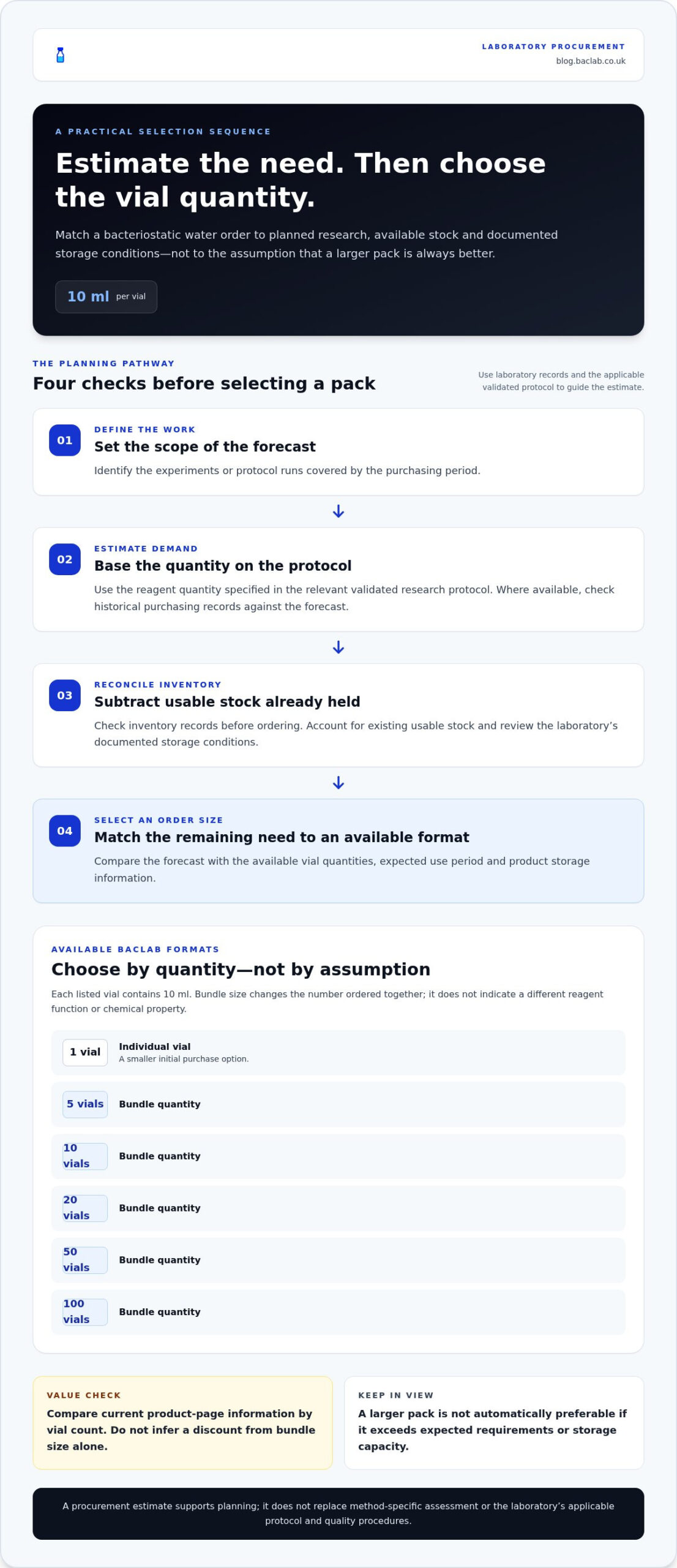
Estimate the requirement before comparing bacteriostatic water bundle deals: define the planned research work, forecast consumption from the applicable validated protocol, then select a quantity that accounts for stock already held and documented storage conditions. This ties the order to the laboratory’s own records rather than assuming a particular pack size suits every method.
A simple planning sequence is:
- Define the work: identify the experiments or protocol runs covered by the purchasing period.
- Estimate demand: use the reagent quantity specified by the applicable validated research protocol, supported by historical purchasing records where available.
- Reconcile inventory: account for usable existing stock before calculating the additional quantity required.
- Select an order size: compare the resulting requirement with available vial quantities and consider storage capacity and product storage information.
This is a procurement estimate, not a substitute for method-specific assessment. Bundle size alone can’t establish whether a reagent is suitable for a particular research method. Follow the laboratory’s applicable protocol and quality procedures; don’t infer suitability from the number of vials in a pack.
Forecasting vial requirements from a research plan
Begin with the planned experiments or protocol runs for the period being forecast. Apply the quantity stated in the relevant validated research protocol, then compare the estimate with historical purchasing records to identify differences between forecast and actual requirements. Avoid relying on a universal consumption figure: needs vary by research plan, and no general vial quantity can replace protocol-specific validation.
Balancing order size with stock and storage
Check inventory records before placing a new order, including the quantity already held and the laboratory’s documented storage conditions. Compare the expected use period with the product’s stated storage information rather than assuming that all ordered vials will be used within the same timeframe. The bacteriostatic water storage and shelf-life guide provides further context for this review.
Keep the estimate, stock check and storage review together in the purchasing record. This gives the team a clear basis for selecting a pack quantity and reviewing future orders against actual procurement patterns.
Once the forecast is reconciled with stock and storage capacity, select the closest available quantity without treating a larger order as inherently preferable. If a smaller initial purchase fits the plan, BacLab’s single 10 ml vial option can be considered before ordering a multi-vial quantity.
Comparing bacteriostatic water bundle sizes and value
BacLab’s listed formats range from an individual 10 ml vial to bundles of 5, 10, 20, 50 and 100 vials. The table compares the quantities and their nominal combined volume, calculated from the stated 10 ml per vial. It describes the order size, not a difference in reagent function.
| Format | Vial count | Nominal combined volume |
|---|---|---|
| Single vial | 1 | 10 ml |
| 5-vial bundle | 5 | 50 ml |
| 10-vial bundle | 10 | 100 ml |
| 20-vial bundle | 20 | 200 ml |
| 50-vial bundle | 50 | 500 ml |
| 100-vial bundle | 100 | 1,000 ml |
These figures describe the quantity ordered, not the amount a laboratory should use for a particular method. The single-vial option is a lower-quantity alternative; larger formats may suit planned procurement at a different scale. The lowest apparent per-vial amount, where a product page displays one, isn’t automatically the best fit if the order exceeds expected use or available storage.
What to compare across 10 ml vial bundles
Use the same comparison points for each format: vial count, stated volume per vial and product description. Review the product information for composition and laboratory research context relevant to your purchasing assessment. BacLab’s technical specifications for 10 ml vials provide a deeper reference. Compare the details stated for the product being purchased, rather than transferring specifications from another product description or source.
How to assess value without focusing only on discounts
Compare current product-page totals on a like-for-like basis. Where a listed bundle total is available, divide it by the number of vials to calculate a per-vial figure; don’t infer a saving from pack size alone. Prices and savings should be taken from current product information, rather than assumed from the number of vials in a pack.
Then weigh the comparison against expected use, stock already held and storage capacity. A lower unit amount may not represent better procurement value if some of the order is unlikely to be needed within the laboratory’s planned use period. Consider both the displayed price information and the fit between quantity and documented requirements.
Which product and quality details matter when buying a bundle?
Assess the stated product details independently of pack size. A bundle’s vial count describes the quantity purchased; it doesn’t establish the product’s purity, sterility or suitability for a particular laboratory method. For bacteriostatic water bundle deals, research buyers should distinguish verifiable specifications from general promotional wording and compare product information with the requirements set by their own laboratory procedures.
Assessing product information and research suitability
Start with the product description and its stated volume, composition and intended application. BacLab supplies 10 ml bacteriostatic water vials for laboratory and research applications. Compare the available details with the criteria defined by the relevant research method, rather than assuming that a product is suitable because it is sold in a larger pack or described in broad promotional terms.
Claims about quality should be considered in relation to specific, stated information. A vial count or bundle label is not evidence of composition, purity or sterility, and cannot demonstrate compatibility with a particular protocol. Keep the assessment within the laboratory research context: these supplies should not be presented as medicines or as suitable for clinical practice or human administration. For a more specification-focused discussion, consult the bacteriostatic water purity standards reference.
Storage, handling and documentation considerations
Use the product’s own stated storage and handling information, alongside the laboratory’s documented procedures. Avoid applying generic assumptions where product-specific guidance is relevant. For additional technical context, the site’s bacteriostatic water storage and shelf-life guide covers storage considerations in more detail.
Good purchasing records make later review more reliable. Record the product details associated with each order and the number of vials purchased, then maintain those records alongside the laboratory’s stock information. This helps purchasing teams distinguish between orders and track whether procurement matches the facility’s documented requirements. It also prevents bundle quantity from being mistaken for evidence about a product specification.
How to choose and order bacteriostatic water bundle deals from BacLab
Select an order by moving from the laboratory’s documented research requirement to an appropriate quantity, then checking the product details against the relevant method. This keeps the decision grounded in expected use rather than pack size or promotional wording. BacLab supplies 10 ml bacteriostatic water vials for laboratory and research applications, with a single-vial option and bundle formats of 5, 10, 20, 50 and 100 vials.
A final checklist before selecting a bundle
Before choosing a format, review the order against these points:
- Research plan: confirm the required vial volume and estimated total vial quantity against the laboratory’s applicable protocol and purchasing records.
- Current stock: subtract usable inventory from the forecast so the new order reflects the additional quantity required.
- Storage: consider the laboratory’s stated storage conditions and whether the expected use period aligns with product information.
- Product details: compare the listing’s stated information with the requirements of the research method. Quantity alone cannot establish suitability.
This review helps distinguish a calculated procurement decision from a default preference for either the smallest or largest pack. If the forecast falls between available formats, use the laboratory’s purchasing approach and practical storage capacity to decide which quantity is the closer fit, rather than treating a pack size as a recommendation for a particular method.
Selecting an order quantity
Once the requirement is established, compare it with BacLab’s listed options: 5, 10, 20, 50 or 100 vials. A single vial is also available as a lower-quantity purchasing option. Choose the format that most closely matches the estimated need after accounting for stock; no one bundle is appropriate for every research facility. Review the product listing details as part of the selection, and don’t infer a particular saving from the number of vials.
For additional procurement context, consult this guide to UK bacteriostatic water bulk discounts. It can inform purchasing comparisons, while the final order quantity should remain tied to your laboratory’s documented requirement.
For a smaller order, view BacLab’s single 10 ml bacteriostatic water vial. BacLab supplies laboratory research products; it doesn’t sell peptides or provide medical advice.
Make your next research order fit the work
Choose bacteriostatic water bundle deals by working from your laboratory’s documented research requirement, not from pack size alone. Estimate consumption using the applicable validated protocol and purchasing records, then account for stock on hand and storage capacity. Compare the product details with your research requirements, since vial count by itself can’t establish suitability for a method.
BacLab is a UK-based supplier of bacteriostatic water for laboratory and research applications, with 10 ml vials available individually and through wholesale bundle options. The appropriate quantity depends on your planned use: a single vial may suit a smaller requirement, while multi-vial formats allow buyers to align order size with their forecast without assuming a universal best choice.
Review the individual-vial product details as a starting point for your purchasing assessment.
With a measured estimate and a clear review of product information, your next order can better reflect your laboratory’s research needs.
Frequently Asked Questions
Are bacteriostatic water bundle deals cheaper than buying single vials?
Not necessarily; compare the current listed price for each pack rather than assuming a bundle costs less per vial. BacLab offers wholesale bundles and bulk-discount options, but the saving, if any, depends on the current product listing. Calculate the listed bundle total divided by its vial count, then weigh that figure against your laboratory’s forecast, existing stock and storage capacity. A lower unit price may not make a larger order the more appropriate choice.
What bundle sizes are available for 10 ml bacteriostatic water?
BacLab lists 10 ml bacteriostatic water in bundles of 5, 10, 20, 50 and 100 vials. An individual vial is also available as a lower-quantity option. These formats differ in the number of vials ordered together, not in stated vial volume. Match the pack quantity to your laboratory’s planned research requirement rather than assuming that one bundle size suits every purchasing need.
How do I calculate how many bacteriostatic water vials my laboratory needs?
Start with the planned experiments or protocol runs, then estimate consumption using the quantity specified by your applicable validated research protocol. Compare the estimate with historical purchasing records and check current inventory so existing stock is accounted for. Finally, consider your laboratory’s documented storage conditions and select an order quantity that fits the resulting requirement. Avoid using a universal vial estimate, as requirements depend on the research method.
Is bacteriostatic water intended for medical or human use?
No. BacLab supplies bacteriostatic water for laboratory and research applications. It should not be represented as a product for human use, clinical practice or treatment. Product selection should be based on the laboratory’s research requirements and relevant product information, not on assumptions about medical or clinical suitability. BacLab supplies laboratory products and does not sell prescription medicines or provide medical advice.
What should I compare when choosing a bacteriostatic water bundle?
Compare the vial count, stated volume per vial and product description across the available formats. Review the stated composition and intended laboratory research context, then assess those details against your method’s requirements. A larger pack doesn’t establish purity, sterility or protocol suitability. Also consider planned consumption, stock already held and storage capacity. If comparing value, use current product-page totals and calculate a per-vial figure where the information permits.
How should bacteriostatic water bundles be stored?
Follow the storage and handling information stated for the product, together with your laboratory’s documented procedures. Don’t infer storage conditions or a usable period from bundle size, and don’t apply generic assumptions in place of product-specific information. For a larger order, consider whether expected use and available storage align with the stated guidance. Keep relevant product and purchasing details with laboratory stock records to support consistent inventory review.
Can I buy bacteriostatic water in bulk in the UK?
Yes. BacLab is a UK-based supplier of bacteriostatic water for laboratory and research applications, offering individual 10 ml vials as well as wholesale bundles and bulk-discount options. Listed bundle quantities are 5, 10, 20, 50 and 100 vials. Select a format by estimating your laboratory’s requirement and considering existing stock and storage, rather than treating bulk purchasing as the default choice.