
Reducing diluent waste in laboratories is not simply a matter of using smaller volumes. It starts with choosing, ordering and handling materials in ways that prevent avoidable surplus while preserving protocol requirements and reagent integrity. Unused or expired stock can build up when demand is hard to forecast, but cutting consumption indiscriminately may compromise validated methods or contamination controls.
To reduce waste effectively, identify where diluent is being lost and distinguish preventable surplus from volumes a protocol requires. This guide covers how to review laboratory workflows, improve purchasing and stock management, and apply suitable storage, handling and disposal controls. It also explains how to track progress without changing validated protocol requirements.
Focus on operational improvements rather than across-the-board volume cuts. Protocol-specific requirements remain authoritative, and waste must be managed according to applicable procedures. Clear stock records and order quantities based on documented use can help reduce avoidable losses whilst maintaining research quality and reagent integrity.
Key Takeaways
- Map potential diluent losses from ordering through disposal to find where avoidable waste enters laboratory workflows.
- Use demand estimates, visible stock records and stock rotation to reduce surplus and preventable expiry.
- Assess prevention, reuse and substitution separately. Protocol validity, reagent compatibility and contamination controls should guide each decision.
- Record quantities received, used, discarded and expired consistently to establish a baseline and evaluate changes.
- Reducing diluent waste in laboratories starts with matching order quantities to documented use, storage limits and protocol requirements.
Where does diluent waste occur in laboratory workflows?
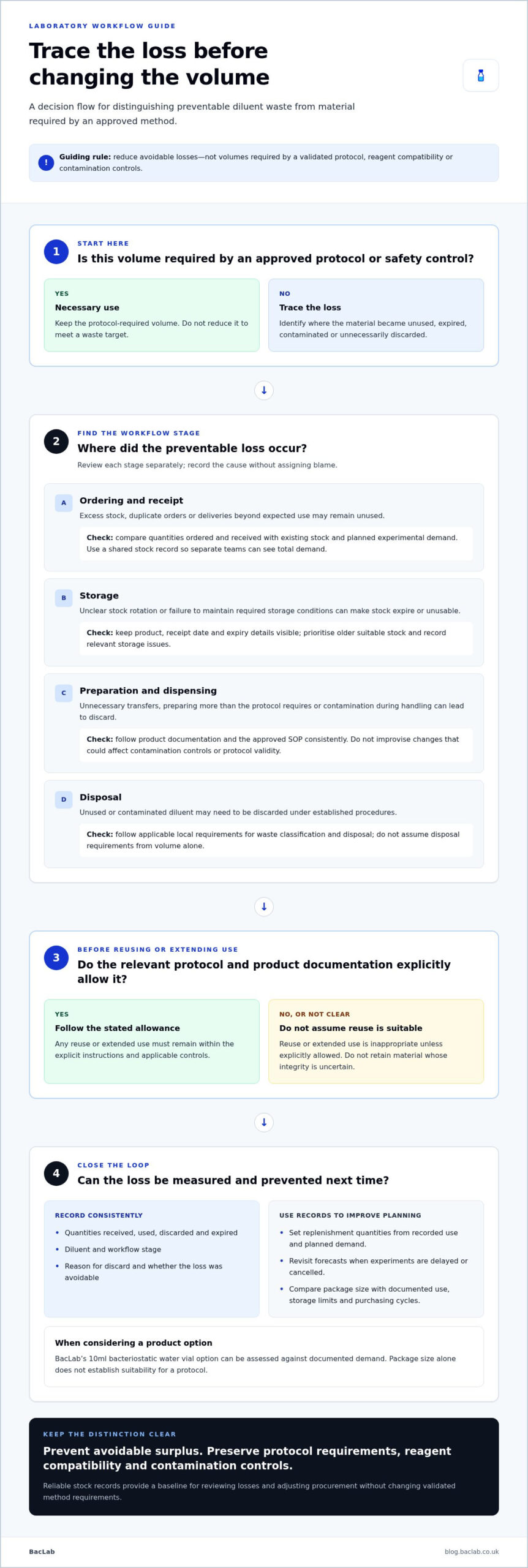
Preventable diluent waste is material that becomes unused, expired, contaminated or unnecessarily discarded because of avoidable purchasing, storage or handling decisions. It does not include diluent required by an approved protocol or safety control. This distinction is central to reducing diluent waste in laboratories: the aim is to find avoidable losses, not to cut volumes a validated method requires.
Waste can occur at every stage, from ordering more than expected use justifies to discarding material after preparation or dispensing. Review each loss by its cause and consider whether it can be prevented without changing protocol requirements, reagent compatibility or contamination controls.
Which stages of a diluent workflow create preventable waste?
Review ordering, receipt, storage, preparation, dispensing and disposal separately. This helps pinpoint when stock becomes unusable instead of attributing every discarded volume to laboratory technique.
- Ordering and receipt: Excess stock, duplicate orders or deliveries that exceed expected use can leave unopened material unused. Record quantities ordered and received, and note any discrepancy.
- Storage: Unclear stock rotation or failure to maintain required storage conditions can lead to expiry or unusable stock. Record the product, date and any relevant storage issue.
- Preparation and dispensing: Unnecessary transfers, preparing more than the protocol requires or contamination during handling can result in discard. Record the workflow stage and apparent cause without assigning blame.
- Disposal: Unused or contaminated diluent may need to be disposed of under the laboratory’s established procedures. Follow applicable local requirements for waste classification and disposal, rather than making assumptions based on volume alone.
For example, if an opened container is discarded after a planned task changes, the loss may point to a forecasting or scheduling issue. A volume required for a validated preparation, on the other hand, is necessary use, even if some remains afterwards.
How does diluent waste affect research operations?
Recorded losses can inform future procurement. Without reliable records, it is harder to estimate demand, which can contribute to repeated surplus or stock shortages. Waste also takes staff time to identify, segregate and dispose of, as well as manage through routine stock control. Environmental considerations matter, but claims about impact should be based on relevant local data rather than assumed savings.
A consistent record can include the diluent, quantity, workflow stage, reason for discard and whether the loss was avoidable. This gives the laboratory a baseline for review. When assessing procurement options, BacLab’s 10ml bacteriostatic water vial option can be considered against documented demand. Package size alone does not establish protocol suitability. The broader principles of green chemistry also support preventing waste at source, provided any material choice remains compatible with the approved laboratory method.
What causes avoidable diluent waste, and what prevents it?
Avoidable waste often begins before a vial is opened. Incomplete consumption records, separate teams ordering the same material or purchases that exceed planned use can leave stock unused until it expires. Storage deviations and unclear rotation practices create further risks, whilst inconsistent handling may lead to contamination and premature discard. Reducing diluent waste in laboratories therefore calls for coordinated planning across procurement, storage and use, not simply smaller orders.
How can inventory planning prevent expired diluents?
Use consumption records and planned experimental demand to set replenishment quantities. Check existing stock before ordering, and keep receipt dates and expiry details visible so older suitable stock can be prioritised. A larger package or consolidated delivery is not automatically more efficient: compare the quantity with documented use, storage limits and purchasing cycles before ordering.
Separate orders from researchers or teams can hide total demand. A shared stock record makes existing inventory and upcoming requirements easier to assess. Revisit forecasts when experiments are delayed or cancelled, and use actual consumption to adjust future orders rather than treating an earlier estimate as fixed.
How can handling reduce contamination-related discard?
Base handling controls on the product documentation and the laboratory’s approved standard operating procedure (SOP). Staff should follow those instructions consistently. Improvised changes intended to conserve material may introduce contamination risk or undermine protocol validity. For further guidance, see BacLab’s guide to vial handling and contamination.
Reuse or extended use is inappropriate unless the relevant protocol and product documentation explicitly allow it. If material is discarded following a handling concern, record the reason to help identify recurring process issues without assigning blame. The aim is to prevent avoidable contamination, not to retain material whose integrity is uncertain.
Demand planning limits surplus, suitable storage protects stock, and consistent handling helps preserve material integrity. These controls work together, but none overrides protocol-specific requirements. Where a protocol specifies bacteriostatic water, choose a vial quantity that supports actual use without assuming this diluent suits every method. If documented demand supports an individual unit, BacLab’s 10ml bacteriostatic water vial is one purchasing option to assess against the protocol and stock plan.
How should laboratories balance waste reduction with research integrity?
Waste reduction is appropriate only when it preserves the scientific conditions needed for valid, reproducible work. Prevention, reuse and substitution are different approaches, each subject to protocol requirements. Preventing surplus through better planning generally avoids changing experimental conditions, whereas using less diluent, reusing materials or choosing a different diluent may affect them. A reduction that compromises protocol validity, reagent compatibility or contamination control is not a sound waste-prevention measure.
Before adopting a change, determine whether it affects the approved method and identify the scientific approval, validation, documentation and review required by the laboratory. Reduced consumption is not a benefit if it changes a validated procedure without appropriate approval. This boundary is central to reducing diluent waste in laboratories whilst maintaining research integrity.
When is reducing a diluent volume scientifically acceptable?
Keep to the specified volume unless an approved protocol change supports an alternative. Depending on the method, using less can affect concentration, dissolution, transfer or downstream results. Before changing experimental conditions, establish what validation and documentation are required, including how results will be reviewed against the existing procedure. The diluent volume and concentration guidance can help explain the relationship between volume and concentration, but the approved protocol remains authoritative.
When can reuse or substitution increase risk?
Reusable equipment and reagent containers are not interchangeable categories. Equipment may be reused under documented cleaning procedures, whilst a container or material designated as single-use must not be reused unless the protocol explicitly permits it. Substituting a diluent may affect compatibility, concentration or reproducibility. Consider reuse or substitution only where suitability, cleaning and any necessary validation are documented and approved.
- Prevention: reduce surplus through demand planning without changing the method.
- Reuse: consider only when the protocol permits it and cleaning controls are established.
- Substitution: assess compatibility and validate the change before use.
These distinctions also matter when choosing package quantities. A smaller vial may help match purchasing to documented demand, but package size does not establish whether a diluent is suitable for a particular protocol. Where the approved method specifies bacteriostatic water, laboratories can consider BacLab’s 10ml bacteriostatic water vial as a procurement option, keeping product choice separate from scientific approval of its use.
How can a laboratory audit and reduce diluent waste step by step?
A structured audit shows where diluent is lost and whether a process change reduces waste without affecting research quality. To reduce diluent waste in laboratories, use a consistent measurement period and follow the same sequence: define the scope, establish a baseline, identify causes, test a controlled change and review the results.
- Define the scope. Specify which diluents, teams and workflow stages are included. Track diluent separately from packaging and other consumables so changes in one waste stream do not obscure another.
- Establish a baseline. Over a consistent period, record quantities received, used, discarded and expired. Reconcile stock carried into and out of the period where possible.
- Identify causes. Review records by product and workflow stage to distinguish expiry, contamination, surplus and other reasons for discard. Use the evidence to identify a process to examine rather than assuming the cause.
- Test a change. Make one controlled operational adjustment, such as improving stock visibility, without altering protocol requirements unless an approved change process permits it.
- Review and refine. Compare the same measures before and after the change. Retain it only if the evidence supports lower avoidable waste and continued scientific acceptability.
What should a diluent-waste audit record?
Use existing inventory or waste records if they capture the necessary detail. For each entry, record product identity, quantity, date, workflow stage and reason for disposal or expiry. Keep units consistent and separate packaging from liquid diluent. Protect confidential research information and follow the laboratory’s recordkeeping procedures. An audit needs enough operational context to interpret waste, not unnecessary experimental details.
A simple diluent waste rate is the quantity discarded or expired divided by the quantity received during the same period. It is an indicator, not a complete account, unless opening and closing stock and other inventory movements are also reconciled. Apply the measure consistently and state its limits when reporting results.
How should laboratories evaluate an improvement?
Compare equivalent periods using the same units and scope, then review waste alongside protocol compliance, contamination incidents and experimental consistency. A lower discard total alone does not demonstrate improvement if material integrity or result validity has been affected. Record the process change and relevant observations so later reviews can distinguish its effect from differences in demand or activity.
Once an audit identifies a suitable purchasing need, consider a 10ml bacteriostatic water vial if it matches the laboratory’s documented protocol and stock plan.
How can procurement and suitable diluent choices support lower waste?
Procurement can reduce avoidable surplus when order quantities reflect documented use, storage capacity and the laboratory’s purchasing cycle. First determine whether the product suits the approved method. Package size can inform how much to order, but it cannot establish chemical or protocol compatibility. Reducing diluent waste in laboratories means considering these decisions in that order.
How should laboratories select order quantities?
Estimate demand from planned work and recent consumption, then account for stock already held and the expected time before replenishment. Optimistic projections can leave excess material unused, whilst ordering too little may disrupt planned work. Consider expiry information, storage capacity and purchasing frequency together. Neither a larger order nor fewer deliveries is automatically more efficient.
Use the technical specifications for 10ml research vials as product information, alongside the laboratory’s protocol and inventory records. A 10ml vial format may suit a particular purchasing plan, but the appropriate quantity depends on documented demand and intended use.
How can supplier and product information support planning?
Review product information for details relevant to the laboratory application, then compare these with the approved protocol’s requirements. Assess suitability before considering package size or order consolidation. Bacteriostatic water is one laboratory-use option, not a universal diluent; suitability depends on the method and its requirements.
For example, if a protocol specifies bacteriostatic water and the laboratory’s records support purchasing in 10ml units, those vials may be considered as part of its inventory plan. If the protocol specifies another diluent, or compatibility is unclear, package convenience is not a reason to substitute. Keep the product decision, order quantity and scientific approval distinct in purchasing records.
Compare planned demand with recent use, current stock, storage limits and the next purchasing point. This helps determine whether individual units or a larger order better fits the laboratory’s actual cycle. Neither option is inherently less wasteful without that context. Product information supports the assessment, but protocol requirements remain decisive.
Make waste reduction a measurable part of laboratory practice
Reducing diluent waste in laboratories starts with finding where avoidable losses occur and using records to guide improvements. Reviewing procurement, storage, preparation, handling and disposal can show whether surplus stock, expiry or preventable contamination is contributing to waste.
Track quantities received, used, discarded and expired with consistent audit measures, and compare results before and after a controlled change. Better demand planning and stock rotation can prevent avoidable losses, but reduced volumes, reuse or substitutions must never compromise protocol validity, reagent compatibility or contamination controls. Keep approved procedures central to every decision.
Where a laboratory protocol specifies bacteriostatic water, BacLab supplies 10ml vials for individual purchase and wholesale customers in the UK. Matching order quantities to documented use can support clearer inventory planning, whilst product suitability remains protocol-dependent.
A measured approach helps laboratories prevent avoidable waste whilst protecting research quality and the integrity of their work.
Frequently Asked Questions
How can laboratories reduce diluent waste?
Improve demand planning, stock rotation and handling without changing validated protocol requirements. Review inventory and planned work before ordering, then record quantities received, used, discarded and expired to identify where losses occur. Store and handle each diluent according to its documentation and the laboratory’s procedures. Reducing diluent waste in laboratories means preventing avoidable surplus or discard, not using less material than a method requires.
Can reducing diluent volume affect experimental results?
Yes. Depending on the method, changing diluent volume may affect concentration, dissolution, compatibility or downstream results. Keep to the specified volume unless an approved protocol change supports an alternative. Before making a change, establish the scientific approval, validation, documentation and review required by the laboratory. A lower volume is not an improvement if it compromises reproducibility or changes a validated procedure without appropriate approval.
How should laboratories prevent diluents from expiring unused?
Use recent consumption and planned experimental demand to guide replenishment, and check current stock before ordering. Keep receipt and expiry details clear, rotate suitable stock in line with product instructions, and maintain required storage conditions. Review forecasts when planned work changes so future orders reflect actual requirements. Account for storage capacity and purchasing frequency rather than relying on optimistic estimates or package size alone.
Can leftover diluent be reused in another experiment?
Reuse leftover diluent only if the applicable protocol and product documentation explicitly permit it and its integrity can be maintained. Reuse may introduce contamination or compatibility concerns, and material opened or handled for one task may not be suitable for another. Follow the laboratory’s approved procedures for storage, handling and disposal. Do not extend use or transfer material between experiments simply to avoid discard.
Should a laboratory buy larger quantities of diluent to reduce packaging waste?
Not automatically. Compare expected use with expiry information, storage capacity and replenishment frequency before selecting an order quantity. Larger orders may leave excess stock unused, whilst smaller units may better match documented demand in some purchasing cycles. Assess product suitability against the protocol first: package size cannot establish that a diluent is compatible with a method. Consider packaging alongside material waste, not as the only measure.
How can a laboratory measure diluent waste?
Over a consistent period, record quantities received, used, discarded and expired, along with product identity and reason for disposal. A simple measure is the quantity discarded and expired divided by the quantity received during that period. Treat this as an indicator, not a complete inventory measure, unless opening and closing stock and other movements are reconciled. Keep diluent separate from packaging and other consumables, then compare equivalent periods when reviewing a process change.