
What does peptide reconstitution water UK have to do with CagriSema, and can general guidance about laboratory liquids be applied to it? The search terms often appear together online, but that doesn’t make a generic reconstitution guide appropriate for a specific investigational compound.
CagriSema combines semaglutide, a GLP-1 receptor agonist, with cagrilintide, a long-acting amylin analogue. As of October 2026, it isn’t an authorised medicine in the UK and remains investigational. Searches about water or diluents should therefore be read in that context, not as evidence of an approved product or a validated personal-use protocol.
This article explains what CagriSema is, why claims about bacteriostatic water and peptide preparation need careful interpretation, and how to check them against current, authoritative sources such as the MHRA and primary research records. It also separates general laboratory-reagent information from medical guidance. BacLab supplies bacteriostatic water for laboratory and research applications. Product information about the reagent describes its properties and supply, not a method for preparing or administering a medicine.
Key Takeaways
- “Peptide reconstitution water UK” is a search phrase, not evidence of a validated CagriSema preparation method.
- Assess compatibility claims against evidence for the exact compound and formulation. A preservative’s presence alone doesn’t establish suitability or stability.
- Compare water and other reagents by their stated composition and purpose, but don’t use general laboratory distinctions to select a reagent for CagriSema.
- Check a claim’s source, publication date, exact compound and context. Current MHRA information and official trial records are relevant for checking regulatory and research status.
- BacLab supplies bacteriostatic water for laboratory and research applications. Product information is about the reagent, not medical guidance or a CagriSema protocol.
CagriSema and reconstitution water in the UK: what the search terms mean
CagriSema is an investigational combination of semaglutide, a GLP-1 receptor agonist, and cagrilintide, a long-acting amylin analogue. Novo Nordisk’s clinical-development materials describe the combination, but development evidence is not the same as authorisation for treatment. As of October 2026, CagriSema is not a licensed medicine in the UK. Regulatory status can change, so check current Medicines and Healthcare products Regulatory Agency (MHRA) information for the latest position.
The phrase peptide reconstitution water UK describes a broad search interest, not a recognised product specification or validated CagriSema protocol. Search results may place information about a compound beside laboratory-reagent listings, but that proximity does not show that a particular reagent is compatible with the compound.
What is CagriSema?
CagriSema combines two distinct active compounds that act through different hormonal pathways. Its status as a treatment in clinical development should be kept separate from the status of an authorised medicine: trial information describes research, not a UK marketing authorisation or approved treatment instructions. For current development and regulatory claims, consult the manufacturer’s primary materials, official trial records and the MHRA rather than relying on a supplier listing or an undated summary.
What does peptide reconstitution water refer to?
In laboratory language, reconstitution is the process of bringing a dried material into solution using a liquid specified by the relevant research method. Reconstitution describes a laboratory process; it does not, by itself, specify a liquid, establish compatibility or provide instructions for administration.
“Water” is not a single interchangeable category. Reagents can differ in composition, preservatives and intended application. Those differences are relevant to research, but they cannot establish suitability for CagriSema. Bacteriostatic water contains a bacteriostatic agent, whereas other sterile liquids may have different formulations and uses. This is a descriptive distinction, not a recommendation. For background on the reagent itself, see what bacteriostatic water is.
BacLab supplies bacteriostatic water for laboratory and research applications. Its product information concerns the reagent, not CagriSema. A general description of laboratory water should not be read as a compound-specific preparation method or personal-use guidance.
Why generic peptide reconstitution guidance cannot establish CagriSema compatibility
A general peptide guide cannot establish which liquid is compatible with CagriSema. Compatibility depends on the specific compound and formulation, the purpose of the research, and a protocol validated for those conditions. Generic instructions may explain reagent terminology, but they cannot replace compound-specific evidence.
No generic water guide can validate a compound-specific protocol. A reagent’s listed properties describe that reagent; they don’t establish what happens when it is combined with a particular compound. General examples of volume or concentration do not demonstrate a CagriSema requirement either.
Why reagent properties matter
Sterility, preservative content and formulation are separate attributes, not interchangeable assurances. Sterility concerns the reagent’s microbial state; a preservative is a component with a particular function; formulation describes the material’s composition. None of these attributes, on its own, proves compatibility, stability or safety in a mixture with a named compound.
For example, knowing that a liquid contains a preservative doesn’t show that a compound remains stable in it or that the combination is appropriate for a given research purpose. The Sterile water for injection SmPC sets out information for that specific product and its stated context. It is not a universal protocol for research compounds. A broader comparison of bacteriostatic water versus sterile water can clarify how the reagent categories differ without selecting one for CagriSema.
Why product claims do not transfer between compounds
A vial’s label or technical description applies to the reagent as supplied. It cannot establish the stability or behaviour of every possible mixture, and a statement about use with one material does not automatically apply to another. Likewise, storage or post-opening information for a reagent is not evidence of a compound’s stability after mixing.
For searches such as peptide reconstitution water UK, check whether a claim cites a primary source that names the exact compound and formulation, describes the relevant research conditions, and supports the conclusion being made. If it only describes a general laboratory reagent or another peptide, it doesn’t validate a CagriSema method. An online example is not a substitute for validated documentation.
BacLab supplies bacteriostatic water for laboratory and research applications. For professional research contexts where reagent information is relevant, see the 10 ml bacteriostatic-water vial. The product information describes the reagent and is not a CagriSema protocol or a recommendation for personal use.
Bacteriostatic water, sterile water and other reagents: how to compare their roles
These liquid categories differ in composition and intended application, but comparing their general properties cannot identify a suitable reagent for CagriSema. The distinction is descriptive: it helps interpret product information, not select a liquid or establish compatibility with a specific compound.
How bacteriostatic and sterile water differ
Bacteriostatic water is sterile water containing a preservative, commonly benzyl alcohol. Sterilised Water for Injections is a UK licensed medicinal product supplied without a preservative; its product information specifies its own medical context. Other laboratory reagents may have different compositions and specifications. These descriptions should not be treated as interchangeable or as evidence that a reagent is appropriate for every research mixture.
| Reagent category | Composition and preservative status | Broad distinction |
|---|---|---|
| Bacteriostatic water | Sterile water with a preservative, commonly benzyl alcohol | A preservative distinguishes it from preservative-free sterile water; this alone does not establish compound compatibility. |
| Sterilised Water for Injections | Sterile water without a preservative | A licensed medicinal product with defined product information and application; this does not make it a universal research reagent. |
| Other laboratory reagents | Composition and additives vary by product | Specifications and intended applications are product-specific and must be interpreted in the relevant research context. |
The presence or absence of a preservative does not prove a mixture’s stability, suitability or safety. Nor does describing a liquid as sterile establish that it is appropriate for a particular compound. For a closer explanation of the category differences, see this technical comparison of bacteriostatic water and sterile water in research.
When a research protocol must specify a reagent
A research protocol should identify the materials and conditions relevant to the work, including the specified reagent where applicable. Look for documentation that names the exact compound and formulation, rather than relying on a retailer summary or search-result snippet that may omit qualifications. A general statement about “peptide reconstitution water UK” is not a substitute for compound-specific primary documentation.
If a validated protocol specifies a particular reagent, a general comparison cannot justify replacing it with another. The table above explains broad distinctions only; it cannot select a reagent for CagriSema or validate a preparation method. Laboratory and research descriptions should also remain distinct from information about licensed medical products and their authorised applications.
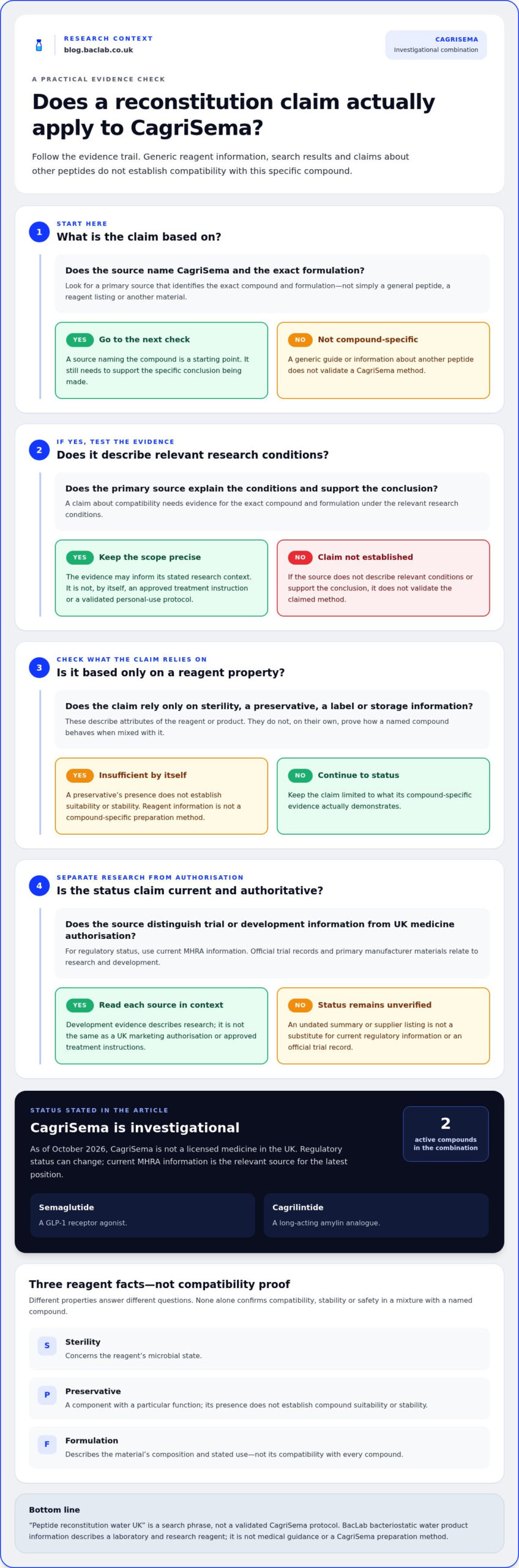
How to assess CagriSema information and reconstitution claims in the UK
Before relying on a claim about CagriSema or peptide reconstitution water UK, check four things: the source’s authority, its publication or update date, whether it names the exact compound and formulation, and whether it concerns clinical use or laboratory research. These checks help distinguish evidence about a named product from broad reagent descriptions and commercial statements.
- Authority: Is the claim supported by a regulator, official trial registry, primary publication or product documentation, or does it come only from a retailer or discussion forum?
- Date: Is the information current? Regulatory status and development records can change, so check them immediately before publication or relying on a status statement.
- Exact compound: Does the source identify CagriSema and the relevant formulation, or does it generalise from another peptide?
- Context: Is the information about clinical authorisation, a clinical trial or laboratory research? These categories are not interchangeable.
Which sources can establish UK status?
For claims about UK authorisation, consult current MHRA information and confirm that it refers to the precise product and indication in question. A clinical trial entry shows that a study is registered; it does not, by itself, establish marketing authorisation or routine availability. Check trial details against the relevant official registry record or primary publication. A retailer listing, social-media post or online discussion cannot establish UK approval, even if it uses medical terminology.
How to recognise unsupported reconstitution claims
Universal wording such as “works for every peptide” should prompt scrutiny, not confidence. Look for a source protocol that identifies the exact compound and formulation and provides evidence relevant to the claim. If a page discusses a reagent generally or draws conclusions from a different peptide, it hasn’t demonstrated CagriSema-specific compatibility. Reagent-handling guidance can explain laboratory context, but it cannot replace compound-specific validation; see this overview of laboratory handling protocols for that limited purpose.
This section is a source-evaluation framework, not a preparation guide. It does not provide mixing volumes, dose calculations, injection instructions or storage timelines. Those details should not be inferred from general search results or reagent descriptions. BacLab supplies bacteriostatic water for laboratory and research applications; that supply information is separate from medical guidance and does not establish its suitability for CagriSema.
BacLab bacteriostatic water: research-supply scope and responsible next steps
BacLab supplies bacteriostatic water for laboratory and research applications, including 10 ml vials. These are laboratory reagents, and their product information describes the reagent rather than CagriSema. Supply of a reagent does not establish compatibility with a particular compound or suitability for a CagriSema procedure or human administration. This distinction matters when searches for peptide reconstitution water UK bring research reagents and investigational compounds together.
What BacLab supplies, and what it does not
BacLab supplies 10 ml bacteriostatic-water vials as research reagents, with individual purchase and wholesale options. Product information describes the reagent itself; it should not be interpreted as a preparation protocol, a recommendation for a specific compound or guidance for personal use. A product’s stated properties cannot establish compatibility with a separate substance.
Responsible next steps for readers
For questions about treatment, medicines or personal health, consult an appropriately qualified healthcare professional. For laboratory research, follow the applicable study protocol and relevant institutional oversight. If a protocol or source document is unclear, general descriptions of water or preservatives cannot resolve compound-specific questions. Keep clinical guidance, regulatory information and laboratory-reagent descriptions distinct.
This separation also helps readers interpret online claims: a reagent listing can describe what is supplied, but it cannot prove that the reagent is appropriate for CagriSema. The same applies to general information about peptide reconstitution. Neither search rankings nor retailer summaries replace a validated research protocol or current official information.
For laboratory and research supply details, view BacLab’s 10 ml bacteriostatic water.
Use compound-specific evidence to guide your next steps
The key distinction is that peptide reconstitution water UK is a broad search phrase, not a validated CagriSema protocol. General descriptions of bacteriostatic or sterile water explain reagent properties; they don’t establish compatibility with a particular compound. For claims about CagriSema’s development or UK authorisation, consult current MHRA information and official trial records, and distinguish laboratory research from medical guidance.
BacLab is a UK-based specialist supplier of bacteriostatic water for laboratory and research applications. Its 10 ml vials are available for individual purchase and wholesale supply. Product information describes the reagent and should not be taken as a recommendation for a CagriSema procedure or personal use.
For clinical questions, seek advice from an appropriately qualified healthcare professional. For research, rely on the applicable study protocol and relevant institutional oversight. Keeping those boundaries clear helps ensure reagent information is interpreted in its proper context.
Careful source-checking is a sound next step whenever compound-specific evidence and general reagent information appear together.
Frequently Asked Questions
Is CagriSema authorised for use in the UK?
No. As of October 2026, CagriSema is not authorised as a medicine in the UK and remains investigational. Regulatory status can change, so check current Medicines and Healthcare products Regulatory Agency (MHRA) information before relying on this statement. A clinical trial record or report of research activity does not by itself establish marketing authorisation, prescribing status or routine availability in the UK.
Can bacteriostatic water be used to reconstitute CagriSema?
General information about bacteriostatic water cannot establish that it is compatible with CagriSema. Compatibility depends on evidence and a validated protocol for the exact compound and formulation; the preservative alone does not demonstrate suitability, stability or safety. The search phrase “peptide reconstitution water UK” is not a CagriSema-specific protocol. This article does not provide instructions for preparing or administering CagriSema.
What is the difference between bacteriostatic water and sterile water?
Bacteriostatic water is sterile water containing a preservative, commonly benzyl alcohol at 0.9% in the standard formulation. Sterilised Water for Injections is preservative-free and is a licensed UK medicinal product with its own product information and intended application. These are descriptive differences, not a recommendation for a particular compound. Neither the presence nor absence of a preservative proves compatibility with CagriSema or another peptide.
Does peptide reconstitution water determine the final concentration?
The amount of liquid affects the concentration of a known quantity of dissolved material: more liquid generally produces a lower concentration, and less liquid a higher one, assuming the material fully dissolves and no other factors alter the final volume. This general principle is not a preparation instruction. The correct quantities and resulting concentration cannot be inferred from generic search results; they depend on the exact substance and a validated protocol.
Is BacLab bacteriostatic water a CagriSema product?
BacLab supplies bacteriostatic water for laboratory and research applications, including 10 ml vials. The product is a laboratory reagent, and its product information describes the reagent itself rather than a CagriSema product or protocol recommendation. Supply for research applications does not establish that it is suitable for a specific compound or for human administration.
Where should I check research or regulatory information about CagriSema in the UK?
For UK authorisation claims, consult current MHRA information and check that it refers to the precise product and indication. For trial details, use an official study registry or the primary publication, and distinguish trial participation from medicine authorisation. Check publication and update dates, since regulatory status and research records can change. Retailer listings, social-media posts and search snippets cannot establish UK regulatory status or validate a reconstitution claim.