
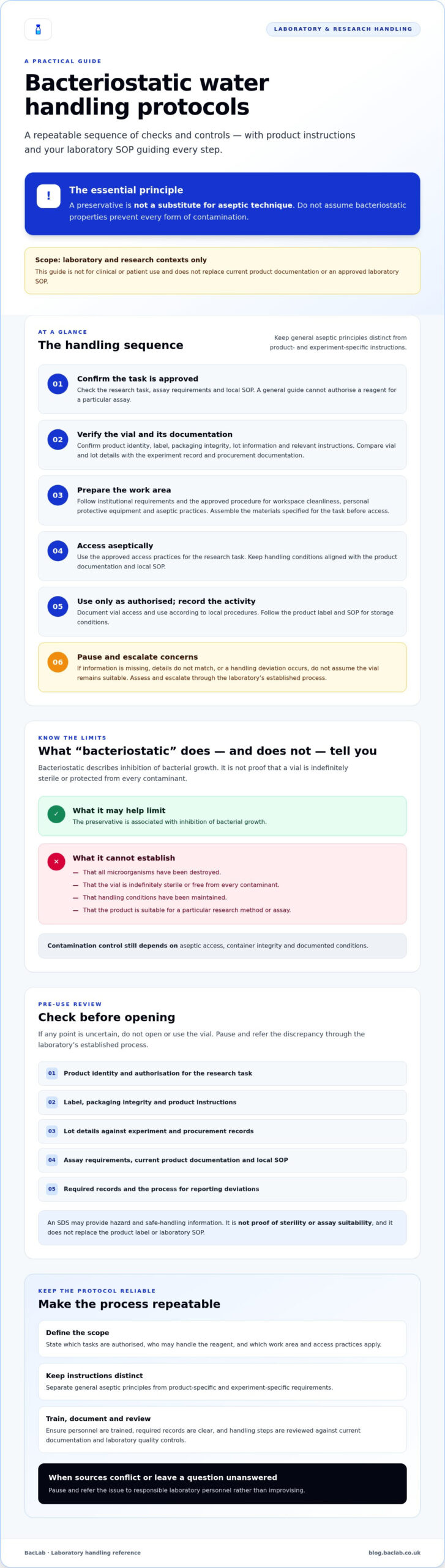
A preservative is not a substitute for aseptic technique. Reliable bacteriostatic water handling protocols depend on controlled access, product-specific instructions and clear records, not on an assumption that bacteriostatic properties prevent every form of contamination. When you are unsure which precautions apply, start with the vial label and your laboratory’s standard operating procedure (SOP).
This guide sets out a practical handling sequence for laboratory and research contexts. It separates general aseptic principles from requirements that depend on the specific product, and explains what a preservative may help limit and what it cannot establish about sterility, contamination or suitability for an assay. It does not replace current product documentation or an approved laboratory SOP.
The sections below cover preparation, vial access, documentation and how to respond to deviations. They also explain when to stop work and escalate a concern rather than assume a vial remains suitable. The aim is a repeatable process that protects research integrity while keeping product-label instructions and general handling guidance distinct.
Key Takeaways
- Use bacteriostatic water handling protocols as a documented sequence of controls for research work, not as a substitute for a laboratory SOP.
- Before use, confirm the product identity, label, packaging integrity, lot information and relevant documentation.
- Follow a consistent sequence: confirm the approved task, prepare the workspace, access the vial aseptically, use it only as authorised and record the activity.
- Document vial access and deviations according to local procedures. Assess concerns and escalate them rather than assuming the preservative resolves them.
- Review handling steps against current product documentation, the research task, staff training and laboratory quality controls.
Bacteriostatic water handling protocols: purpose, scope and limits
A handling protocol is a documented sequence of controls intended to protect reagent integrity during receipt, storage and use. In laboratory practice, bacteriostatic water handling protocols should define how a vial is checked, accessed and recorded for an approved research task. They should not rely on assumptions about the product’s preservative.
This guide covers laboratory and research handling only. It is not guidance for clinical or patient use. Before work begins, consult the current vial label, supplier documentation, assay requirements and local SOP. If these sources differ or leave a question unanswered, pause and refer it to the laboratory’s responsible personnel rather than improvising.
What a bacteriostatic water handling protocol should cover
A useful protocol states its scope, the tasks for which the reagent is authorised, who may handle it, and which work area and access practices apply. It should also identify required records and explain how to report deviations. For example, an assay-specific instruction may set conditions that a general laboratory handling document does not cover.
Keep general aseptic principles separate from product-specific and experiment-specific instructions. The laboratory is responsible for approving its protocol and ensuring personnel are trained to follow it. A general guide cannot authorise a reagent for a particular assay.
What the preservative does not establish
“Bacteriostatic” describes inhibition of bacterial growth, not the destruction of all microorganisms. The general meaning of a bacteriostatic agent should not be interpreted as proof that a vial is indefinitely sterile or protected from every contaminant. The presence of a preservative does not confirm that handling conditions have been maintained or that a product suits a particular research method.
Contamination control still depends on aseptic access, container integrity and documented conditions. Damage, an uncertain access history or a handling deviation may require assessment under the local SOP. Do not infer acceptability from the preservative. For background on the substance and its composition, see the guide to the definition and composition of bacteriostatic water. Use current product documentation for product-specific limits.
Before handling bacteriostatic water: check the vial, workspace and records
Start by confirming the product identity and the approved procedure for the research task. A pre-use check should establish that the vial is authorised for the work, its condition meets local criteria and the necessary instructions are available. If any point is uncertain, do not open or use the vial. Pause and escalate the discrepancy through the laboratory’s established process.
Review product documentation before opening
Compare the vial name and lot details with the experiment record and procurement documentation. Check the label, packaging integrity and supplied product instructions, including product-specific handling and storage conditions. Record any mismatch for review rather than assuming that similar-looking products or lots are interchangeable.
A safety data sheet (SDS) can provide information relevant to hazards and safe handling, but it is not proof of sterility or assay suitability, and it does not replace the product label or laboratory SOP. The FDA guidance on sterile lyophilized products discusses sterility considerations in a specific manufacturing context. It is not a ready-to-adopt research handling procedure.
Prepare the work area and required materials
Prepare the work area in accordance with institutional requirements and the approved procedure. Workspace cleanliness, personal protective equipment and aseptic practices should be determined by local risk assessment and SOP. A generic checklist cannot assume that identical controls suit every laboratory or task.
Before accessing the vial, assemble the materials specified for the approved research procedure. This limits interruptions and helps ensure the work can be completed under the conditions documented by the laboratory. Do not introduce extra equipment or environmental thresholds without an applicable procedural basis.
Pre-use checklist
- Confirm the product identity against the authorised task and experiment record.
- Check the label, lot identification, packaging condition and relevant product documentation.
- Verify that the local SOP and assay requirements are current and available.
- Prepare the work area and required materials according to local instructions.
- Stop and escalate if identity, integrity, labelling or documentation is unclear.
For purchasing reference, BacLab lists a 10 ml bacteriostatic water vial. The current label and supplied documentation remain the basis for product-specific decisions. Once these pre-use checks are complete, follow the approved access sequence and document what happens during use.
How to handle a bacteriostatic water vial during laboratory work
Use a controlled sequence: confirm the vial and task, prepare the approved materials, access the container aseptically, use it only for the authorised research procedure, then document the activity. The laboratory SOP determines the exact materials, technique and task-specific requirements. The principles below are not a universal method for accessing a vial.
Aseptic access and contamination control
Aseptic technique aims to reduce the opportunity for contamination during access and use. Follow the method specified in the laboratory SOP, and prevent critical surfaces from contacting hands, benches or materials that are not sterile. Do not substitute a remembered technique for the approved procedure. Access requirements may depend on the container, the work and the laboratory’s controls.
A preservative does not correct contamination introduced during access. If the closure or container is damaged, the access point has been compromised, or the work area no longer meets the procedure’s requirements, stop before proceeding. Keep the vial out of use and seek assessment through the local deviation process.
Use only within the approved research procedure
Before use, confirm that the intended research application is compatible with current product documentation and the approved experiment. Experiment-specific preparation belongs in the validated protocol and should be carried out by personnel trained and authorised for that work. This guide does not provide injection instructions or medicine-reconstitution steps.
Container condition remains part of the assessment. An intact label alone does not establish that handling has been appropriate. For related background, consult guidance on sterile water multi-dose vial requirements, while relying on the product’s own documentation and local SOP to make decisions about the vial in use.
Working sequence
- Confirm: Match the vial to the approved research task and check that no concern has emerged since the pre-use review.
- Prepare: Arrange the materials and work area specified by the SOP before accessing the container.
- Access aseptically: Follow the approved technique and protect critical surfaces from contact with non-sterile items.
- Use: Keep use within the authorised procedure. Do not infer suitability for another assay or task.
- Document: Record the activity and any deviation as required by local procedure.
Pause whenever the closure, container or working conditions are compromised or uncertain. Do not attempt to resolve the issue by relying on the preservative. Isolate the concern and refer it to the responsible laboratory personnel. Applying bacteriostatic water handling protocols consistently means following the approved sequence and recording exceptions, not improvising a replacement for it.
After access: record vial use, assess deviations and follow storage instructions
After accessing a vial, make the required record promptly and follow the storage conditions and any use limits stated in current product documentation and the laboratory SOP. There is no universal post-access period or discard deadline that can safely be applied to every product and research setting. If the applicable instructions are missing or unclear, pause use and ask the responsible laboratory personnel to resolve the uncertainty.
Document access and maintain traceability
Use the controlled procedure to identify mandatory record fields and any additional information your laboratory collects. Required fields may include product identity, lot number, access date and operator. Depending on local requirements, the record may also include the research task, storage conditions, later access events or a deviation reference.
Lot traceability connects the vial used in an experiment with its product documentation and procurement record. Enter information in the designated record system, and document deviations where the SOP requires it. Record-keeping and retention requirements are laboratory-specific, so do not assume a universal retention period.
Respond to suspected contamination or compromised integrity
Stop using the vial if its container or closure appears compromised, its access history is uncertain, or handling or storage may have departed from documented conditions. Follow the laboratory’s deviation, quarantine and reporting process. Consult the responsible supervisor and current supplier documentation before any decision about further use. Appearance alone cannot establish that a vial is suitable or rule out contamination.
Record the concern and relevant circumstances according to local procedure. If the controlled process calls for it, note when the discrepancy was identified and which records or handling conditions may be affected. Do not return a questioned vial to routine use unless it has been assessed and dispositioned through the laboratory’s approved process.
For additional context, consult this guide to bacteriostatic water storage and shelf life, then verify the applicable limits against the vial’s current label and supplied documentation. Consistent bacteriostatic water handling protocols depend on traceable records and documented decisions, not assumptions based on elapsed time or visual inspection.
Build a repeatable bacteriostatic water handling protocol for your laboratory
A repeatable procedure translates general handling principles into controls that fit the product, research task and laboratory quality system. Bacteriostatic water handling protocols are local, controlled documents, not universal instructions to adopt unchanged. Each step should have a clear source, a responsible person and a defined response when requirements are not met.
Turn general principles into a controlled local SOP
Assign responsibility for writing, approving, training personnel on and reviewing the procedure. Map each stage to its governing information: product checks to current supplier documentation, intended use to the approved research method, access practices to trained personnel, and records or deviations to local quality controls. Include clear pause points for damaged packaging, uncertain identity or suspected procedural deviation.
Before approval, compare the draft with current product information and laboratory requirements. Review it when the product, assay, equipment or institutional procedure changes, and document that review through the laboratory’s controlled process. This keeps revisions traceable and helps prevent outdated instructions from being treated as current practice.
Select research supplies using documentation, not assumptions
Before procurement, compare the product details available from the supplier with the documented requirements of the research method. The product category alone does not establish compatibility with an assay, expected performance or a storage duration. If essential information is absent or unclear, refer the question to the responsible laboratory personnel and resolve it before introducing the material into the work.
A concise review sequence can help maintain consistency:
- Confirm the research task and its approved procedure.
- Check product documentation against the method’s stated requirements.
- Assign trained personnel and identify the applicable local controls.
- Define records, stop points and deviation escalation routes.
- Review the procedure after relevant product or laboratory changes.
This sequence supports protocol development. It is not a ready-to-adopt SOP and does not determine whether a particular vial is suitable for a particular experiment. BacLab’s 10 ml vial page provides product information to review alongside the current documentation and approved research protocol.
Make your laboratory handling process repeatable
Reliable bacteriostatic water handling protocols are built around the approved research task, current product documentation and a controlled local procedure. Before access, verify the vial and its records. During work, follow trained aseptic practices and pause if the container or conditions are compromised. After use, document access and deviations, and follow product-specific storage instructions and the local SOP rather than applying a universal discard period.
Review the procedure when product information, the assay, equipment or institutional requirements change. Clear responsibilities for approval, training and escalation help make decisions traceable and ensure uncertainty is addressed before work proceeds.
BacLab is a UK-based supplier focused on laboratory and research applications. Its 10 ml bacteriostatic water vial is available as a product-information reference, but suitability must be assessed against current documentation and your approved protocol.
A consistent, carefully reviewed process gives your team a practical foundation for protecting research integrity.
Frequently Asked Questions
Is bacteriostatic water sterile after a vial has been opened?
Not necessarily. The term “bacteriostatic” and the presence of a preservative do not guarantee that a vial remains sterile after access. Contamination control depends on container integrity, aseptic handling and compliance with current product instructions and the laboratory SOP. Do not use appearance as evidence of sterility or apply a universal safe-use period. Follow the product-specific limits and your laboratory’s controlled procedure for the task.
Can bacteriostatic water be used for every laboratory protocol?
No. Suitability depends on the research experiment, reagent compatibility, product documentation and approved method. The product category alone cannot establish assay compatibility or confirm that it meets a task’s requirements. Bacteriostatic water handling protocols should refer to the specific product and procedure rather than assume one vial suits all work. If requirements are unclear, consult the protocol owner or laboratory supervisor before use.
How should a laboratory prepare before accessing a bacteriostatic water vial?
First, confirm the product identity and lot against the approved research task. Review the vial label and applicable supplier documentation, then prepare the workspace and required materials in accordance with the local SOP. The person accessing the vial should be trained for the procedure. Do not open the vial if packaging is damaged, identity is uncertain or documentation questions remain unresolved. Refer the concern through the laboratory’s established process.
What should be recorded when a bacteriostatic water vial is accessed?
Follow the laboratory’s controlled procedure, which may require the product identity, lot, access date, operator and any relevant deviation to be recorded. These details can support traceability between the vial, research task and associated documentation. Required fields and record-retention periods vary by organisation, so do not treat an example list as a UK-wide legal requirement. Use the designated record system and escalate missing or inconsistent information as directed locally.
Does the preservative prevent contamination during vial handling?
No. A bacteriostatic property must not be treated as sterilisation or as a substitute for aseptic technique. Contamination may be introduced during handling, so follow current product instructions and laboratory procedures for access and use. The preservative does not establish that a vial remains uncontaminated or is suitable for research. If there is uncertainty, pause and use the laboratory’s assessment and escalation process rather than relying on the preservative.
What should happen if a vial or its contents may be compromised?
Pause use and follow the laboratory’s deviation, quarantine and reporting procedure. Record the concern and relevant circumstances as required locally, then refer the matter to the responsible supervisor and consult current supplier documentation. Do not decide that a vial is suitable or unsuitable from visual inspection alone. Further use or disposition should be determined through the laboratory’s approved review process, not by applying a universal discard interval.