
Can an SDS tell you whether a bacteriostatic water vial is safe for a particular use? Not by itself. Bacteriostatic water safety data describes hazards associated with a specific product and provides information on handling, storage and emergency response. It does not, on its own, establish sterility, product quality or suitability for a procedure.
It’s understandable to look to the safety data sheet for a definitive answer, especially when hazard classifications and product claims appear side by side. The key is to distinguish what the document supports from what requires separate evidence. A bacteriostatic claim, for example, should not be treated as proof of sterility or a guarantee of overall safety.
This article explains how to assess relevant SDS sections, including hazard identification, composition, handling and exposure controls. It also shows how to check that the document is current and applies to the exact product and vial. Knowing what to verify with the supplier or your institutional safety lead can help you distinguish documented hazards from quality, sterility and use claims that an SDS may not establish.
Key Takeaways
- Bacteriostatic water safety data describes hazards and precautions for an identified product. It is not a substitute for a certificate of analysis or sterility evidence.
- Prioritise the SDS sections on product identification, hazards, composition, first aid, and handling and storage.
- Check that the product name, supplier, formulation and SDS revision match the vial label and procurement records.
- Assess hazard classification, batch testing, sterility evidence and method compatibility as separate questions.
- If product-specific details are unclear, verify them with the supplier or your institutional safety lead before relying on the document.
Bacteriostatic water safety data: what an SDS can and cannot tell you
A Safety Data Sheet (SDS) communicates hazards, precautions and emergency information for an identified product. Bacteriostatic water safety data can help you understand how the documented product should be handled in a workplace. An SDS is not a complete experimental protocol or a blanket declaration that every handling method or application is safe.
The document is relevant only if it matches the product in hand. Check the product identity, formulation, supplier and SDS revision, and consider whether its stated scope fits the workplace context. If any details differ from the vial label or procurement record, don’t assume the SDS applies. Confirm product-specific ingredients and hazard classifications against the current document for that product.
What does bacteriostatic water safety data cover?
An SDS is a hazard-communication resource. It may help you assess handling precautions and emergency responses, but it does not set out every step of an experiment or establish that a particular research method is appropriate. For background on the terminology, see bacteriostatic versus sterile water. Check the relevant product-specific SDS for exact composition and classifications rather than inferring them from the general product name.
SDS, quality data and sterility evidence are not interchangeable
Different documents answer different questions. An SDS communicates hazards and precautions. A certificate of analysis reports specified analytical results for a product or batch, while sterility evidence concerns microbiological status under the stated test or process. Research-method validation addresses whether a method performs as intended under defined conditions. None of these documents automatically substitutes for the others.
The term bacteriostatic describes inhibition of bacterial growth, not proof that a product is sterile or suitable for every application. A bacteriostatic agent can inhibit bacterial proliferation, but that description alone does not establish product purity, sterility or compatibility with a research method. These are separate claims that require evidence relevant to the product, batch and intended context. For more on the terminology, read what bacteriostatic water means alongside the exact product documentation.
Read the SDS as one part of a wider evidence set. If you need to establish a product’s composition, microbiological status or suitability for a defined method, identify which evidence addresses that question and verify it with the supplier or your institutional safety lead. An SDS can inform a risk assessment, but it cannot certify every use as safe.
How to read bacteriostatic water SDS sections that matter
Read an SDS in its numbered sequence, but first check its revision date, supplier and stated jurisdiction. The familiar 16-section format is a useful navigation framework. It does not mean every document applies to UK workplace requirements. OSHA’s How to Read a Safety Data Sheet explains that sequence, but use it as a reading aid, not as evidence that a US document is automatically appropriate for your workplace.
For bacteriostatic water safety data, prioritise the sections that identify the product, describe its hazards and composition, and set out first-aid and handling precautions. Later sections, including exposure controls, physical properties, stability and disposal, may also matter depending on the product and task. Read the entries in the document rather than assuming they are the same across products.
Identification, hazards and composition
Start with the product identifier and supplier details. Compare them with the vial label and order record, then check any recommended use or restrictions in the SDS. In the hazard section, rely on the classification and precautionary statements in the current SDS that matches the product. Apply the same rule to composition: don’t infer a preservative or its concentration from a familiar product name. Confirm the ingredients in the document, and consult this reference on multi-dose sterile water with 0.9% benzyl alcohol for context on how formulation and preservation are distinct considerations.
First aid, handling, storage and disposal
Use the first-aid and handling sections to identify precautions relevant to your workplace. Follow the source document rather than paraphrasing it into a substitute procedure. Check storage instructions against the product label and applicable workplace controls. For more context on storage and dating, see bacteriostatic water storage and shelf life. Read disposal directions alongside local procedures and institutional requirements.
Record uncertainties rather than filling gaps with assumptions. Refer a blank field, illegible scan, conflicting product name or unclear revision date to the supplier or institutional safety lead. Check that answers relate to the exact vial and document, not simply to bacteriostatic water as a general category.
If you’re assessing a laboratory or research supply, BacLab lists a 10 ml bacteriostatic water vial. Confirm whether current product-specific safety documentation is available and matches the vial before relying on it. View the 10 ml vial details.
Does bacteriostatic water safety data prove a vial is safe to use?
No. An SDS helps identify hazards and precautions, but bacteriostatic activity does not establish that a vial is sterile or safe for every application. The term describes inhibition of bacterial growth; it does not, by itself, confirm microbiological quality, product purity or compatibility with a particular method.
Safety is assessed against the exact product, exposure route and task. Bacteriostatic water safety data is one part of that assessment, not a universal approval. The evidence needed depends on the question. Findings for one batch, formulation or research method should not automatically be applied to another.
Hazard classification is not a sterility certificate
An SDS hazard classification communicates identified hazards and relevant precautions. It does not report whether a product is sterile. Nor does the absence of a stated hazard classification prove sterility or the absence of contamination. For background on how hazard information is arranged, the Occupational Safety and Health Administration’s How to read a Safety Data Sheet describes the SDS format. Its guidance does not replace product-specific evidence or UK workplace review.
Claims about sterility or contamination control need separate supporting evidence relevant to the product and, where applicable, the batch and process. Check what was tested, which sample or batch the result covers, and what the stated test can establish. Don’t assign a hazard class from general product descriptions. Use only the classification in the current SDS that matches the exact product.
Product safety data does not validate every research method
Different evidence answers different questions. An SDS addresses hazards and precautions. Batch testing reports specified characteristics of a sampled batch, sterility evidence concerns microbiological status under the stated test or process, and method validation assesses performance under defined conditions. One cannot stand in for another. For example, a test result for one batch does not automatically establish the characteristics of later batches.
Method compatibility is context-dependent. Materials, experimental conditions and the relevant institutional protocol may affect whether a product is appropriate for a defined research method. The SDS may inform hazard controls, but it does not validate the method or provide a complete protocol. Check uncertainties against current product documentation and the applicable institutional review process. Don’t infer suitability from the product name alone.
BacLab supplies bacteriostatic water as a laboratory and research product. It does not provide medical advice, and product documentation should not be interpreted as approval for human or veterinary use.
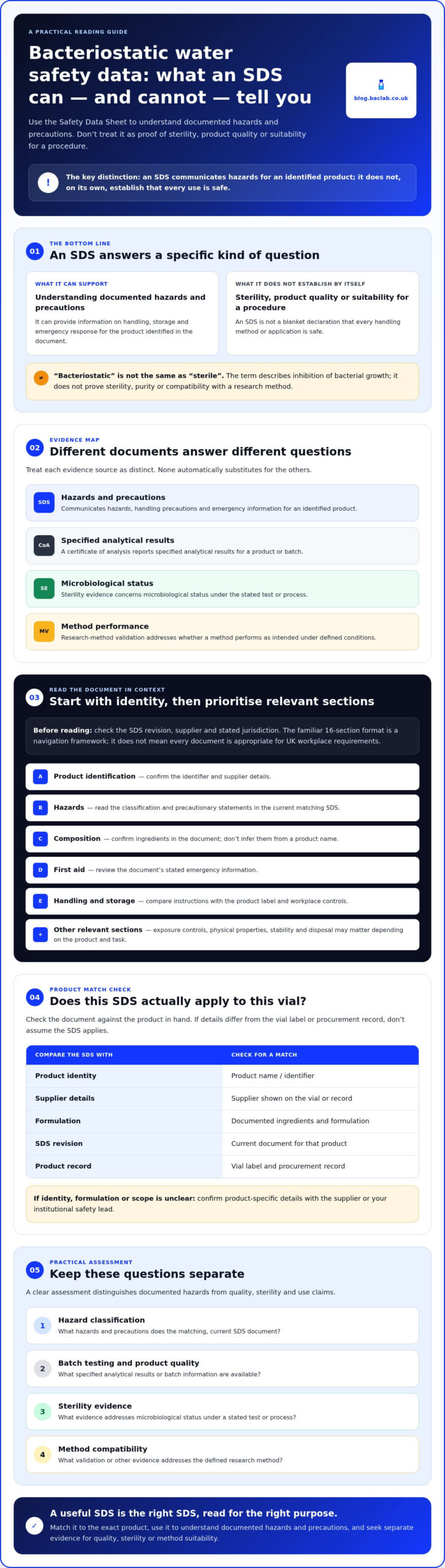
A practical checklist for evaluating a bacteriostatic water SDS
Use a consistent review sequence before relying on bacteriostatic water safety data. The aim is to establish whether the document matches the vial and workplace, and to identify gaps for review, not to fill missing information with assumptions.
- Confirm product identity. Compare the SDS product name or identifier with the vial label and procurement record. A generic description, similar name or different pack size may not establish that it covers the exact product.
- Check the supplier. Ensure the supplier details in the document align with the supplier shown on the order or product information. If they differ, ask whether the SDS applies to the supplied item.
- Verify formulation and intended use. Check the stated composition, recommended use and any restrictions. Don’t infer ingredients or concentrations from the product category.
- Review the revision date. Record the SDS version and check whether it is current for the product. Clarify an undated or older copy before using it in a workplace assessment.
- Check key sections together. Review hazard, first-aid, exposure-control and storage information. Consider whether the statements are consistent with one another and relevant to the task.
Match the SDS to the exact vial and jurisdiction
Confirm that the document covers the specific product and formulation, not a related product or broad category. Check which UK jurisdiction applies: Great Britain or Northern Ireland. Regulatory wording may depend on that context, so verify it before summarising requirements. For current workplace obligations, consult relevant HSE guidance or a qualified safety professional. Don’t treat an SDS from another jurisdiction as confirmation of UK compliance.
Record limitations and escalate unresolved questions
Keep the document version, the date it was accessed and any discrepancy in your organisation’s record-keeping process. If the SDS is unavailable, appears outdated, or conflicts with the vial label or procurement record, request clarification from the supplier or institutional safety lead. Don’t infer a hazard classification, ingredient or precaution from a blank or unclear field.
For storage conditions and shelf-life context, consult the dedicated guide to bacteriostatic water storage and shelf life, while checking product-specific directions separately. When reviewing how precautions translate into practice, the bacteriostatic water handling protocols laboratory guide sets out a practical sequence for controlled access, vial use and documentation.
Where to find product-specific bacteriostatic water safety information
Start with documentation for the exact product, then assess it alongside your organisation’s workplace controls and the requirements of the task. A product page can help identify a vial for procurement, but it does not replace an SDS, workplace risk assessment or method validation. Purchasing a product does not, by itself, resolve regulatory questions or establish that a particular method is suitable.
To verify bacteriostatic water safety data with a supplier, ask:
- Does the current safety documentation cover the exact product and formulation being supplied?
- How is the document revision identified, and how can users obtain updated information?
- Does the product identifier match the vial label and procurement record?
- Who should be contacted if the document is unavailable or appears inconsistent with the product information?
Questions to ask a supplier before procurement
Keep your questions specific to the product you intend to procure. Ask whether the document refers to that exact vial and formulation, how you can confirm its revision, and how updated information is made available. Record the response through your usual procurement or safety process. Don’t assume a certificate, guarantee or SDS is provided unless the supplier confirms it for the specific product.
Choose documentation before drawing conclusions
Use the applicable SDS and workplace risk assessment to inform task-specific precautions, and refer unresolved issues to the supplier or institutional safety lead. BacLab supplies 10 ml bacteriostatic water vials for laboratory and research applications. Confirm whether current, product-specific safety documentation is available before relying on it. The product page is a procurement reference, not a substitute for that documentation, regulatory review or method validation.
Use product-specific evidence to guide your next steps
The central point is that bacteriostatic water safety data describes hazards and precautions for an identified product. It does not, by itself, certify sterility, quality or suitability for a particular method. Check that the SDS matches the vial, formulation, supplier and applicable workplace context, then review its hazard, composition, first-aid and handling information. Treat batch testing, sterility evidence and method validation as distinct forms of evidence, and refer gaps or inconsistencies to the supplier or your institutional safety lead.
BacLab is a UK-based specialist supplier of bacteriostatic water for laboratory and research applications. Its 10 ml vials are available for individual purchase, with wholesale options also offered. Confirm whether current, product-specific safety documentation is available before relying on it. A product page is a procurement reference, not a substitute for that documentation or your organisation’s safety controls.
A careful document check gives you a clearer basis for questions and decisions. Keep the evidence specific, record what remains uncertain, and follow your workplace review process.
Frequently Asked Questions
What safety information should a bacteriostatic water SDS contain?
A bacteriostatic water SDS should identify the product and supplier and provide applicable hazard, composition, first-aid, handling and storage information. Other sections may cover exposure controls, physical properties, stability and disposal, depending on the product. Check the current, product-specific document rather than relying on a generic description. The SDS communicates hazards and precautions; it does not replace batch analysis, sterility evidence or a workplace risk assessment.
Is bacteriostatic water considered hazardous under UK regulations?
There isn’t enough information to classify every bacteriostatic water product as hazardous or non-hazardous. Classification depends on the exact formulation and applicable UK jurisdiction, and should be taken from the current SDS for that product. Check its hazard identification and precautionary statements, and refer uncertainties to the supplier or a qualified safety professional. Don’t infer a classification from the product name or assume that one supplier’s SDS applies to another product.
Does bacteriostatic water mean the contents are sterile?
No. “Bacteriostatic” describes inhibition of bacterial growth; the term alone does not establish that a product is sterile. Sterility must be supported by evidence relevant to the specific product and, where applicable, its batch and manufacturing or testing process. Review the documentation and vial labelling for the exact item. Don’t treat a bacteriostatic claim, an SDS or the presence of a preservative as proof of sterility or suitability for a particular use.
Can an SDS confirm that bacteriostatic water is suitable for a research method?
No. An SDS provides hazard and precaution information, not validation of an experimental method. Compatibility may depend on the research question, materials, conditions and the protocol approved or required by the relevant institution. Assess those factors using appropriate method-specific evidence and institutional controls. A result for one formulation or batch should not automatically be applied to another. BacLab supplies laboratory and research products, but does not provide medical advice or validate research methods.
How do I know whether an SDS matches my bacteriostatic water vial?
Compare the SDS product identifier, supplier and formulation with the vial label and procurement record. Check the revision date and whether the document applies to the relevant UK jurisdiction and workplace context. If the name, composition, supplier or packaging information differs, ask the supplier to confirm the document’s applicability before relying on it. Don’t assume product-specific bacteriostatic water safety data from a similar product name or generic category.
What should I do if the bacteriostatic water SDS is missing or unclear?
Ask the supplier for current documentation that identifies the exact product and formulation, and request clarification about any missing, illegible or conflicting information. Don’t guess at ingredients, hazards or precautions. Record the discrepancy and refer it to your institutional safety lead or qualified safety professional under your organisation’s procedures. Until the information has been reviewed, follow applicable workplace controls and don’t treat an incomplete document as confirmation that a task is safe. For guidance on translating precautions into a repeatable laboratory sequence, see the bacteriostatic water handling protocols laboratory guide.