
Could water that inhibits bacterial growth still compromise an analytical result? It depends on the method. Bacteriostatic water for analytical chemistry isn’t suitable simply because it is water or carries a bacteriostatic label. Its preservative and other characteristics may affect an analyte, background signal or instrument response, depending on the procedure.
That uncertainty is justified. Bacteriostatic describes an effect on bacterial growth; it doesn’t establish analytical-grade suitability or compatibility with a particular method. Before use, consider the composition, pH, batch documentation, and requirements of the instrument and analyte.
This reference explains how to assess suitability against a defined method, which variables to verify and how to document the decision. It covers practical checks, including reagent blanks, appropriate controls, and validation of recovery and instrument response. It also considers when purified or higher-grade water, a buffered solution or another solvent should be evaluated instead. The aim is an evidence-led choice, not a universal recommendation.
Key Takeaways
- Assess bacteriostatic water for analytical chemistry against the method, analyte, instrument and acceptance criteria, rather than relying on its label.
- Check whether the preservative could affect blanks, co-elution or detector response. Treat these as method-specific questions to test.
- Compare reagent options by disclosed composition, intended use, available documentation and compatibility with the procedure.
- Use a structured evaluation workflow: review the method, verify product and batch information, then test against suitable controls and acceptance limits.
- Document the evidence behind reagent selection. Batch records can inform the assessment, but they don’t replace method validation.
What Does Bacteriostatic Water Mean in Analytical Chemistry?
Bacteriostatic water is water formulated to inhibit bacterial growth under specified conditions. That property alone does not establish its purity, analytical grade or compatibility with a particular procedure. Whether bacteriostatic water for analytical chemistry is suitable depends on the method, analyte, instrument and predefined acceptance criteria. Treat it as a candidate reagent to assess, not a universal analytical solvent.
The distinction matters. A product description that refers to bacteriostatic action doesn’t, by itself, confirm which substances are present, their concentrations, or whether trace constituents are controlled to a level appropriate for an assay. Check the product label and available batch documentation rather than inferring composition or specifications from the term.
What does bacteriostatic describe?
“Bacteriostatic” describes inhibition of bacterial growth under defined conditions. It is distinct from sterilisation, which concerns the absence of viable microorganisms under specified criteria, and from a reagent purity specification, which sets chemical quality requirements. A bacteriostatic agent inhibits growth rather than necessarily killing bacteria. This microbiological property does not demonstrate that a material is free of chemical components that could affect measurement.
For background on the definition and composition of bacteriostatic water, consult product-specific information alongside general descriptions. Verify composition from the relevant documentation rather than assuming it from a general category name.
Why does analytical context change the answer?
Trace components matter according to the method’s sensitivity and detection limits. A constituent that is inconsequential in one procedure could contribute to background signal, overlap with an analyte during separation, or alter detector response in another. These are potential interference pathways to investigate, not guaranteed outcomes.
Intended function also matters. Water used to prepare a sample may affect extraction, dissolution or analyte stability. Water used as a blank can contribute directly to the baseline against which results are interpreted. If included in a mobile phase, it may influence separation or instrument response. Assess each use against the method’s controls and acceptance criteria.
This discussion concerns laboratory and research reagent selection only. It isn’t clinical, medicinal or human-use advice. Where a validated procedure specifies a water grade or another solvent, follow that requirement unless a properly documented change is assessed and validated.
How Can Preservatives Affect Analytical Chemistry Results?
Preservative-related interference is a possibility to investigate, not an outcome to assume. For bacteriostatic water for analytical chemistry, the significance of any additional constituent depends on its disclosed identity and level, the analyte’s chemistry, sample preparation, the analytical system and the method’s acceptance criteria. Method-specific evidence, not the product label, demonstrates reagent suitability.
Start with the validated procedure and product documentation. If the method specifies a particular water grade or solvent, don’t substitute a different reagent without assessing and documenting the change. Product information can help identify what needs evaluation, but it can’t establish compatibility with an assay on its own.
Which analytical variables should be considered?
Assess the candidate reagent under the conditions in which it will actually be used. A reagent blank can reveal whether the water contributes a response at the relevant measurement point. Compare it with the method’s established blank and acceptance limits. Where applicable, examine baseline behaviour and whether an apparent signal persists in subsequent injections or measurements, which may indicate carry-over requiring investigation.
Then consider interactions across the preparation workflow. Could a disclosed constituent affect analyte solubility, stability, extraction or response in the sample matrix? The answer depends on the analyte and procedure. For chromatographic methods, check for co-elution if a signal appears near the analyte’s retention region. It is not a predictable effect of using bacteriostatic water. Likewise, don’t infer a specific spectrometric effect without method-relevant evidence.
Why do method and detector choice matter?
Different methods do not share one sensitivity threshold. An HPLC method with one detector may assess selectivity and baseline response differently from an LC-MS procedure, where the validated method’s criteria for background and analyte response govern the assessment. Other analytical systems have their own sources of signal, interferences and acceptance limits. The relevant question is whether the observed response could affect the result under the intended method.
Use controls that distinguish reagent contribution from analyte and matrix effects. Depending on the validated procedure, these may include reagent blanks, matrix blanks, comparison with the specified reagent and replicate preparations. Define acceptance criteria before testing so that any observed signal can be judged objectively.
For a candidate such as BacLab’s 10 ml bacteriostatic water vial, review the available product and batch information against the method before considering use. Its listing does not establish suitability for a particular assay. Any substitution still requires method-specific evaluation.
Bacteriostatic Water Versus Other Reagents: What Should Researchers Compare?
Compare reagents against the analytical method’s requirements, not by ranking labels such as “bacteriostatic”, “sterile” or “purified”. These terms describe different properties or specifications. None, on its own, demonstrates compatibility with an assay. If a validated method names a water grade or reagent, follow that instruction unless a change is formally assessed within the laboratory’s quality system.
| Reagent category | What to verify | Analytical question |
|---|---|---|
| Bacteriostatic water | Product-specific composition disclosure, intended use and available batch documentation. | Could any disclosed component affect the analyte, blank response or instrument under the method conditions? |
| Sterile water | The exact product formulation, sterility information and stated intended use. | Does it meet the method’s chemical requirements as well as any relevant microbiological requirement? |
| Method-specified purified water | The method or laboratory specification, including relevant limits for trace contaminants and supporting records. | Does the supplied grade meet the requirements for this preparation, blank or instrument application? |
How does bacteriostatic water differ from sterile water?
The terms describe different attributes, and the exact distinction depends on the product’s documented formulation and intended use. Sterility is not equivalent to chemical purity or analytical-grade status. Likewise, a bacteriostatic description doesn’t demonstrate sterility or assay compatibility. Review the specific label and batch information rather than assuming products in either category have identical compositions. See this overview of bacteriostatic water versus sterile water for a general comparison.
When should another water grade be considered?
Evaluate the water specified by the method first, then check the instrument requirements and laboratory quality system. For trace analysis, for example, consider whether documented limits for particular contaminants are low enough for the assay’s acceptance criteria. Another procedure may have different requirements. “Purified” is not a complete specification unless the applicable requirements and evidence are clear.
For bacteriostatic water for analytical chemistry, consider an alternative when the method explicitly requires one, when composition or batch information is insufficient for assessment, or when validation shows that the candidate reagent fails a predefined criterion. Don’t substitute a water grade solely because its label sounds more suitable. Record the method requirement, documentation reviewed and evidence supporting the final choice.
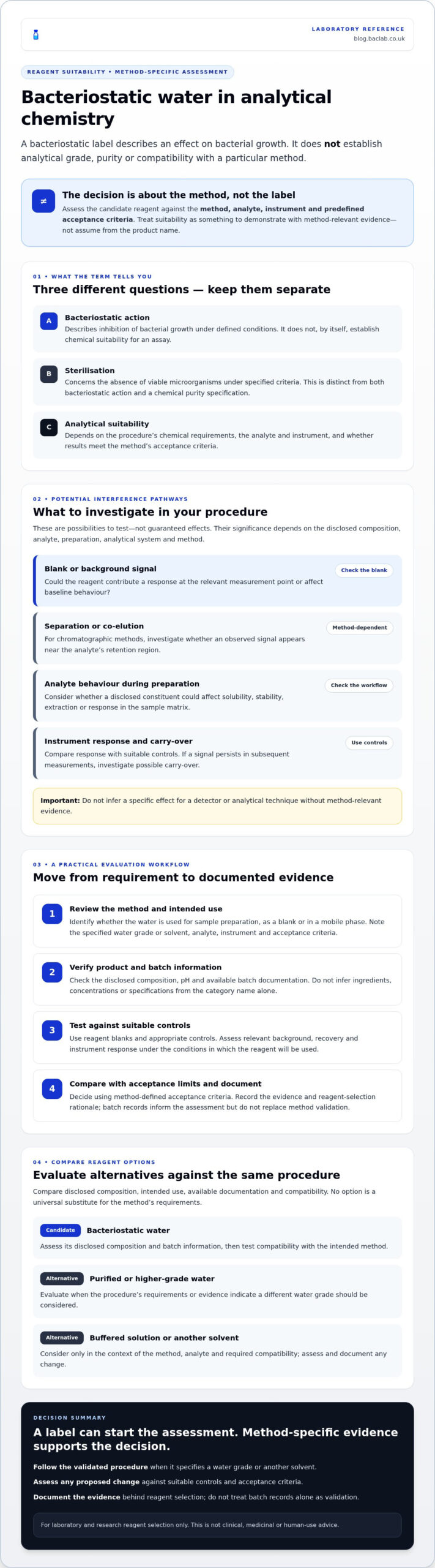
How to Evaluate Bacteriostatic Water for Analytical Chemistry
Assess bacteriostatic water for analytical chemistry through a documented, method-specific workflow. The objective is to determine whether a candidate reagent meets the validated procedure’s requirements, not to infer suitability from a general product description.
- Start with the validated method. Identify the analyte, instrument, preparation conditions and intended reagent function, such as sample preparation, blank or dilution. Record any specified water grade or solvent before considering alternatives.
- Review product and batch information. Check the label, batch identity, composition disclosure, available specifications and storage information. Confirm that the documentation relates to the material being assessed. If information is missing or ambiguous, seek clarification rather than treating an unspecified property as verified.
- Set the assessment criteria. Define the reagent blank, relevant controls and number of replicates in accordance with the laboratory procedure. Establish acceptance criteria before reviewing results, including limits relevant to blank response and method performance.
- Test under intended conditions. Compare the candidate reagent with the method-specified reagent or an appropriate control using the same preparation and analytical conditions. Assess observed background and relevant performance measures against the predefined criteria.
- Document and obtain approval. Record the outcome, any deviation from the validated procedure and the rationale for proceeding or rejecting the reagent. Obtain approval through the laboratory’s quality process before adopting an unlisted reagent.
What should the suitability checklist include?
At minimum, record the method and version, analyte, reagent role, product and lot identification, documentation reviewed and test conditions. Include blank and control results, replicate observations, acceptance criteria and any unresolved specification gaps. This makes the decision traceable and helps distinguish evidence about one batch and use from assumptions about a product category.
How should results and limitations be documented?
Use the laboratory’s established record format to report observed background and other method-relevant performance measures. State the tested conditions, acceptance criteria, deviations and conclusion. Limit the conclusion to the scope of the assessment: acceptable performance in one procedure does not establish compatibility with a different analyte, instrument or preparation. For additional context, consult this guide to bacteriostatic water for laboratory protocols.
BacLab offers a 10 ml vial for laboratory and research use. Review its product information and available batch documentation against the intended method. The vial’s availability does not establish suitability for a specific assay.
Choosing and Sourcing a Reagent for Research Use
Procurement should follow the technical decision, not precede it. For bacteriostatic water for analytical chemistry, first identify the reagent requirements in the intended method. Then review product information, assess suitability under relevant conditions and procure only when the evidence supports its use. A supplier’s description can guide questions, but it can’t replace the laboratory’s own assessment.
Which supplier and documentation questions matter?
Before ordering, check whether the information needed for your assessment is available and sufficiently specific. Confirm product identity and review any composition disclosure and batch-specific records provided. Establish whether the batch information corresponds to the material being considered, and check the product label for storage and handling instructions. Apply those instructions alongside your laboratory’s procedures.
Ask whether the available documentation addresses the variables your method requires you to control. If composition details or batch records are unavailable, unclear or insufficient, don’t infer a grade, certification or analytical performance from the product category. Treat the gap as unresolved and seek clarification or evaluate a reagent with specifications that better match the method.
Batch records and disclosed specifications support a reasoned assessment. They don’t demonstrate compatibility with every analyte, instrument or procedure, and they don’t replace validation against defined acceptance criteria.
What is the next step for a research laboratory?
Compare the candidate reagent with the method’s documented requirements and your laboratory’s procurement and quality processes. If the method names a specific grade or reagent, follow that specification unless a proposed change has been evaluated and approved under the relevant procedure. Once suitability has been assessed, retain records that connect the procurement decision to the method and batch evaluated.
BacLab supplies bacteriostatic water for laboratory and research use. This is a reagent-sourcing reference only: it isn’t a medicine, and BacLab doesn’t provide medical advice. The BacLab bacteriostatic water 10 ml vial may be considered as a candidate for evaluation, subject to review of its product information and compatibility with the intended method. Its availability does not establish general suitability for analytical use.
Make Reagent Selection Evidence-Led
The central principle is straightforward: bacteriostatic water for analytical chemistry should be judged against a defined method, not accepted on the strength of its label. Suitability depends on the analyte, instrument, intended reagent role and method acceptance criteria.
Before procurement, check the available product and batch information, then assess the candidate under relevant method conditions using appropriate blanks and controls. Record the conditions, results and limitations, and refer any proposed departure from a validated procedure to the laboratory’s quality process. Documentation can support that decision, but it doesn’t replace method-specific validation or establish suitability for other assays.
BacLab supplies bacteriostatic water in 10 ml vials for laboratory and research applications, with individual and wholesale options. Review the product information against your laboratory’s requirements before deciding whether it is an appropriate candidate for evaluation.
A clear, documented assessment gives your team a more defensible basis for reagent selection and helps keep analytical decisions aligned with the method.
Frequently Asked Questions
Is bacteriostatic water suitable for analytical chemistry?
It may be suitable for a particular procedure, but the label alone cannot establish that. Assess bacteriostatic water for analytical chemistry against the validated method, analyte, instrument, reagent function and acceptance criteria. Review product and batch documentation, then test under the intended conditions using appropriate blanks and controls. If the method specifies another water grade or solvent, follow that specification unless a change is assessed and approved through the laboratory’s quality process.
Can bacteriostatic water be used as an HPLC or LC-MS solvent?
Only if the relevant method and suitability assessment support its use. HPLC and LC-MS procedures have specific requirements for mobile phases, sample diluents and blanks. A product label doesn’t demonstrate compatibility with a column, detector or mass spectrometer. Check the validated procedure and product documentation, then assess relevant blank response and system performance against predefined criteria. Don’t substitute it for a method-specified solvent without evaluating and documenting the change.
What is the difference between bacteriostatic water and sterile water?
“Bacteriostatic” refers to inhibition of bacterial growth under defined conditions, whereas “sterile” refers to a microbiological status established against applicable criteria. These terms describe different properties and don’t, by themselves, establish chemical purity or suitability for analysis. Formulations and documentation can vary by product, so check the label and batch information for the specific material. Neither term alone demonstrates that a water reagent meets an analytical method’s requirements.
Can benzyl alcohol affect analytical results?
It could, depending on the product, method and analyte, but an effect shouldn’t be assumed without evidence. First establish from product-specific documentation whether benzyl alcohol is present and, if disclosed, at what level. Then consider whether it could contribute to background, affect analyte response or interact with sample preparation under the method conditions. Use suitable blanks and controls to investigate any relevant effect against the method’s acceptance criteria.
How do researchers test whether a water reagent is suitable?
Begin with the validated method and define the reagent’s role, such as sample preparation, dilution or blank. Review product identity, batch details, composition disclosure and storage information. Before testing, specify appropriate blanks, controls, replicates and acceptance criteria. Assess the reagent under the intended analytical conditions, record relevant background and performance measures, and document deviations and limitations. Seek laboratory quality approval before adopting a reagent not listed in the method.
Does bacteriostatic mean the water is analytically pure?
No. Bacteriostatic describes inhibition of bacterial growth; it isn’t a chemical purity grade or an analytical performance claim. A reagent may require control of trace constituents that are irrelevant to microbial growth but material to a sensitive assay. Check whether the product documentation discloses specifications relevant to the intended method, and evaluate the reagent using method-specific controls. Don’t infer analytical purity from the word “bacteriostatic”.
To review BacLab’s 10 ml bacteriostatic water vial for possible laboratory evaluation, check the product information against your method’s requirements.