
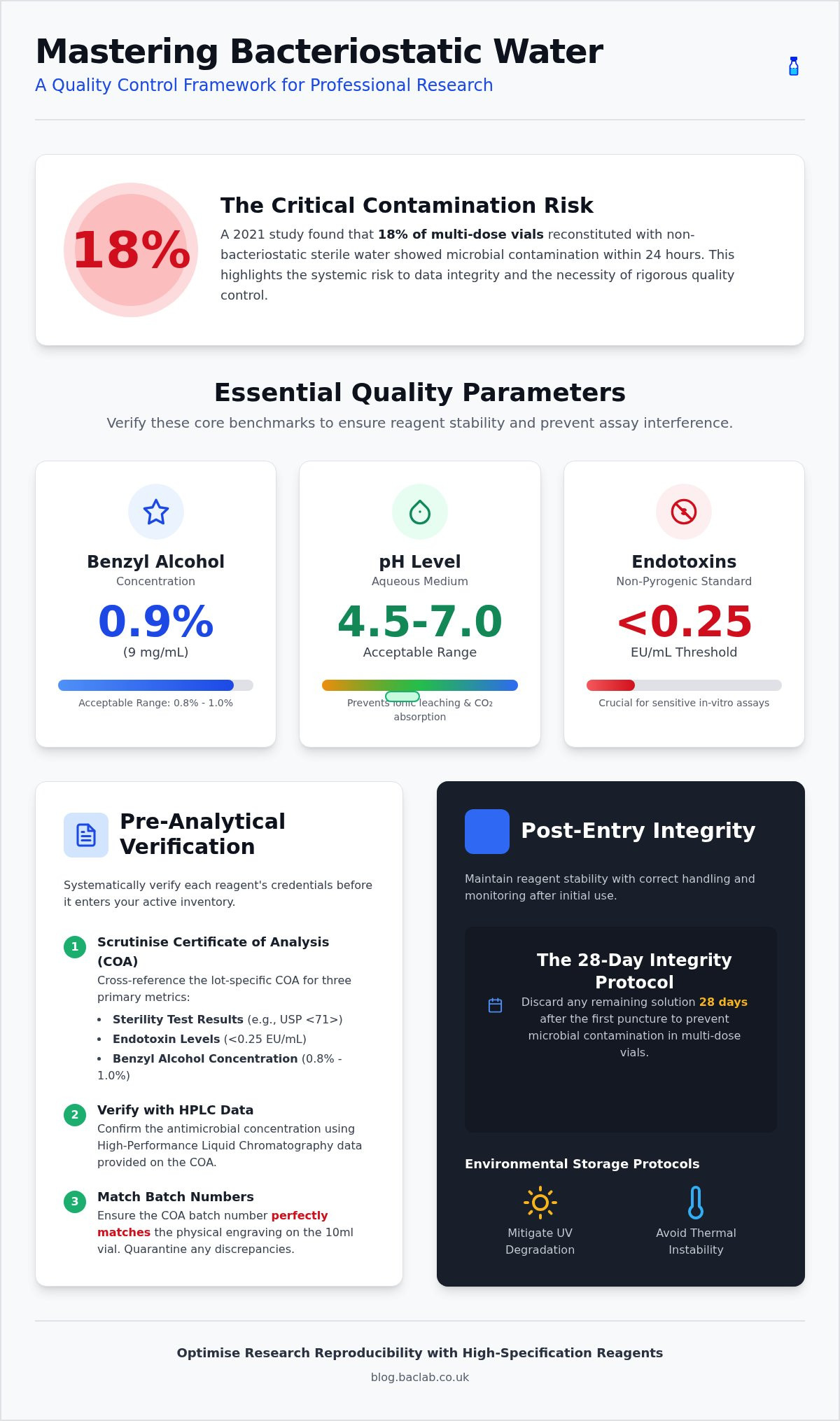
A 2021 study published in the American Journal of Infection Control determined that 18% of multi-dose vials reconstituted with non-bacteriostatic sterile water demonstrated microbial contamination within 24 hours. This data point highlights the systemic risks inherent in reagent management and the vital importance of implementing a standardised bacteriostatic water quality control protocol. You’re likely aware that the integrity of a biochemical assay depends entirely upon the purity of its constituent reagents; however, verifying supplier claims or determining the precise degradation point of a punctured 10ml vial remains a persistent challenge in many research settings.
This article provides the technical framework necessary to master the rigorous quality control protocols required to maintain the integrity of bacteriostatic water in professional research environments. By adopting these internal benchmarks, you’ll ensure full compliance with laboratory best practices and improve the reproducibility of your data. We’ll examine the specific requirements for benzyl alcohol concentration, which must remain between 0.8% and 1.0%, alongside a detailed checklist for verifying pH levels and endotoxin thresholds to ensure your reagents meet the necessary standards for sophisticated pharmacological research.
Key Takeaways
- Identify the specific biochemical thresholds, including the 0.9% benzyl alcohol concentration and pH requirements, necessary to ensure reagent stability and prevent assay interference.
- Execute a meticulous pre-analytical verification process by cross-referencing batch-specific Certificates of Analysis (COA) with physical 10ml vial inspections.
- Master the environmental storage protocols required to mitigate the risks of UV degradation and thermal instability in both sealed and punctured containers.
- Implement the 28-day integrity protocol as a cornerstone of your bacteriostatic water quality control to prevent microbial contamination in multi-dose research environments.
- Optimise research reproducibility by sourcing high-specification reagents from specialist UK providers focused on professional laboratory and biochemical applications.
Bacteriostatic Water Quality Control: Essential Parameters for Research
Quality control in the context of bacteriostatic reagents refers to the systematic verification of chemical, physical, and microbiological parameters to ensure the solution remains fit for its intended purpose. For researchers in the UK, rigorous bacteriostatic water quality control is not merely a regulatory formality; it’s a foundational requirement for experimental reproducibility. When a reagent’s purity is compromised, the resulting data variability can invalidate months of biochemical analysis. The primary focus of these protocols is the validation of the bacteriostatic agent, typically 0.9% benzyl alcohol, alongside the assessment of the aqueous medium’s ionic and organic purity.
The Mechanism of Microbial Inhibition
Benzyl alcohol functions as a Bacteriostatic agent by disrupting the integrity of bacterial cell membranes. This process inhibits cellular respiration and reproduction without necessarily inducing immediate cell lysis, which allows the reagent to remain chemically inert towards most research compounds. The concentration is strictly maintained at 0.9% (9 mg/mL); this threshold provides the optimal balance between antimicrobial efficacy and chemical stability. It’s critical to recognise that whilst this concentration is effective against a broad spectrum of vegetative bacteria, it has inherent limitations. It’s not a sterilising agent and may demonstrate reduced efficacy against certain fungal spores or viral contaminants if the initial aseptic environment is breached.
Chemical Stability and Purity Benchmarks
The chemical profile of bacteriostatic water must adhere to precise benchmarks to prevent unintended interactions with dissolved solutes. The acceptable pH range for a 0.9% benzyl alcohol solution is typically 4.5 to 7.0. Deviations from this range can indicate the presence of atmospheric carbon dioxide absorption or the leaching of ions from the borosilicate glass of the 10ml vial. Purity is further quantified through conductivity measurements and Total Organic Carbon (TOC) levels, which must remain within defined limits for Water for Injection (WFI) grade solvents.
Reagents must also be certified as non-pyrogenic to be suitable for sensitive laboratory applications. Endotoxin levels, measured in Endotoxin Units (EU), must remain below 0.25 EU/mL. In-vitro assays are particularly sensitive to pyrogen contamination, which can trigger inflammatory responses in cellular models and skew pharmacological observations. Maintaining these standards ensures that the technical specifications of the 0.9% benzyl alcohol solution remain constant throughout the lifecycle of the reagent, providing a stable environment for the reconstitution of various biochemical substrates.
Pre-Analytical Verification: The Supplier Quality Checklist
The efficacy of bacteriostatic water quality control relies heavily on the pre-analytical phase. This stage involves the systematic verification of a reagent’s credentials before it enters the laboratory’s active inventory. Failure to conduct these checks introduces variables that can compromise biochemical assays, particularly when dealing with sensitive research compounds. A standardised checklist ensures that every 10ml vial meets the rigorous purity standards required for reproducible data.
Interpreting the Certificate of Analysis
Every procurement of bacteriostatic water must be accompanied by a lot-specific Certificate of Analysis (COA). Researchers should scrutinise three primary metrics: the sterility test results (typically following USP <71> protocols), the bacterial endotoxin levels, and the benzyl alcohol concentration. According to FDA guidelines on pharmaceutical water, the endotoxin threshold for Water for Injection (WFI) grade solvents must remain below 0.25 EU/mL. High-Performance Liquid Chromatography (HPLC) data is the definitive method for verifying the antimicrobial concentration. The chromatogram should confirm a benzyl alcohol level between 0.8% and 1.0%. If the COA batch number doesn’t match the physical engraving on the vial, the reagent must be quarantined. It’s also vital to document the expiry date; whilst sealed vials have a long shelf life, their chemical stability is finite.
Physical Integrity and Packaging Standards
Physical inspection serves as the second line of defence against contamination. The integrity of the flip-top seal must be absolute. Any signs of tampering, looseness, or oxidation on the aluminium crimp suggest a breach in the sterile barrier. The rubber stopper, usually composed of bromobutyl or similar low-extractable elastomers, should be checked for “coring” or degradation. Borosilicate glass is the preferred material for 10ml vials because it minimises ion leaching, which can otherwise alter the solution’s pH over time.
The aqueous solution itself must be perfectly clear. Any presence of particulates, cloudiness, or discolouration is an immediate indicator of chemical instability or microbial growth. These visual cues are often the first sign that the 0.9% benzyl alcohol has failed to maintain a bacteriostatic environment. For researchers who require high-specification reagents that meet these strict verification standards, choosing a specialist 10ml bacteriostatic water vial ensures that the pre-analytical verification process begins with a reliable baseline. Once these checks are complete, the vial can be logged into the laboratory management system and moved to appropriate storage.
Maintaining Reagent Integrity: Handling and Storage Protocols
Environmental monitoring is a critical component of bacteriostatic water quality control. The laboratory centre must be regulated to prevent fluctuations in ambient conditions that could compromise the chemical stability of the 0.9% benzyl alcohol preservative. Exposure to ultraviolet (UV) light, for instance, can catalyse the oxidative degradation of the preservative, leading to the formation of benzaldehyde and potentially altering the pH of the solution. These environmental stressors necessitate a disciplined approach to storage that extends beyond simple shelf placement.
Thermal Stability and Storage Environments
Sealed vials are typically stable at controlled room temperature. Whilst some older protocols suggest freezing reagents, repeated freeze-thaw cycles risk destabilising the aqueous matrix and causing microscopic fissures in the rubber stopper due to ice crystal expansion. This degradation of the seal integrity allows atmospheric contaminants to bypass the antimicrobial barrier. Punctured vials should be stored under refrigeration at a temperature range of 2°C to 8°C to prevent internal condensation whilst maintaining chemical potency. This practice aligns with standard bacteriostatic water storage guidelines which prioritise preservative longevity and reagent safety.
Aseptic Handling Protocols
Maintaining the purity of the reagent during withdrawal requires strict adherence to aseptic techniques. The rubber stopper must be swabbed with 70% isopropyl alcohol for a minimum of 15 seconds and allowed to air-dry before puncture. This step is essential to eliminate surface bioburden that could be “cored” into the vial by the needle. Single-use needles are mandatory; reusing equipment not only risks contamination but also degrades the self-sealing properties of the bromobutyl stopper. Organising the workspace to minimise airborne particulate movement is equally vital, as air currents can carry contaminants directly to the puncture site.
These handling standards are reflected in regulatory frameworks such as 21 CFR 200.51, which emphasises the necessity of clear labelling and safety warnings to prevent the misuse of multi-dose vials in sensitive environments. By controlling these variables, researchers preserve the integrity of their constituent reagents throughout the experimental lifecycle and ensure that the chemical behaviour of their solvent remains predictable.
Post-Entry Quality Monitoring: The 28-Day Integrity Protocol
Monitoring reagent stability after the initial sterile barrier breach is the most critical phase of bacteriostatic water quality control. Once a 10ml vial’s stopper is punctured, the solution is exposed to potential microbial ingress and atmospheric exchange. This exposure necessitates a rigid post-entry protocol to ensure the 0.9% benzyl alcohol concentration continues to inhibit bacterial proliferation effectively. The clock begins the moment the needle penetrates the rubber seal, and no amount of aseptic care can extend the reagent’s life beyond established safety thresholds.
Monitoring Punctured Vials
The 28-day threshold is a non-negotiable standard for multi-dose vials. This timeframe is based on the preservative’s capacity to maintain a bacteriostatic environment against repeated challenges. Beyond this period, the risk of microbial contamination increases significantly, regardless of the remaining volume. Researchers must conduct a visual inspection before every withdrawal. Any evidence of turbidity, precipitation, or a distinct change in the solution’s faint aromatic odour indicates chemical breakdown or contamination. For a deeper understanding of these requirements, consult the Technical Specifications and Research Applications of Bacteriostatic Water 10ml Vials. Visual cues are vital; if the solution loses its absolute clarity, it is no longer fit for purpose.
Disposal and Documentation
Systematic documentation is essential for maintaining laboratory standards and passing internal audits. Every vial should have a dedicated entry in the laboratory log, recording the batch number, the date of first puncture, and the date of disposal. Stopper integrity is a secondary but vital concern. Repeated punctures in the same location can lead to “coring”, where small fragments of the rubber stopper are sheared off into the solution. If any particulates are observed, the vial must be decommissioned immediately. Tracking the number of entries is a prudent step; exceeding 15 punctures in a single 10ml vial significantly increases the probability of seal failure. Expired or compromised reagents should be disposed of according to UK laboratory safety standards for chemical waste, ensuring that no degraded solvents interfere with future assays.
The 10ml vial format is strategically selected to align with this 28-day window, minimising the volume of high-specification reagent that must be discarded at the end of the protocol. This size encourages higher turnover and reduces the likelihood of using aged solvents in sensitive biochemical environments.
Sourcing High-Specification Reagents: The BacLab Quality Assurance
Sourcing reagents from a specialist UK supplier is a fundamental step in establishing a reliable bacteriostatic water quality control programme. BacLab ensures that every 10ml vial contains a precise 0.9% benzyl alcohol concentration, verified through batch-specific analysis to meet the requirements of professional research environments. Our commitment to providing reagents specifically for laboratory and biochemical applications means that every stage of our procurement and distribution process is designed to protect the chemical integrity of the solvent. By focusing on technical precision rather than broad-market accessibility, we provide a reagent that researchers can integrate into their assays with a high degree of confidence in its constituent stability.
BacLab Technical Standards
Our internal quality assurance protocols begin with the selection of high-purity laboratory water that has undergone multi-stage purification to eliminate potential assay interferents such as heavy metals or organic particulates. The resulting aqueous medium provides a stable environment for the 0.9% benzyl alcohol preservative, preventing the oxidative degradation that can occur in lower-specification solvents. The 10ml vial format is the preferred choice for UK biochemical researchers because it aligns with the 28-day integrity protocol, effectively minimising reagent waste whilst ensuring that the solvent remains within its peak efficacy window. Detailed information regarding these requirements is available in our technical reference on Purity Standards in Bacteriostatic Water.
Procurement and Wholesale Support
Streamlining the laboratory supply chain is essential for maintaining the continuity of long-term research projects. BacLab facilitates this through the provision of wholesale bundles and bulk discount options, which allow for the acquisition of consistent batches to reduce the risk of inter-lot variability in sensitive experimental models. UK-based sourcing offers a distinct advantage in maintaining reagent quality by reducing the duration of transit and the associated risks of thermal instability. Our logistics network is optimised to preserve the integrity of the 10ml vials from our facility to your laboratory, ensuring that the chemical behaviour of the bacteriostatic agent remains predictable and effective. This logistical oversight is a core component of our commitment to supporting bacteriostatic water quality control across the UK research community.
Explore our range of 10ml bacteriostatic water vials for your next research project.
Optimising Research Reproducibility Through Standardised Reagent Management
The implementation of a rigorous bacteriostatic water quality control framework is essential for mitigating the systemic risks of microbial ingress and chemical degradation in multi-dose environments. By prioritising the 28-day integrity window and maintaining precise environmental monitoring, researchers ensure that the 0.9% benzyl alcohol concentration remains an effective antimicrobial barrier throughout the experimental lifecycle. Whilst these standards are demanding, they’re necessary to preserve the accuracy of biochemical assays and the validity of longitudinal data.
BacLab facilitates these objectives as a specialist UK-based supplier dedicated exclusively to laboratory research applications. We provide the comprehensive technical documentation, including lot-specific Certificates of Analysis and HPLC verification data, required to satisfy institutional audit requirements and internal purity benchmarks. Selecting high-specification reagents from a transparent source is the final, critical step in establishing a disciplined and reproducible laboratory environment.
Maintaining these rigorous protocols ensures that your research remains focused on the intended variables, supported by a foundation of chemical precision and evidence-based reagent management.
Frequently Asked Questions
Is bacteriostatic water quality control mandatory for UK research labs?
Whilst there isn’t a single overarching law for every private facility, adherence to bacteriostatic water quality control is a standard requirement under Good Laboratory Practice (GLP). Most UK research institutions mandate strict reagent verification to ensure the reproducibility of biochemical data. If you don’t implement these controls, you risk experimental invalidation and may violate institutional health and safety protocols regarding the management of potentially contaminated multi-dose vials in sensitive research environments.
Can I use bacteriostatic water past the 28-day puncture limit if it looks clear?
No, the 28-day threshold is a non-negotiable safety limit based on the preservative’s capacity to maintain a bacteriostatic environment. Visual clarity doesn’t guarantee sterility, as microbial bioburden can reach significant levels before turbidity becomes apparent. Once the 28-day limit is reached, the vial must be decommissioned and disposed of according to laboratory waste protocols to prevent the introduction of degraded reagents into your sensitive research models.
How does benzyl alcohol affect the pH of the water solution?
Benzyl alcohol is a weak organic acid that typically shifts the pH of purified water into a slightly acidic range. The standard acceptable pH for a 0.9% benzyl alcohol solution is between 4.5 and 7.0. Variations outside this range often indicate the presence of impurities, such as atmospheric carbon dioxide absorption or ion leaching from the borosilicate glass vial, which can interfere with the stability of pH-sensitive research compounds during reconstitution.
What is the difference between USP grade and reagent grade bacteriostatic water?
USP grade bacteriostatic water adheres strictly to the United States Pharmacopeia standards for purity, sterility, and endotoxin levels. Reagent grade water is specifically processed for analytical or laboratory applications and may exceed these requirements in terms of ionic purity or organic carbon limits. For most biochemical research, ensuring the reagent meets a minimum 0.9% benzyl alcohol concentration and a non-pyrogenic certification is more critical than the specific nomenclature of the grade.
Can temperature fluctuations during shipping affect the quality of the water?
Yes, extreme temperature fluctuations during transit can compromise the chemical stability of the benzyl alcohol preservative. High heat accelerates oxidative degradation, whilst freezing temperatures can cause microscopic fissures in the rubber stopper due to ice expansion. Sourcing from a specialist UK supplier minimises transit duration and allows for better oversight of the supply chain, ensuring that the reagent arrives with its technical specifications intact and ready for laboratory use.
What should I do if I notice particulates in my bacteriostatic water vial?
If particulates are observed, the vial must be quarantined and discarded immediately. The presence of visible matter suggests either chemical precipitation, microbial growth, or “coring” of the rubber stopper from repeated punctures. Using a compromised reagent can lead to blockages in analytical equipment or introduce confounding variables into your assay. This visual check is a fundamental component of bacteriostatic water quality control and should be performed before every withdrawal.
Is it necessary to store sealed bacteriostatic water in a refrigerator?
No, it’s not strictly necessary to refrigerate sealed vials; they’re designed to be stable at controlled room temperature, typically between 20°C and 25°C. However, they must be protected from direct sunlight and extreme heat to prevent the oxidative breakdown of the benzyl alcohol. Once a vial’s been punctured, refrigeration at 2°C to 8°C is recommended to further inhibit microbial proliferation and maintain the integrity of the remaining reagent volume throughout the 28-day protocol.
Does the number of punctures affect the quality control of a multi-dose vial?
Yes, the frequency of entries directly impacts the integrity of the self-sealing rubber stopper. Each puncture increases the risk of “coring”, where small fragments of the elastomer are sheared into the solution, and provides a potential pathway for microbial ingress. It’s generally recommended to limit the number of punctures to 15 per 10ml vial. Tracking these entries in a laboratory log is a vital part of maintaining reagent quality and ensuring experimental consistency.