
A reagent SOP that stops at storage is incomplete: analytical preparation, verification and disposal also need controlled instructions. Developing a standard operating procedure for reagent handling means defining who receives, labels and monitors each reagent, how incompatible materials are segregated, and what staff must record at each stage. The procedure should connect identified hazards with practical controls and set out the steps needed to prepare and verify analytical reagents consistently.
It’s understandable to focus first on safe storage and clear handling rules. These are essential, but they do not address every source of variation in laboratory work. A useful SOP also clarifies responsibilities, explains how to manage expired or suspect materials, and gives instructions suited to the task and users’ experience.
This article explains how to define an SOP’s purpose and scope, assign responsibilities, set storage and segregation rules, and write practical procedures for regulated and analytical laboratory work. It also covers records, staff training, review and revision, helping the document support safe reagent control and repeatable analytical work.
Key Takeaways
- Define the SOP’s purpose, scope and responsibilities so staff know which reagents and tasks it governs.
- Document receipt, labelling, expiry monitoring, records and disposal as connected parts of reagent control.
- Set storage conditions and segregation rules according to reagent properties, stability and incompatibilities.
- Write procedures for their users, with clear steps, training records and a process for review and revision.
- For analytical work, specify preparation, verification and acceptance criteria; explore BacLab’s 10ml bacteriostatic water vials when a sterile reagent is needed for professional laboratory research.
Reagent control in regulated laboratory environments
In the UK, applicable requirements depend on the reagent, its hazards and the laboratory’s activities. Identify relevant requirements before drafting controls, then use the reagent’s safety data sheet, documented risk assessment and quality framework to guide handling and storage.
A controlled SOP links each identified hazard to a specific control, record and responsible role. The steps below explain how to make those links, alongside guidance on replicate testing and document distribution.
Check applicable UK regulations and guidance
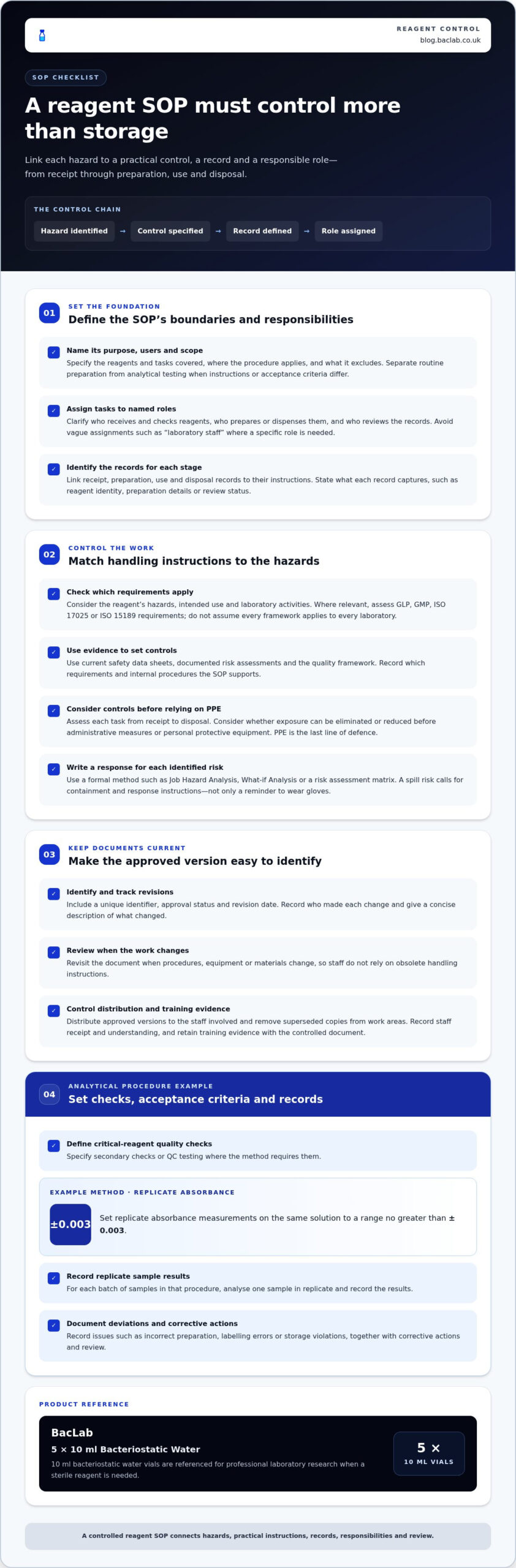
Identify the requirements that apply to your laboratory’s work before approving the SOP. Consider the reagent’s hazards, intended use and whether the work operates under GLP, GMP, ISO 17025 or ISO 15189 requirements. Do not treat every quality framework as relevant to every laboratory. Use current safety data sheets and documented risk assessments to define handling, storage and disposal instructions.
Record which requirements and internal procedures the SOP supports. This gives reviewers a clear basis for assessing whether the controls suit the work, rather than relying on a generic template.
Apply the hierarchy of controls
Assess each reagent task, from receipt through use and disposal, and select controls for the identified hazards. Consider whether the process can eliminate or reduce exposure before relying on administrative measures or personal protective equipment. PPE is the last line of defence; specify it when higher-level controls are infeasible or do not fully control the hazard.
Use a formal method, such as Job Hazard Analysis, What-if Analysis or a risk assessment matrix. For example, a spill risk calls for defined containment and response instructions, not just a reminder to wear gloves. Include any training required to operate specialist equipment.
Control SOP versions and distribution
Give each SOP a unique identifier, approval status and revision date. Record the revision date, the person responsible for each change and a concise description of what changed. Review the document when procedures, equipment or materials change, so staff do not rely on obsolete handling instructions.
Distribute approved versions promptly to the staff involved, and remove superseded copies from work areas. Record each employee’s receipt and understanding, then retain training evidence with the controlled document. A version register can show which copy is current and where it is used.
- Define quality checks for critical reagents, including secondary checks or QC testing where required by the method.
- For the example method, set replicate absorbance measurements on the same solution to a range no greater than ± 0.003.
- For each batch of samples in that procedure, analyse one sample in replicate and record the results.
- Document deviations, such as incorrect preparation, labelling errors or storage violations, with corrective actions and review.
SOP purpose, scope and responsibilities
Define the procedure’s purpose, users and boundaries before drafting individual instructions. A precise scope identifies the reagents, tasks and method limits the document covers.
Define the SOP purpose and scope
Write the purpose in a sentence or two. Name the task and intended outcome, such as controlling the receipt, preparation and use of laboratory reagents. Identify the materials covered, including buffers, acids, bases and staining agents. Avoid broad wording such as “all chemicals” unless the procedure genuinely addresses every chemical and activity involved.
State who must use the SOP and where it applies. A reagent preparation procedure, for example, may cover preparation and labelling but exclude instrument operation. Make those boundaries explicit so staff can find the right procedure for each task.
Set scope and method limits
Describe the method’s intended application and limits, including the reagent types and work stages it covers. Distinguish routine preparation from analytical testing when their instructions or acceptance criteria differ. Do not imply that one method applies to every concentration, sample type or laboratory activity.
For an analytical procedure, identify the method being followed and the conditions that affect its use. Explain what staff should do when a sample or preparation falls outside those limits, such as pausing work and referring the issue to the designated supervisor.
- Complete the document header. Include a clear title, document identifier, version, preparation date and approval fields. Name the author, technical reviewer and approving role, so accountability is visible on the controlled copy. Use the same format across related SOPs to make essential fields easy to locate.
- Assign responsibilities by task. Specify who receives and checks reagents, who prepares or dispenses them, and who reviews records. For example, distinguish the preparer’s responsibility for recording a preparation from the reviewer’s responsibility for checking its entries. Avoid assigning a task to “laboratory staff” when a specific role is needed.
- Identify required records. List the forms or electronic records that demonstrate each step occurred. Link reagent receipt, preparation, use and disposal records to the corresponding instruction. State what information each record captures, such as reagent identity, preparation details or review status.
- Align the SOP with the quality framework. Identify whether the organisation’s work is governed by GLP, GMP, ISO 17025 or ISO 15189 requirements. Describe the relevant internal guidelines and records without treating every framework as applicable to every laboratory.
- Check the draft against the work. Have an involved user compare each instruction with the actual method and equipment. Correct ambiguous terms such as “proper amount” by specifying the approved method or reference that determines the amount. This evaluation should also confirm that responsibilities and scope remain consistent throughout the document.
Storage conditions and segregation of incompatible materials
Collect reagent waste by compatible waste type, label each container clearly and dispose of it under applicable hazardous waste regulations. Specify who classifies the waste, the information required on its label and how disposal is recorded.
- Inspect reagents at receipt. Compare each delivery with its accompanying documentation and the laboratory’s order. Check that containers are intact and that reagent identity is legible before accepting them into storage. Record receipt details, including any damage or visible change, and retain available certificates in a separate file. Follow the supplier’s handling instructions during shipment and transfer; don’t assume every reagent tolerates the same conditions.
- Assign storage conditions from reagent information. Record required temperature, light protection and stability for each material, using its safety data sheets and relevant product documentation. Translate those conditions into practical instructions for the storage location. For example, the sulphanilamide reagent in the example method is kept in an amber glass bottle, refrigerated, and stable for 1 month. Don’t apply that example’s conditions to unrelated chemicals.
- Separate incompatible materials. Use hazard information to identify substances that could react dangerously if containers leak or break. Specify segregated storage locations or suitable containment, and make the arrangement clear in the storage instructions. Keep labels visible during inspection, so staff can identify materials without moving containers unnecessarily. The SOP should also state how to report a damaged container or unexpected reaction risk.
- Control preparation and labelling. Direct staff to prepare reagents using the applicable method, then label each prepared container with its name, concentration, preparation date, expiry date, preparer’s initials and storage conditions. For instance, a light-sensitive solution should have its storage requirement stated on the label, not only in a separate procedure. Record preparation and expiry details in the relevant logbook or electronic system.
- Define warehouse and shutdown arrangements. Describe how reagents move from receipt into designated warehouse or laboratory storage, including who checks placement and records location. Include the actions required during planned shutdowns or interruptions: identify materials needing controlled conditions, assign responsibility for monitoring them, and document any transfer. Base these instructions on each reagent’s stated storage requirements.
- Set inspection, expiry and waste steps. Require staff to check container condition, labels and expiry status during routine stock checks. Separate expired, suspect or visibly changed reagents from usable stock, record the decision, and follow the specified disposal route. Classify and label waste by its contents, keep incompatible waste streams separate, and document collection and disposal. The SOP should name the responsible role and records used for each action.
Writing procedures for their end users
Choose a format that helps users find the right instruction at the point of work. Then test the written procedure with the people who will use it.
-
Write and validate the SOP
Draft the procedure in the order the task occurs, from set-up to completion and recordkeeping. Use numbered instructions for sequences, a table for comparisons or a flowchart for decision points. Photos and diagrams can clarify equipment set-up. Ask an end user to follow the draft using the actual materials and equipment, then revise any unclear instructions before approval.
-
Match the format to the task.
Choose a narrative, bulleted, numbered, table, photo-step, graphic-step, flowchart or checklist format to suit the work. For reagent preparation, numbered instructions can show the sequence, while a table can present reagent quantities and storage conditions. Avoid combining formats in ways that split one action across pages or make a decision point difficult to find.
-
Write for the intended audience.
Use terms familiar to the laboratory team, and define specialised terms that users might interpret differently. Separate mandatory actions from explanatory notes, and identify the materials, equipment and records needed at each stage. For example, “mix until dissolved” should specify the visible endpoint or method reference users are expected to apply.
-
Train users on the SOP
Train each user on the approved procedure before they perform the task independently. Include a signature area to document that SOP training has taken place, and retain the training record with the controlled document. A demonstration can show a preparation sequence, while observed practice can confirm whether the user follows each written instruction.
-
Check comprehension against the procedure.
Ask the trainee to explain critical steps and demonstrate the task using the relevant materials. Record completion and any follow-up instruction required. For example, if a user misses a labelling step during practice, revisit the instruction and assess performance again before recording the training as complete.
-
Review usability after release.
Provide the approved SOP to the team and make the current version accessible where the task takes place. Ask for specific feedback about unclear wording, missing steps or differences between the written method and actual practice. Revise the document through its change-control process, then communicate the updated instructions and record staff training on the revision.
Test and retest an SOP, amending it when the task reveals a problem. In GMP settings, the document should communicate employees’ responsibilities, work instructions, specifications and required records. This makes the written method a practical control rather than a corporate document detached from laboratory work.
Analytical reagent procedures
Analytical controls must reflect the method, equipment and hazards involved. When developing a standard operating procedure for reagent handling, link each preparation step to a measurable check and a clear response to failure. Include spill, exposure, fire and other emergency actions, with applicable first aid, escalation steps and spill-response materials. Water-reactive chemicals may require a specific spill kit.
- Specify the preparation sequence. Set out the actions in working order, from equipment checks to final records. Identify calibrated equipment and validated methods, then explain how to weigh, dilute, mix and adjust pH. State the order of additions and the observable endpoint where relevant. For example, replace “mix thoroughly” with the method’s defined mixing instruction or endpoint. This helps users distinguish a completed preparation from an unfinished one.
- Record quantities and tolerances. Give chemical names, units and acceptable ranges exactly as the applicable method requires. In the example sulphanilamide preparation, use 20.00 g ± 0.25 g sulphanilamide and 1.00 g ± 0.10 g N-1-naphthylethylenediamine dihydrochloride. Treat these values as method-specific, not as general formulation guidance. Include a record field for actual measured amounts.
- Control analytical conditions. Document timings and instrument settings that can affect results. The example procedure adds 0.75 cm3 sulphanilamide solution to each test tube, then leaves the mixture for at least 30 minutes but no longer than two hours. The nitrite method measures absorbance at 540 nm; its spectrophotometer is switched on for at least half an hour before analysis.
- Define verification criteria. State how staff verify reagent identity, concentration and stability, then specify the response to a failed check. For the example method, the 0.25 mg dm-3 nitrite standard has an absorbance acceptance value of 0.250 ± 0.010. Replicate measurements on the same solution must have a range no greater than ± 0.003. Record results and assign review of out-of-range findings.
- Make emergency actions reagent-specific. Identify alarm, isolation and first-aid actions for each relevant hazard. Specify who responds to a spill and which materials are suitable. Water-reactive chemicals may need a specific spill kit. Flammable metals require a Class D extinguisher or extinguishing agent, rather than a standard ABC extinguisher. Do not apply one generic response to incompatible hazards.
- Test the written method. Ask an analyst to follow the procedure using its stated materials and equipment. Record unclear steps, failed acceptance checks and corrective revisions, then retest the amended method. This practical evaluation checks whether a user can carry out each action and record results correctly. It also links analytical controls to developing a standard operating procedure for reagent handling in routine laboratory work.
For laboratory methods that call for bacteriostatic water, consider the 5x 10ml Bacteriostatic Water pack.
BacLab: Bacteriostatic Water, 10ml vial
BacLab’s 5x 10ml Bacteriostatic Water pack is a practical option for research laboratories whose approved methods call for this reagent. Each 10ml vial provides sterile bacteriostatic water for professional laboratory use. Include the selected product in your local purchasing and inventory process, following your SOP’s requirements for receipt and reagent records.
Individual 10ml vials and wholesale bundles are also available. For further information about laboratory reagents, visit BacLab’s blog.
Make the next step part of your reagent workflow
A controlled procedure becomes useful when it shapes routine decisions, including which reagent a method requires and how that material is recorded in the laboratory. As you continue developing a standard operating procedure for reagent handling, treat reagent selection as part of method control: document the required material and apply your laboratory’s acceptance criteria before use.
For research users whose established method calls for bacteriostatic water, select a pack size that fits the laboratory’s purchasing and stock-control process.
Use your completed SOP as the reference point for the next reagent purchase, keeping procurement aligned with the method.
View the 5x 10ml Bacteriostatic Water pack
Frequently Asked Questions
Why Download This SOP?
Use the approach in this article to turn reagent tasks into clear, repeatable instructions. It helps laboratory teams identify what their own document needs to cover, from task ownership to method-specific checks. Adapt each part to the materials and equipment in use. For example, a procedure for routine solution preparation needs different operational detail from one governing receipt or waste handling.
What sections should a reagent handling standard operating procedure include?
Organise the document around how work is performed and controlled: purpose, scope, roles, hazards, handling, records, storage, waste, emergency response, training and revision control. Add task-specific appendices or forms where the main procedure would become difficult to use. A separate preparation record, for instance, can capture batch details without interrupting the instructions followed at the bench.
How do you assess and classify reagent hazards under UK COSHH regulations?
Start with the reagent’s safety data sheet and label, then assess the hazards created by the actual task. Record the form and quantity handled, possible exposure routes, work area and controls already in place. When developing a standard operating procedure for reagent handling, use that assessment to link each task hazard to a practical control, rather than copying generic precautions into every procedure.
How should reagents be received, labelled, logged and tracked in a laboratory?
Establish a traceable record from delivery to final use. Capture the reagent identity, supplier, batch or lot, receipt date, container condition and assigned storage location. Label prepared solutions so their preparation record and status can be identified. If an entry is corrected, retain a clear audit trail showing what changed, who made the correction and when.
What are the safe procedures for preparing, transferring and dispensing reagents?
Write instructions that prevent mix-ups at each transfer point. Identify the source container, receiving vessel and required equipment before dispensing, and explain how users can distinguish similar reagents. For example, the procedure can require labelling the receiving vessel before solution transfer begins. Include steps for interrupted work, such as securing the source container and recording the partial preparation.
What PPE and engineering controls are needed for common reagent hazards?
Choose controls for the specific exposure route and activity. A procedure involving volatile substances may need to describe suitable containment or ventilation, while splash-prone work may require eye protection. Specify PPE by type and task, and explain when it is required. If respiratory protection is necessary, account for the required training, medical evaluation and fit testing before use.
How should incompatible reagents be segregated and stored, including temperature requirements?
Base segregation on the chemical hazards and potential reactions identified in relevant safety information. Set storage locations and containment so leaks or breakage cannot readily bring incompatible materials together. Follow the reagent’s documented stability conditions for temperature, rather than applying one assumption across the laboratory. Define who monitors sensitive storage and how staff document and respond to a temperature excursion.
How should staff be trained and competency documented for reagent handling?
Train staff on the current procedure, then document training against its identifier and version. Competency evidence should reflect the task, not attendance alone: a supervisor might observe an employee completing a transfer or preparing a record. When developing a standard operating procedure for reagent handling, also define how staff receive revised instructions and how changes prompt any necessary retraining.