
A USP claim refers to a defined standard, not a universal guarantee of product quality. If you are assessing bacteriostatic water USP, the distinction matters: the wording alone does not identify the specification a supplier is claiming or the evidence behind that claim.
For laboratory procurement, a standards claim should be clear and verifiable. This article explains what USP refers to, why the term is not a standalone certification, and how to compare product descriptions with labels and supporting documentation.
It also distinguishes laboratory research supply from medicinal or clinical products, keeping the intended context clear. Once you know how to assess a claim, consider your purchasing needs, including vial format and quantity. BacLab supplies bacteriostatic water for laboratory and research applications in 10ml vials, including a five-vial format.
Key Takeaways
- Interpret bacteriostatic water USP as a standards-related claim, then identify the evidence provided to support it.
- Compare product identity, labelled composition, documentation, intended use and vial format using current product information.
- Keep a compendial reference, a supplier’s claim and evidence of conformity distinct. Terminology alone does not establish pharmaceutical status.
- Use a step-by-step review to separate documented product details from assumptions based on wording.
- For laboratory research supply, BacLab offers 10ml vials, including a five-vial format.
What does bacteriostatic water USP mean?
Featured definition: Bacteriostatic water is water containing an agent intended to inhibit bacterial growth; USP refers to standards published by the United States Pharmacopeia. The phrase bacteriostatic water USP links a product description to a compendial reference, but the wording alone does not prove that a product conforms to a particular standard.
The terms describe different things. “Bacteriostatic” refers to inhibiting bacterial growth, rather than necessarily destroying bacteria. A bacteriostatic agent is a substance that inhibits bacterial growth. “Water” identifies the product’s base, while “USP” points to standards issued by the United States Pharmacopeia. Together, the words may signal a standards claim, but they do not show the evidence behind it.
What does USP identify in a product description?
USP is a compendial reference, not a general synonym for “high quality”. Its standards set defined requirements for the substances and preparations covered by the relevant text. A product description that uses “USP” may refer to a particular standard, but its precise meaning depends on the wording and the documentation supporting the claim.
Context matters. “USP” in a product title, a statement that a material is “USP grade”, and a specific claim that a product meets a named compendial specification are not necessarily equivalent. None should be read as proof of certification, regulatory approval or conformity without supporting evidence. Compare the wording in a listing with the current product label and records that explain the claim.
How is a standards reference different from product suitability?
A standard describes specified characteristics or tests; it does not determine whether a reagent suits every laboratory procedure. Suitability depends on the research method’s requirements and the product’s documented specification. For example, a protocol may set criteria for composition or other parameters that are not established simply by seeing “USP” in a description.
Assess the claim and the application separately. First identify the standard being referenced, then compare the available product information with the protocol’s requirements. If documentation does not state a relevant property, do not infer it from the USP wording. This distinction matters when assessing research-grade bacteriostatic water and technical standards, because a grade label and a method-specific fit answer different questions.
For a practical review, record the exact wording, identify any named compendial reference, and check whether the accompanying documentation substantiates it for the product in question. A USP reference is useful when its scope and evidence are clear. It can inform procurement, but it does not replace a review of product records or the laboratory’s method requirements.
Which specifications matter when comparing bacteriostatic water standards?
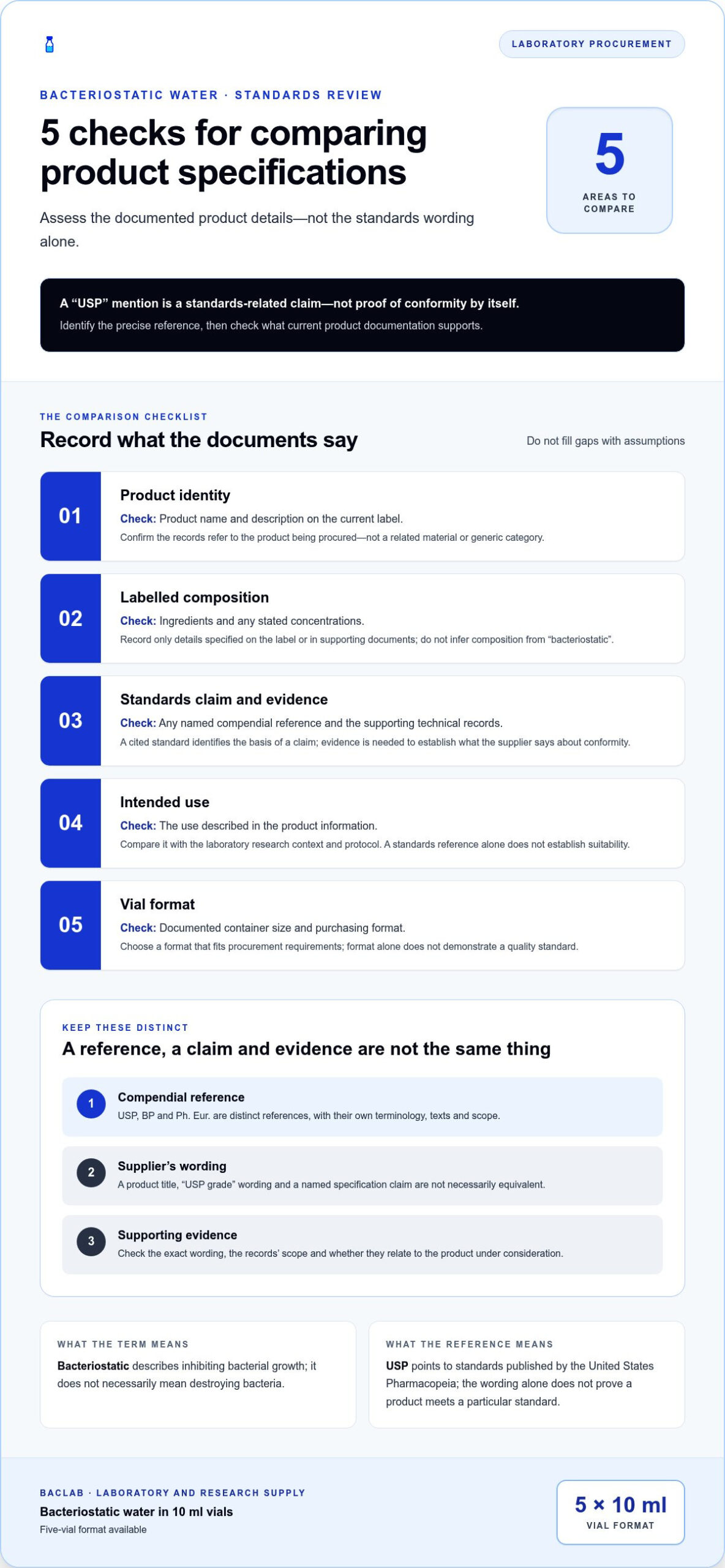
Compare the product’s documented identity and characteristics, not just the standard named in its description. A useful procurement review separates three questions: what the product is, what its current documentation states, and whether those details align with the research method. Use the table as a checklist, entering only details stated in current product documentation rather than filling gaps with assumptions.
| Comparison area | What to examine | How to interpret it |
|---|---|---|
| Identity | The product name and description on the current label | Check that the documentation refers to the product being procured, not a related material or generic category. |
| Labelled composition | Ingredients and any stated concentrations | Record only what the label or supporting documents specify; do not infer composition from the term “bacteriostatic”. |
| Documentation | Any stated compendial reference and supporting technical records | A cited standard identifies the basis of a claim; evidence is needed to establish what the supplier says about conformity. |
| Intended use | The use described in the product information | Compare this with the laboratory’s research context and protocol, without assuming suitability from a standards reference. |
| Vial format | Documented container size and purchasing format | Choose a format that fits procurement requirements; format alone does not demonstrate a quality standard. |
Assess the documented specification, not the label alone. This is especially important when a description uses a phrase such as “USP” without naming the particular standard or explaining the basis of the claim.
What evidence supports a USP-related claim?
Start with the current product label and technical documentation. Note the exact wording, whether a specific compendial reference is named, and whether the supporting records relate to the product under consideration. A USP reference is not, by itself, test data or evidence that a particular product meets a specified requirement. Interpret a certificate or other record according to its stated scope and the product or lot it covers.
For a structured review of product records and laboratory checks, the bacteriostatic water quality-control checklist offers a related procurement framework.
How should buyers compare USP, BP and Ph. Eur. references?
USP, the British Pharmacopoeia (BP) and the European Pharmacopoeia (Ph. Eur.) are distinct compendial references, each with its own terminology, texts and scope. Their names are not interchangeable labels, and a product category alone does not establish compliance with any one of them.
Before comparing a specific monograph or requirement, verify the relevant wording and edition in the current authoritative text. Then compare the product’s documentation with that reference, without assuming equivalence where it has not been demonstrated. When reviewing bacteriostatic water USP wording alongside other purchasing criteria, this helps keep standards evidence separate from protocol suitability.
Once the specification review is complete, account for the vial format required for procurement. BacLab supplies bacteriostatic water for laboratory and research applications in 10ml vials. The five-vial 10ml format is one purchasing option.
Does bacteriostatic water USP automatically mean pharmaceutical grade?
No. The wording alone does not establish pharmaceutical status, regulatory classification or intended use. A USP reference, a supplier’s statement, the product documentation and the buyer’s laboratory application are separate pieces of information. Treating them as interchangeable can lead procurement teams to infer attributes that the available evidence does not demonstrate.
For a research purchase, ask what the supplier is claiming, which documentation supports that claim, and whether the documented characteristics match the laboratory’s requirements. Assess the phrase bacteriostatic water USP in context rather than treating it as a complete statement of product status.
What can a USP reference establish, and what can it not establish?
A clearly identified compendial reference indicates which standard is being cited. On its own, it does not establish that a specific product has been shown to meet every requirement within that standard. That conclusion depends on the claim’s wording and the supporting records, including their scope and the product they relate to.
A reference also does not establish every quality attribute, manufacturing condition or performance characteristic a researcher might care about. A standard may address specified criteria, but it does not guarantee a particular experimental outcome or prove suitability for every method. Keep claims proportionate to the evidence: distinguish the name of a standard from records that substantiate a supplier’s claim of conformity.
“Pharmaceutical grade” can also be used in different ways in product descriptions. Do not infer a regulatory status from that phrase or from a USP reference alone. Any statement about a product’s legal classification, approval or regulatory pathway must be checked against current authoritative sources before it is used in a procurement decision.
Why intended use remains a separate decision
Laboratory suitability depends on the method. Compare the product’s documented identity and specification with the relevant research protocol, including any properties the method explicitly requires. If product information does not address a criterion, its status cannot be inferred from a general grade or standards label. Record the evidence separately from the laboratory’s assessment of fit.
This article concerns laboratory and research applications, which is also the intended context of BacLab’s bacteriostatic water supply. Keep that context explicit in product selection and procurement records. A compendial reference does not change the stated application or establish suitability beyond the documented scope.
For a related distinction between two laboratory water categories, the technical comparison of bacteriostatic and sterile water considers how their characteristics differ in research contexts. Keeping identity, evidence and method suitability separate gives buyers a clearer basis for comparing products than relying on a grade phrase alone.
How can research buyers assess a bacteriostatic water USP claim?
Use a documented review rather than treating terminology as proof. For a bacteriostatic water USP claim, record what is stated, trace it to product-specific evidence, check whether the stated application fits the laboratory method, and compare formats with procurement needs. Keep verified details distinct from assumptions, and record unresolved specification questions for internal laboratory review.
A four-step check for labels and documentation
- Identify the claim. Record the exact wording from the current product description or label, including any named compendium or specification. Do not turn a broad phrase into a stronger claim of conformity.
- Locate its evidence. Match each statement to a specific label entry or supporting technical document. Note which product the document covers and whether it directly substantiates the claim, rather than simply repeating the same terminology.
- Check intended use. Compare the documented product information with the requirements of the laboratory research method. Keep this assessment separate from the standards claim; a reference alone does not establish method-specific suitability.
- Compare formats. Review the stated vial size and purchasing format against the laboratory’s procurement requirements and planned workflow. Do not infer composition, performance or other specifications from the container format.
If a characteristic is not stated in current documentation, mark it as unverified. Do not fill the gap using the product category, a familiar label phrase or an assumption about what a standard usually covers. This creates a traceable record of what has been established and identifies questions for internal laboratory review, without turning procurement analysis into clinical guidance.
When should buyers compare vial formats?
Compare formats once you have assessed the documented information, using the laboratory’s purchasing needs as the basis for selection. BacLab supplies 10ml bacteriostatic water vials individually and in multi-vial formats, including a five-vial option. These are purchasing formats, not evidence of a particular standard or any other product characteristic.
Take care with terminology: a multi-vial order describes the quantity purchased, whereas “multi-dose” refers to a different product or container concept. Do not treat the terms as interchangeable. Keep questions about terminology separate from decisions about the quantity required for laboratory procurement.
When distinguishing bacteriostatic water from sterile water, compare the stated product characteristics with the research method rather than relying on category names. BacLab’s technical comparison of bacteriostatic and sterile water provides relevant context for that distinction.
For laboratory and research purchasing, the five-vial format contains 10ml bacteriostatic water vials.
View five 10ml bacteriostatic water vials
BacLab bacteriostatic water: applying the comparison to a research purchase
After assessing a standards claim, focus on the practical procurement decision: identify the intended research application, review the product information for the purchase, and select a vial format that fits laboratory requirements. BacLab is a UK-based specialist supplier of bacteriostatic water in 10ml vials for laboratory and research applications, with individual and multi-vial purchasing options.
The five-vial 10ml format suits a purchasing plan that calls for multiple vials. Vial quantity and volume describe the purchasing format; they do not, by themselves, establish conformity with USP or another standard. Use USP wording only where current product documentation supports the specific claim.
What does BacLab supply for laboratory research?
BacLab supplies bacteriostatic water in 10ml vials for laboratory and research applications. You can choose individual vials or multi-vial formats, including five 10ml vials, to match your purchasing requirements. This is laboratory research supply, not a supply of medicines or peptides, and BacLab does not provide medical advice.
What is the next step after checking the specifications?
Before placing an order, align the product information with the laboratory’s purchasing criteria and research workflow. Keep the record specific: note the product identity, stated format and any specifications the decision relies on. If a required detail is not stated in the material you review, keep it as an open item for internal review rather than inferring it from a general product term.
For a multi-vial purchasing requirement, review the five-vial 10ml bacteriostatic water option in the context of your laboratory’s planned order. The format provides five 10ml vials; do not infer an additional specification or standards claim from the pack description alone.
A consistent procurement record helps distinguish the product information used to select a format from the evidence used to evaluate a standards claim. Keep those decisions separate: the first concerns purchasing fit, while the second depends on the claim’s wording and supporting documentation. This makes the basis for selection clearer for laboratory colleagues reviewing the order.
Where a research protocol specifies particular product characteristics, use those requirements as the comparison point rather than relying on the name of a standard or a vial configuration. This grounds the purchasing decision in documented information and the laboratory’s own procurement criteria.
To review BacLab’s five-vial format for laboratory research purchasing:
View five 10ml bacteriostatic water vials
Make your next research purchase with clarity
Turn the laboratory’s method requirements into clear purchasing criteria. Decide which documented product characteristics matter to the work, then use those criteria as you assess product information and select a format. This gives colleagues a consistent basis for reviewing the purchase and helps prevent assumptions from becoming part of the specification.
The phrase bacteriostatic water USP is useful only when its meaning and supporting evidence are clear in the context of the product being considered. If documentation leaves a question unresolved, record it for internal review rather than treating terminology as an answer. A careful decision should not overstate what the available information establishes.
For laboratory research procurement, BacLab supplies bacteriostatic water in individual and multi-vial formats. Review the product information and choose the purchasing option that aligns with your requirements.
With a clear specification and an evidence-led review, you can make a purchase decision grounded in your laboratory’s needs.
Shop five 10ml bacteriostatic water vials
Frequently Asked Questions
What does USP mean on bacteriostatic water?
USP refers to the United States Pharmacopeia, which publishes compendial standards. On bacteriostatic water, the reference may indicate that a supplier is making a standards-related claim, but the wording needs context. A product title that includes “USP”, for example, is not the same as a document identifying the relevant standard and explaining how the product’s specification relates to it. Keep the exact wording with your procurement record.
Is bacteriostatic water USP the same as sterile water?
No. The terms describe different product characteristics, and the names alone do not establish that two products have the same composition. When comparing them, review each product’s label and technical information, including any stated ingredients and intended application. Do not assume that a product described as sterile water has the same formulation as bacteriostatic water, or that one can replace the other in a research method.
Does a USP reference prove that a bacteriostatic water product meets USP requirements?
No. A reference in a product description does not, by itself, demonstrate that a particular product meets the cited requirements. Look for supporting documentation that identifies the product and clarifies the scope of the claim. A lot-specific Certificate of Analysis, where supplied, may help connect test information to the material being purchased. Assess what it actually reports rather than treating the document’s title as proof of every specification.
Can laboratory buyers use USP wording to determine whether a reagent suits a research method?
No. USP wording alone cannot establish that a reagent is suitable for a particular laboratory method. Compare the method’s stated acceptance criteria with the product information, and note any required characteristic the documentation does not address. If a protocol depends on a specified property, for example, do not assume it from a general standards reference. Record the gap for internal laboratory review before making a procurement decision.
What documentation should accompany a bacteriostatic water USP claim?
Review the current product label and technical documentation, then check whether they identify the claim and product clearly. A Certificate of Analysis, if supplied, can provide test results associated with a product or lot, but its contents and scope matter. A Safety Data Sheet serves a different purpose and should not be treated as evidence of compendial conformity. Keep each document’s role clear in procurement records.
How should buyers compare USP, BP and Ph. Eur. terminology?
Treat USP, the British Pharmacopoeia (BP) and the European Pharmacopoeia (Ph. Eur.) as distinct references, not interchangeable labels. If a purchasing specification names one, compare the product claim against that reference rather than assuming another compendium is equivalent. For a precise monograph comparison, consult the relevant current authoritative texts and editions. Record the terminology exactly as stated in the product information to avoid broadening the claim.
Is BacLab bacteriostatic water intended for laboratory research?
Yes. BacLab supplies bacteriostatic water for laboratory and research applications. Consider the product information in that stated context and compare the details provided with your laboratory’s procurement requirements. The research-use positioning does not, by itself, establish conformity with USP; any standards claim needs support from the relevant current product documentation.