
The integrity of a longitudinal study often rests not on the primary analyte, but on the chemical stability of its diluent. For laboratories managing sensitive, lyophilised compounds, the selection of bacteriostatic water for biochemical research represents a critical decision point in protocol design. Whilst standard sterile water is suitable for immediate, single-use applications, it fails to provide the antimicrobial protection necessary for multi-dose environments over extended durations. It’s a fundamental requirement for maintaining aseptic conditions when a single vial must support multiple extraction points without compromising the molecular structure of the reagent.
Researchers frequently encounter the premature degradation of expensive compounds due to subtle microbial ingress or pH fluctuations within multi-use vials. This guide provides a clinical analysis of bacteriostatic water’s biochemical properties, specifically focusing on the 0.9% benzyl alcohol concentration and its role in maintaining reagent stability for up to 28 days. We’ll examine the procurement standards for 10ml vials within the United Kingdom, ensuring that institutional sourcing aligns with 2026 regulatory frameworks and aseptic requirements. The following sections detail the molecular interactions, storage protocols, and cost-efficiency models essential for contemporary biochemical research.
Key Takeaways
- Evaluate the molecular mechanism of 0.9% benzyl alcohol as a preservative agent in bacteriostatic water for biochemical research to effectively inhibit bacterial proliferation.
- Contrast the efficacy of bacteriostatic versus sterile water to determine the most appropriate diluent for longitudinal, multi-dose experimental protocols.
- Assess the technical advantages of 10ml Type 1 borosilicate glass vials in maintaining the biochemical stability and pH of reconstituted reagents.
- Establish protocol-compliant storage and handling procedures to ensure vial sterility remains intact for the maximum 28-day post-puncture window.
- Navigate UK-specific procurement standards to secure high-quality reagents from specialist laboratory suppliers for professional research environments.
Defining Bacteriostatic Water within the Biochemical Research Framework
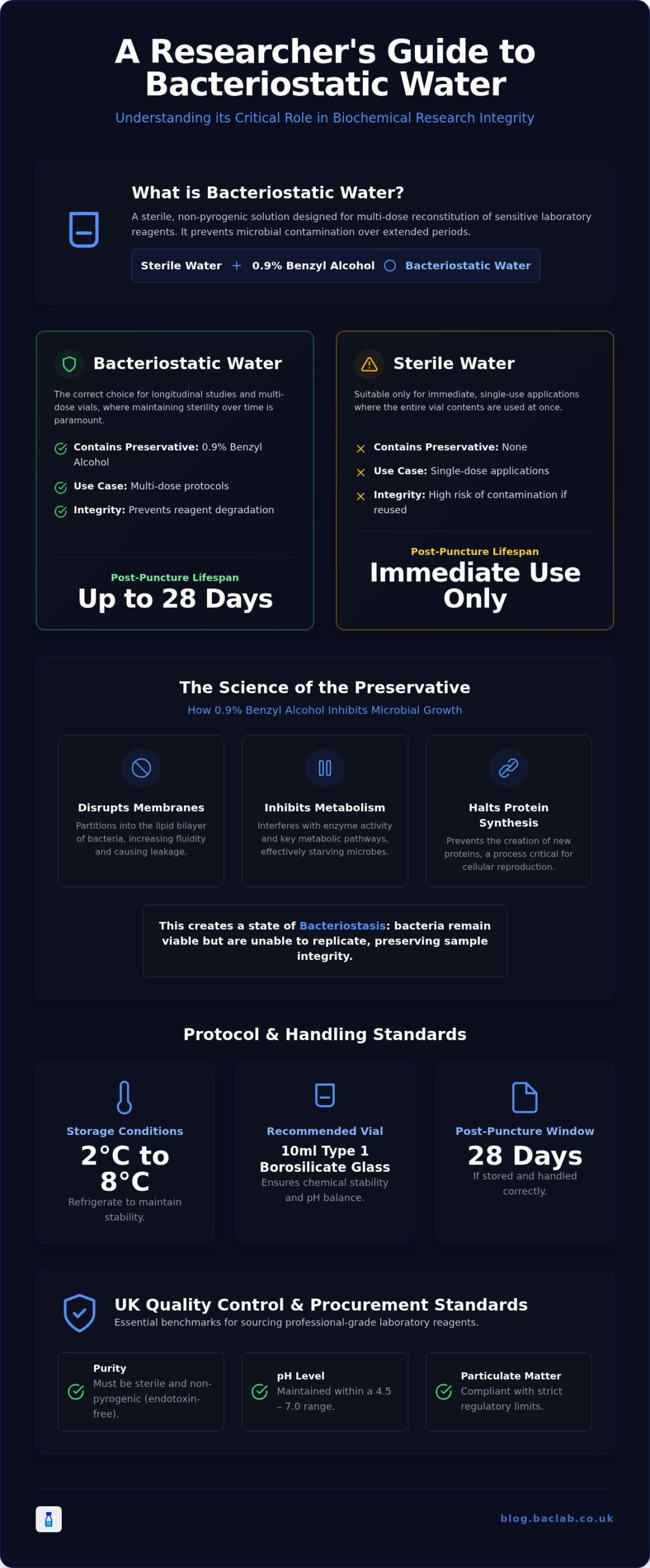
Bacteriostatic water for biochemical research is defined as a sterile, non-pyrogenic preparation specifically formulated for the dilution and reconstitution of lyophilised proteins and sensitive laboratory reagents. Its primary characteristic is the inclusion of 0.9% (9 mg/mL) benzyl alcohol (C7H8O), which functions as a preservative. This aromatic alcohol acts as a Bacteriostatic agent; it effectively halts the reproductive capabilities of gram-positive and gram-negative bacteria by inhibiting protein synthesis and disrupting metabolic pathways. In professional laboratory settings, this prevents the exponential growth of contaminants that might otherwise degrade the primary biochemical analyte during an experiment.
It’s a matter of chemical compatibility when selecting a diluent. Bactericidal substances often employ harsh oxidative or corrosive mechanisms that can denature delicate molecular bonds or alter the pH of the solution. Conversely, the 0.9% benzyl alcohol concentration in bacteriostatic water is high enough to suppress microbial proliferation but low enough to remain biochemically neutral for most research applications. This neutrality is vital when reconstituting lyophilised reagents where even minor shifts in the solvent’s chemical profile could lead to irreversible aggregation or loss of biological potency.
The Significance of Multi-Dose Vial Integrity
Maintaining sterility across longitudinal studies presents significant challenges when utilising multi-dose vials. Each entry into a vial via a syringe introduces a risk of microbial ingress. The presence of the benzyl alcohol preservative enables a 28-day shelf life post-puncture, provided the reagent is stored under appropriate thermal conditions, typically refrigerated between 2 and 8°C. Selecting 10ml vial volumes offers a strategic balance for researchers; it provides sufficient volume for multiple experimental replicates whilst minimising the waste associated with larger containers that might reach their expiration threshold before total depletion.
Regulatory Standards for Laboratory Reagents
Purity requirements for biochemical grade water are stringent, necessitating a total absence of pyrogens. It’s essential for sensitive assays because bacterial endotoxins can provoke unintended biochemical responses, thereby confounding experimental data. Within the United Kingdom, laboratory reagents must comply with established quality protocols regarding pH levels, which are typically maintained between 4.5 and 7.0, and particulate matter limits. Adhering to these standards ensures that the bacteriostatic water for biochemical research does not introduce exogenous variables into controlled environments, preserving the accuracy of the researcher’s observations.
The Biochemistry of 0.9% Benzyl Alcohol as a Preservative Agent
Benzyl alcohol, or phenylmethanol, is an aromatic alcohol with the molecular formula C7H8O. Its structure comprises a benzene ring substituted with a hydroxymethyl group, granting it a unique amphiphilic character. Whilst it’s moderately soluble in aqueous solutions, its lipophilic moiety allows it to interact preferentially with biological membranes. In the context of bacteriostatic water for biochemical research, this molecular configuration is essential for its role as a preservative, providing the necessary chemical environment to suppress microbial proliferation without compromising the solvent’s primary function.
The mechanism of action is primarily centred on the disruption of bacterial cell membrane integrity. Benzyl alcohol molecules partition into the lipid bilayer of contaminating microorganisms, causing structural perturbations that increase membrane fluidity. This disruption leads to the dissipation of the proton motive force and the subsequent leakage of essential intracellular components. Additionally, it interferes with metabolic pathways by inhibiting enzyme activity and protein synthesis, effectively halting cellular division. Unlike bactericidal agents that cause immediate cell lysis, benzyl alcohol maintains a state of bacteriostasis where bacterial cells remain viable but are unable to replicate.
The 0.9% concentration (9 mg/mL) has been established as the industry standard due to its balance between antimicrobial efficacy and reagent compatibility. At this specific concentration, benzyl alcohol provides enough inhibitory pressure to prevent the proliferation of most common laboratory contaminants for up to 28 days. Lower concentrations fail to provide sustained protection, whilst higher concentrations risk the denaturation of delicate biochemical compounds or the alteration of molecular folding patterns in reconstituted proteins. This precise optimisation ensures that the water remains a reliable diluent for sensitive laboratory protocols.
Antimicrobial Spectrum in Laboratory Environments
Benzyl alcohol exhibits a broad spectrum of activity against both Gram-positive and Gram-negative bacteria, such as Staphylococcus aureus and Escherichia coli. However, researchers must note that its efficacy against fungal spores and viral pathogens is significantly lower than its antibacterial performance. It’s a bacteriostatic agent, not a sterilant; it maintains a state of growth inhibition rather than achieving total microbial eradication. This is sufficient for maintaining the sterility of a multi-dose vial under aseptic handling conditions but requires strict adherence to laboratory hygiene standards to prevent overwhelming the preservative’s capacity.
Chemical Stability and pH Considerations
The presence of benzyl alcohol influences the electrochemical profile of the solution, typically resulting in a pH range between 4.5 and 7.0, with an average target of 5.7. This slight acidity is a critical variable when working with pH-sensitive biochemicals. Whilst most lyophilised compounds are stable within this range, some proteins may require specific buffering to prevent precipitation or loss of activity. When sourcing these reagents, researchers often prioritise technical specifications and batch consistency to ensure experimental reproducibility across complex study designs and longitudinal research programmes.
Comparative Efficacy: Bacteriostatic vs. Sterile Water in Longitudinal Studies
The selection between Sterile Water for Injection (SWFI) and bacteriostatic water for biochemical research is dictated by the temporal requirements and sensitivity of the experimental protocol. SWFI is a single-dose reagent, devoid of any antimicrobial preservatives, designed for immediate application. Once the vial’s integrity is compromised by a needle puncture, the solution is susceptible to rapid microbial proliferation. In contrast, bacteriostatic water incorporates 0.9% benzyl alcohol, which establishes a chemically stable environment that suppresses bacterial growth, allowing for sustained use of the vial across multiple extraction points.
Longitudinal studies that rely on the periodic withdrawal of reagents from a single source face a heightened risk profile when using non-preserved diluents. Even under rigorous aseptic conditions, the introduction of ambient microorganisms is a statistical probability over repeated entries. Without a bacteriostatic agent, these contaminants can alter the pH, produce metabolic by-products, or enzymatically degrade the primary analyte. This instability directly compromises the reproducibility of the data; the biochemical environment of the first dose may differ significantly from the final dose extracted 14 days later. Implementing a standardised bacteriostatic water quality control protocol is essential for detecting and mitigating these risks before they compromise experimental outcomes.
Using preserved water ensures that the baseline conditions of the solvent remain constant throughout the study’s duration. This consistency is particularly vital when working with expensive or scarce lyophilised compounds, where the loss of a single vial due to contamination represents a significant setback in both time and institutional resources. By maintaining a stable environment, researchers can ensure that observed variations in data are attributable to the experimental variables rather than diluent degradation.
When to Utilise Sterile Water for Injection
Researchers should opt for SWFI in specific assays where benzyl alcohol might induce chemical interference or toxicological effects on the biological system under observation. This includes certain cell culture methodologies or assays measuring enzymatic kinetics where aromatic alcohols could act as inhibitors. If the protocol requires a single-dose administration or if the reconstituted compound will be entirely consumed within a 24-hour window, the absence of preservatives in sterile water eliminates an unnecessary chemical variable from the experimental matrix.
Advantages of Bacteriostatic Water for Reconstitution
The primary advantage of bacteriostatic water lies in its capacity to facilitate multi-dose experimental designs without the need for immediate disposal of unused reagents. By extending the vial’s viability to 28 days, laboratories can significantly reduce reagent waste and improve cost-efficiency in long-term protein stability studies. The 10ml vial format is particularly efficacious in this regard, providing a sufficient reservoir for repeated aseptic withdrawals whilst maintaining a manageable volume that is likely to be utilised within the preservative’s effective lifespan.
Procurement and Quality Control Standards for UK Laboratory Reagents
Sourcing bacteriostatic water for biochemical research requires a rigorous focus on the structural integrity of the primary packaging. High-quality 10ml vials must be constructed from Type 1 borosilicate glass. This specific material is preferred in laboratory environments due to its superior chemical resistance and low expansion coefficient, which effectively prevents the leaching of alkali ions into the aqueous solution. Such leaching could otherwise disrupt the established pH balance or react unfavourably with sensitive biochemical analytes, leading to compromised experimental results.
Verification of vacuum-sealed integrity is a non-negotiable standard for laboratory-grade supplies. A compromised seal allows for the ingress of atmospheric contaminants and the potential loss of the 0.9% benzyl alcohol concentration through evaporation. Researchers should inspect vials for tamper-evident flip-off caps and ensure the rubber stopper is seated correctly within the aluminium crimp. These physical barriers are essential for maintaining the non-pyrogenic status of the water during transit and subsequent storage amongst laboratory supplies. Once a vial is punctured, the chemical stability of the preservative is designed to maintain sterility for 28 days, provided the vial is stored at 2 to 8°C. Laboratories seeking to formalise these verification steps should consult a comprehensive bacteriostatic water quality control checklist to ensure all internal benchmarks for benzyl alcohol concentration and vial integrity are systematically assessed.
Evaluating Supplier Reliability in the UK
Suppliers must provide comprehensive technical documentation, including batch-specific Certificates of Analysis (CoA). These documents verify that the reagent meets British Pharmacopoeia (BP) grade standards for purity and preservative concentration. UK-based distribution is advantageous as it reduces the transit duration and the likelihood of extreme temperature fluctuations that could affect chemical stability. It’s necessary to distinguish between research-grade reagents and lower-grade industrial supplies that may lack the required sterile processing and pyrogen testing. For institutions requiring high-volume supplies, BacLab provides wholesale bundles of 10ml bacteriostatic water specifically for laboratory use.
Wholesale and Bulk Procurement Strategies
Large-scale biochemical research facilities often utilise bulk procurement to maintain consistent reagent batches across multi-phase studies. Organising inventory around bulk discount structures allows for significant cost-efficiency, but it necessitates a disciplined approach to shelf-life rotation. Unopened vials typically maintain stability for 18 to 24 months when stored at controlled room temperatures between 20 and 25°C. However, once placed into active lab stock, inventory managers must ensure that the First-In, First-Out (FIFO) principle is applied to prevent the use of reagents near their expiration threshold. Maintaining a centralised log of batch numbers and manufacture dates is standard practice for ensuring experimental continuity.
Sourcing 10ml Bacteriostatic Water Vials for Professional Research
BacLab operates as a specialist intermediary within the United Kingdom’s biochemical supply chain, focusing exclusively on the provision of 10ml bacteriostatic water vials. This concentration on a singular reagent format allows for a higher degree of technical oversight regarding batch consistency and structural integrity. The 10ml multi-dose vial is the primary unit of distribution, selected for its optimal alignment with standard laboratory protocols that require repeated aseptic withdrawals over a 28-day period. By specialising in this specific volume, the supply chain is optimised for researchers who require a balance between volume availability and the prevention of reagent expiration.
The technical specifications of these vials meet the rigorous requirements of contemporary biochemistry. Each vial contains sterile, non-pyrogenic water integrated with 0.9% benzyl alcohol, housed in Type 1 borosilicate glass to ensure long-term pH stability. This commitment to laboratory-grade purity ensures that the bacteriostatic water for biochemical research remains a neutral diluent, free from the surfactants or additives that are sometimes present in lower-grade alternatives. Institutional procurement through a UK-based specialist ensures that logistical pathways are shortened, reducing the risk of environmental degradation during transit.
BacLab Procurement Options
Individual 10ml vials are available for pilot studies and small-scale laboratories where reagent throughput is limited. For larger institutional requirements, wholesale bundles are provided to support high-frequency research environments and longitudinal studies. These bundles allow research facilities to maintain a consistent batch number across an entire experimental programme, which is a critical factor in reducing variables during data analysis. The logistical infrastructure supports national coverage, providing a reliable source for sterile reagents that comply with UK laboratory safety standards. Bulk discount structures are applied to these institutional orders, facilitating cost-efficiency without compromising the analytical grade of the supply.
Professional Support and Technical Guidance
The procurement of laboratory reagents is often complicated by suppliers who market a broad range of unrelated biological compounds. BacLab maintains a disciplined focus on reagent purity, ensuring that procurement officers and researchers are not distracted by medical or peptide-related marketing. This transparency is essential for maintaining the professional distance required in academic and industrial research settings. Technical guidance is focused strictly on the biochemical properties and handling requirements of the 10ml vial, ensuring that users can maintain the 28-day stability window through appropriate storage and aseptic technique. To secure high-quality reagents for your laboratory, you may explore the BacLab range of bacteriostatic water to review technical specifications and institutional bundle options.
Advancing Reagent Stability in Longitudinal Protocols
Establishing a rigorous procurement framework is essential for preserving the molecular integrity of sensitive analytes. This guide has detailed how the 0.9% benzyl alcohol preservative within bacteriostatic water for biochemical research facilitates a 28-day stability window, provided that aseptic handling and thermal storage protocols are maintained. It’s a necessary step for ensuring longitudinal data consistency and institutional cost-efficiency when transitioning from single-use sterile water to preserved alternatives for multi-dose experimental designs.
BacLab serves as a specialist UK-based laboratory supplier, providing 10ml multi-dose vials that are specifically optimised for research environments. By utilising wholesale bundles and bulk discounts, institutions can maintain batch uniformity across complex study phases whilst mitigating the risks of reagent degradation. These procurement strategies, combined with the use of Type 1 borosilicate glass, provide a robust defence against microbial ingress and chemical instability. To maintain the highest standards of laboratory precision, you should procure high-purity bacteriostatic water for your research. Adopting these technical standards will support the ongoing accuracy of your biochemical investigations.
Frequently Asked Questions
What is the primary difference between bacteriostatic and sterile water for research?
The primary distinction lies in the presence of 0.9% benzyl alcohol, which acts as an antimicrobial preservative. While sterile water for injection is a single-use diluent that becomes susceptible to contamination immediately upon puncture, bacteriostatic water for biochemical research is formulated to suppress bacterial replication. This allows for repeated access to the same 10ml vial over an extended period. Researchers must select the reagent based on whether the protocol requires a preservative-free environment or multi-dose stability.
How long does a 10ml vial of bacteriostatic water remain stable after the first use?
A 10ml vial of bacteriostatic water remains stable for up to 28 days after the initial rubber stopper puncture. This stability is contingent upon the maintenance of aseptic technique during every withdrawal and the storage of the vial in a controlled refrigerated environment between 2 and 8°C. If the solution appears cloudy or contains particulate matter before this duration concludes, the vial must be discarded immediately to prevent the introduction of contaminants into sensitive biochemical assays.
Is 0.9% benzyl alcohol compatible with all biochemical reconstitution protocols?
Whilst 0.9% benzyl alcohol is a standard preservative, it’s not universally compatible with every biochemical protocol. Certain aromatic alcohol-sensitive enzymes or specific cell culture lines may exhibit altered kinetics or decreased viability when exposed to this concentration. Researchers should perform a preliminary compatibility assessment or consult the technical datasheet of their lyophilised compound. If a protocol requires an absolute absence of preservatives to maintain molecular integrity, sterile water for injection is the mandatory alternative.
Why is bacteriostatic water preferred for multi-dose vials in laboratory settings?
Bacteriostatic water is preferred because it establishes a chemically stable environment that inhibits the growth of gram-positive and gram-negative bacteria introduced during repeated syringe entries. In laboratory settings where reagents are expensive or limited in quantity, the ability to utilise a single 10ml vial for multiple replicates over several weeks is highly cost-efficient. It reduces the logistical burden of disposing of unused sterile water and minimises the volume of reagent waste generated during longitudinal studies.
Can bacteriostatic water be used for in vitro protein assays?
Bacteriostatic water can be utilised for in vitro protein assays provided the researcher accounts for the presence of the 0.9% benzyl alcohol. This preservative can occasionally influence protein-protein interactions or enzymatic activities depending on the protein’s hydrophobic profile. It’s standard practice to verify that the bacteriostatic water for biochemical research doesn’t induce unintended denaturation. For most routine reconstitutions of lyophilised powders, the preservative concentration is sufficiently low to avoid significant interference with downstream analytical results.
What are the storage requirements for bacteriostatic water in the UK?
Storage requirements in the United Kingdom dictate that unopened vials should be kept at a controlled room temperature, typically between 20 and 25°C, away from direct sunlight. Once the vial’s seal is compromised, it must be refrigerated at temperatures between 2 and 8°C to preserve the efficacy of the bacteriostatic agent. Researchers should ensure that vials aren’t subjected to freezing, as this can compromise the structural integrity of the Type 1 borosilicate glass and the vacuum seal.
Are there wholesale options for bacteriostatic water for UK research facilities?
Yes, UK research facilities can access various wholesale bundles and bulk discount structures for their reagent requirements. BacLab provides these options specifically for institutional procurement, allowing laboratories to maintain consistent batch numbers across large-scale experimental programmes. These wholesale arrangements are designed to support high-throughput environments where the frequent use of 10ml multi-dose vials is required. National distribution protocols ensure that these sterile reagents reach research centres across the country through streamlined logistical pathways.
Does BacLab provide certificates of analysis for their laboratory reagents?
BacLab provides technical documentation to verify the purity and concentration of their laboratory reagents. This includes batch-specific data that confirms the 0.9% benzyl alcohol content and ensures the solution is non-pyrogenic and sterile. Providing these specifications is essential for maintaining research compliance and ensuring that experimental variables remain controlled. Researchers can request this information to support their internal quality control audits and to verify that the water meets the necessary British Pharmacopoeia grade standards.