
Creating a lab consumables reordering schedule turns stock counts, consumption records and supplier lead times into planned decisions. Instead of relying on memory or discovering a shortage when an item is needed, staff can use a shared record to see what is in stock, when to reorder and who is responsible.
A missing consumable can interrupt planned work, while over-ordering can take up storage space or leave stock unused near its expiry date. Because consumption and lead times vary by item, one reorder rule will not suit every product. A practical schedule needs clear thresholds, assigned responsibility and regular review.
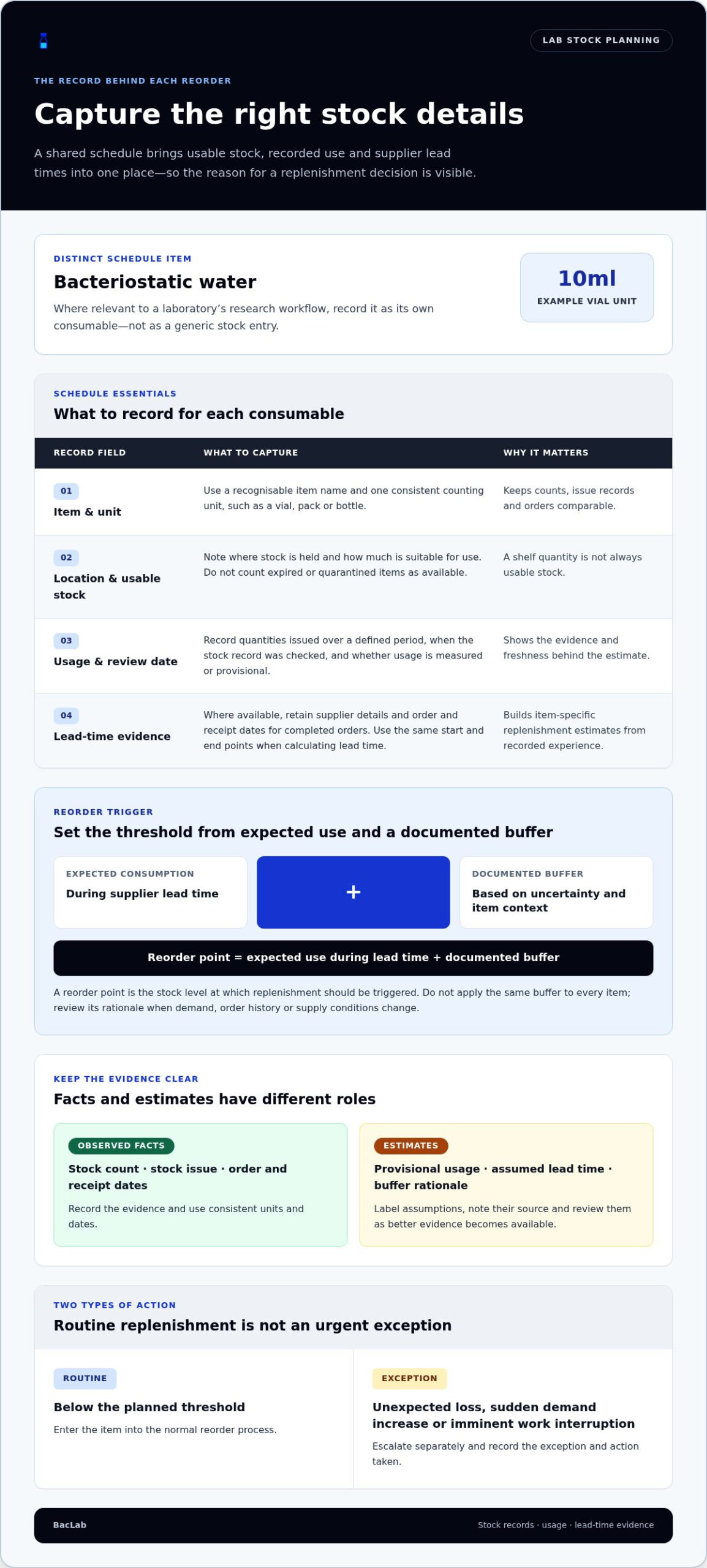
This guide provides a template for recording usage, usable stock, lead times, reorder points and review dates. It also explains how to review assumptions against actual use and rotate stock appropriately. Where bacteriostatic water is relevant to a laboratory’s research workflow, it can be recorded as a distinct item, such as a 10ml vial.
Key Takeaways
- Record each consumable’s unit, storage location, usable stock, usage and review date.
- When creating a lab consumables reordering schedule, base reorder points on expected use during supplier lead time plus a documented buffer.
- Set review frequency according to an item’s criticality and how much its use varies.
- Assign an owner to each item and use a consistent workflow to calculate thresholds, review exceptions and record decisions.
- Review the schedule when demand, storage arrangements, supplier performance or experimental plans change.
Why create a lab consumables reordering schedule?
Creating a lab consumables reordering schedule gives the team a documented way to decide what to replenish, when to act and who is responsible. Staff can refer to a shared stock record instead of relying on memory or informal messages. The reason for each routine purchase becomes visible, and everyone can see which items need attention.
A schedule cannot prevent every shortage, but it can bring stock counts, recorded usage and known supplier lead times into one review process. That makes potential gaps easier to spot before they affect planned work. These practices form part of inventory management, where stock records support replenishment and control decisions.
Ordering only when a shelf looks nearly empty can hide useful patterns. It may not be clear whether use has increased, whether stock is held in more than one location or who is responsible for the next order. Recording purchases and stock checks helps distinguish recurring demand from a one-off requirement, and gives the team a basis for reviewing its assumptions.
Separate routine replenishment from urgent exceptions. An item below its planned threshold can enter the normal reorder process. Unexpected stock loss, a sudden increase in demand or an imminent interruption to planned work needs separate escalation. Record the exception and action taken so it is not mistaken for an ordinary order awaiting review.
Which consumables belong in the schedule?
Prioritise regularly used reagents, sterile supplies and other items whose absence could affect planned work. The laboratory consumables category offers a useful reference, but the schedule should reflect the laboratory’s actual workflows. Bacteriostatic water can be included where it is relevant to those activities; it should not be treated as suitable for every workflow.
Separate routine stock from occasional, project-specific purchases. Track a recurring item against consumption. For a one-off requirement, use a project record and a defined end point rather than a standing reorder rule. This avoids treating temporary demand as a permanent baseline.
What a schedule can and cannot control
A schedule organises decisions, but cannot guarantee supplier availability or fixed delivery times. Separate observed facts, such as a stock count or recorded issue, from estimates, such as assumed usage when records are incomplete. Label estimates clearly and review them as better evidence becomes available.
Expiry dates, storage conditions and handling requirements affect whether recorded stock is usable. A quantity on the shelf may not all be available for planned work. Include relevant notes in the schedule and follow the laboratory’s applicable procedures when assessing stock.
Which data should a lab consumables reordering schedule use?
A schedule is only as useful as its underlying records. At minimum, give each item a recognisable name, unit of measure, storage location, usable stock quantity, consumption record and review date. These fields help staff compare like with like and check when the information was last verified. Add supplier and order and receipt dates where available, so replenishment decisions can use recorded experience rather than a generic assumption.
A reorder point is the stock level at which replenishment should be triggered. To calculate it, record both expected consumption and the time replenishment takes. When creating a lab consumables reordering schedule, distinguish measured figures from estimates. If issue records are incomplete, label usage as provisional and set a date to review it.
- Item and unit: identify the consumable and the quantity unit used for counting.
- Location and usable stock: record where stock is held and how much is currently suitable for use.
- Usage and review date: note quantities issued over a defined period and when the record was checked.
- Lead-time evidence: capture order and receipt dates for completed orders where records exist.
Measure consumption and stock accurately
Choose one consistent unit for each item, such as vial, pack or bottle, and use it for counts, issue records and orders. If the unit changes, apparent consumption may reflect a conversion rather than a change in demand. Count physical stock, then identify how much is usable. Expired or quarantined items should not be counted as available just because they remain on the shelf.
Record the date and quantity whenever stock is issued or consumed. Reviewing entries over a defined period can show whether demand is stable, increasing or linked to a particular project. If the data are incomplete, label the best available estimate with its source and uncertainty. That helps the next reviewer decide whether it remains suitable for planning.
Estimate lead time and a suitable buffer
Calculate lead time from internal order and receipt dates, using the same start and end points each time. One order may not represent the usual pattern, so retain individual records and review them as more orders are completed. Use evidence for the item and ordering route rather than relying on an assumed average.
A buffer allows for uncertainty beyond expected use during lead time, but its basis should be explicit. Consider recorded variation in demand, the impact of a delay and known changes to supply conditions. Avoid applying the same buffer to every consumable. Review the rationale when order histories, experimental plans or supplier performance change, and update estimates rather than letting them become unexamined defaults.
Where bacteriostatic water is relevant to a laboratory’s workflow, record it as a distinct item, such as a 10ml vial. View BacLab’s 10ml bacteriostatic water vial as a product reference for a schedule entry.
How should you set reorder points and review frequencies?
Set a starting reorder point by estimating how much of an item will be used during its supplier lead time, then adding a documented buffer. In basic terms: reorder point = expected use during lead time + buffer. If records show an item is used at a steady rate, match that rate to the recorded lead time to estimate demand before the next delivery. The buffer should have a stated reason, not be an arbitrary amount.
This threshold is an operational estimate, not a guarantee of uninterrupted supply. When creating a lab consumables reordering schedule, keep the assumptions visible so changes in demand or delivery experience can prompt a review.
Choose a reorder-point method that fits the records
For regularly used items, calculate average usage over a defined period and apply it to the lead time recorded for that item. Add the buffer selected for its risk profile, and record the calculation date and evidence used. If demand is intermittent, a historical average may understate an upcoming requirement. Consider known project plans alongside past use rather than treating quiet periods as proof that no stock will be needed.
Where records are sparse, mark the threshold as provisional. Review it as further orders and consumption entries provide better evidence. A clear label helps staff distinguish a measured pattern from a working assumption.
Set review frequencies by item behaviour
Set review frequency according to risk and observed demand. Work-critical items and those with variable use need closer monitoring than predictable stock whose temporary absence has limited impact. Use issue records and order histories to adjust the review interval, rather than applying the same cadence across the inventory. Reassess after a workflow change, a shift in supplier performance or a new experimental plan that affects expected use.
| Item profile | Demand variability | Lead-time confidence | Review cadence |
|---|---|---|---|
| Work-critical | High or changing | Low or variable | Frequent; check stock and exceptions closely |
| Work-critical | Stable | Well documented | Regular; retain close oversight because absence affects planned work |
| Lower impact | High or intermittent | Variable | More frequent until estimates and ordering history improve |
| Lower impact | Stable | Well documented | Less frequent, with a defined date for the next review |
Use the table as a decision aid, not a fixed policy. Translate “frequent” and “less frequent” into review intervals that suit the laboratory’s workload and record-keeping process. If stock is below its threshold, lead time no longer reflects recent orders or demand differs from the estimate, record the exception and action taken. This makes thresholds reviewable and helps distinguish routine replenishment from a developing supply risk.
How to build and use a lab consumables reordering template
A practical template shows the basis for each replenishment decision and gives the responsible person a clear next step. It can be a shared spreadsheet or another record system. What matters is that staff can find the current entry, understand its units and update it consistently. Use these fields as a starting point and adapt them to the laboratory’s purchasing process.
Copyable schedule fields
- Item: name used in the laboratory’s records
- Unit: vial, pack, bottle or other consistent counting unit
- Storage location: where stock is recorded and checked
- Usable stock: quantity currently available for use
- Usage: quantity consumed over the stated period
- Lead time: recorded or clearly labelled estimated duration
- Reorder threshold: level that triggers action, with its calculation basis
- Action owner and review date: person responsible and next check
- Notes: relevant expiry, storage, handling or exception information
Populate the schedule and assign ownership
Start with items classified as routine stock. For each one, transfer available records, confirm the unit and location, and identify who will check the entry and record changes. Assign a person or role to each item so no threshold is left without an owner. Set a review date and state what to do if stock reaches or falls below the threshold, such as recording the exception and starting the agreed replenishment process.
A 10ml bacteriostatic water vial can be an example entry where it suits the laboratory’s research workflow. BacLab’s 5x 10ml bacteriostatic water can also be considered when that product and quantity fit recorded requirements. Keep stock-control decisions separate from handling decisions, which should follow relevant product documentation and laboratory procedures. See related lab consumables guidance for broader context on organising these records.
Review exceptions and improve the schedule
Use a consistent workflow so the schedule leads to recorded decisions, not just a list of quantities:
- Populate item records using available stock, issue and order information.
- Calculate each threshold from expected use, recorded lead time and a documented buffer.
- Assign an owner, review date and clear action for a threshold breach.
- Review exceptions, including stockouts, urgent orders, unused excess and forecast errors.
- Compare planned demand with actual consumption before changing a threshold, then record the reason and date for the revision.
An exception is a prompt to investigate, not automatic evidence that a threshold should rise or fall. Unused excess, for example, may reflect a temporary project change rather than a sustained drop in demand. Compare the forecast with consumption over the relevant period and note any known cause before revising the calculation. If you are reviewing avoidable wastage, guidance on reducing diluent waste may help frame the assessment.
Keep the schedule current and make replenishment straightforward
Set a defined review point to keep the schedule useful. At each review, check consumption records, lead-time evidence, usable stock and unresolved exceptions together. This helps show whether a threshold still reflects the laboratory’s needs or has become outdated. Record the review date and who completed it, even when no changes are needed.
Update the schedule when demand shifts, stock moves location, supplier performance changes or experimental plans alter expected use. A new location may require a different stock-check routine, while a changed workflow may make historical consumption a poor guide to future demand. Do not rely on an old calculation simply because it has not yet led to a shortage.
Use procurement records to refine future decisions
Compare expected and actual receipt dates using internal order records. This can show whether observed lead times vary, but past performance is evidence for an estimate, not a promise about future delivery. Record order quantities and compare them with actual use and internal requirements. This history helps distinguish routine replenishment from purchases driven by a particular project. See laboratory procurement guidance for more on how purchasing records fit into wider processes.
Date every threshold change and add a short reason, such as a revised usage estimate, a documented change in lead time or a change to planned work. Where the record system allows, retain the previous value alongside the new one. This makes the decision traceable and helps the next reviewer understand what changed and why.
Apply the schedule to relevant BacLab supplies
Include bacteriostatic water as a schedule entry where it suits the laboratory’s research workflow. BacLab’s 5x 10ml bacteriostatic water is an option where that pack size fits the laboratory’s recorded requirements. Apply the same evidence-based review as for other items, and follow relevant product documentation and laboratory procedures.
Make replenishment actionable by ensuring the owner knows what to do when a review identifies a threshold breach, changed demand or unresolved exception. Record the decision and its basis, then revisit that basis at the next review. The process is straightforward: record, calculate, assign, review and revise. Used consistently, it gives the team a current reference for routine decisions without treating estimates as certainty.
Put the schedule into practice with a clear first step
Begin creating a lab consumables reordering schedule with one routine item that has a clear record of use. Use the first review to test whether staff can find the entry, interpret its threshold and record an action without relying on informal knowledge. Any gaps will show where ownership, data quality or the review process needs clarification before adding more items.
Keep the schedule as a working record, not a set-and-forget document. Each review should show what was checked, whether a decision changed and what happens next. This helps future reviewers understand the reasoning behind the current approach and improve it as records develop.
Where the workflow and recorded requirements suit it, include BacLab’s 5x 10ml bacteriostatic water as a schedule entry.
Start with a manageable process, refine it through use and let recorded evidence guide each decision.
Frequently Asked Questions
How do you calculate a reorder point for laboratory consumables?
Estimate the quantity used during supplier lead time, then add a buffer based on the item’s risk and demand variability. For example, if average use is U units per day and lead time is L days, estimated lead-time use is U × L; add buffer B in the same units. Creating a lab consumables reordering schedule this way gives staff a traceable working threshold, not a promise of continuous availability. Reassess it when the inputs change.
How often should laboratory stock be reviewed?
Review stock more closely when an item is used quickly, demand fluctuates or running short would affect planned work. A frequently issued consumable may need checking at each scheduled stock review, while a stable, low-impact item could follow a less frequent documented cadence. Use stockout records and actual usage to test whether the interval works. Also consider lead time, since a long or uncertain wait can make delayed checks less useful.
What information should a laboratory consumables reorder template include?
Include enough detail for another team member to understand the entry without informal explanations. Alongside item, unit, location and usable stock, record the period covered by recent consumption, lead-time evidence, threshold, review date and responsible person. A comments field can distinguish an assumption from an observed figure or explain an unusual change. For example, note when an estimate includes a temporary project requirement so it is not mistaken for routine demand.
How can a laboratory avoid over-ordering consumables?
Base each order on current usable stock, recent consumption and known upcoming requirements, rather than repeating the previous order quantity by default. Before ordering, check whether stock elsewhere in the laboratory is available for the same planned work and whether recorded excess reflects a temporary change. Consider expiry and storage constraints where relevant. Identify the cause of any surplus before changing the next order quantity.
What should you do when supplier lead times vary?
Record the order and receipt dates for each purchase, then compare completed orders where records allow. A single delayed delivery may be an exception, while a recurring pattern may mean the schedule’s lead-time estimate needs revision. Document any buffer and its rationale, and flag stock with limited cover through the laboratory’s established purchasing process. Treat an estimated arrival date as planning information, not a guaranteed delivery date.
Can one reordering schedule cover every laboratory consumable?
Yes. One register can hold different consumables as long as each item has its own threshold, review cadence and handling notes. A shared register need not impose identical rules: a frequently used reagent and an occasional project-specific supply may need different controls. Use clear item identifiers and consistent units to avoid confusing similar materials. Separate one-off project purchases from routine stock entries, or label them clearly so they do not distort ongoing demand estimates.