
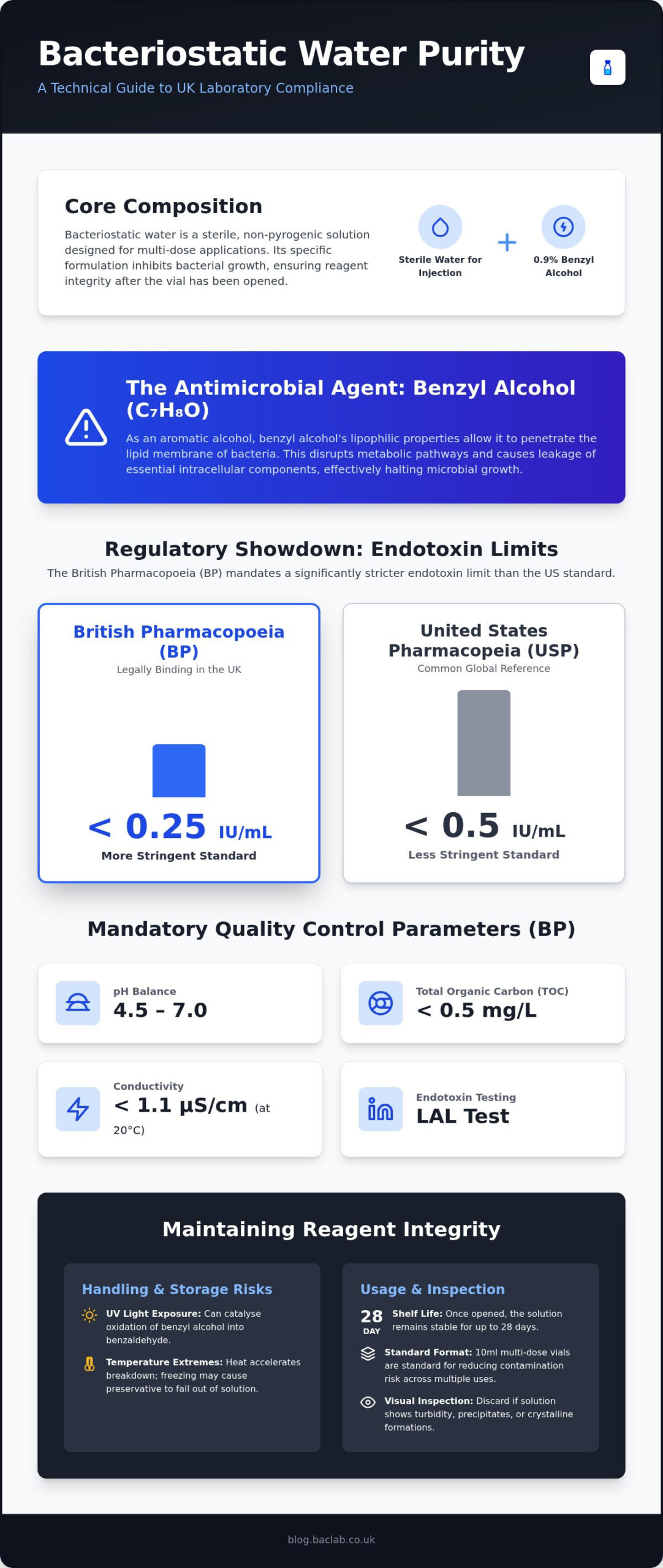
The legal transition to the British Pharmacopoeia (BP) 2027 on 1 January 2027 necessitates a rigorous reassessment of how laboratory facilities verify bacteriostatic water purity standards. Whilst the United States Pharmacopeia (USP) is frequently cited in global literature, the European Pharmacopoeia (Ph. Eur.) remains the legally binding authority for UK research, mandating a bacterial endotoxin limit of less than 0.25 IU/mL. This threshold is notably more stringent than the 0.5 USP Endotoxin Unit per mL allowed under American standards, creating a technical gap that researchers must account for when sourcing reagents.
You likely recognise the operational risks associated with reagent contamination, particularly in multi-dose applications where the integrity of a 10ml vial is paramount. This article delivers a comprehensive technical analysis of the regulatory benchmarks, chemical requirements, and quality control protocols defining bacteriostatic water purity. We provide a methodical examination of pharmacopoeia compliance, the technical criteria for evaluating reagent suppliers, and the specific microbial limits required to maintain experimental validity.
Key Takeaways
- Identify the precise chemical role of 0.9% benzyl alcohol (C7H8O) in disrupting bacterial cell membranes to maintain reagent sterility.
- Differentiate between the British Pharmacopoeia (BP) and USP to ensure that bacteriostatic water purity standards align with the stringent 0.25 IU/mL endotoxin limit required in the UK.
- Evaluate the efficacy of the Limulus Amebocyte Lysate (LAL) test as the primary methodology for validating pyrogen levels in laboratory settings.
- Optimise laboratory workflows by selecting 10ml vials to maintain multi-dose integrity and reduce the risk of reagent contamination.
- Analyse the technical criteria for sourcing from specialist UK suppliers to guarantee consistency across reagent batches and compliance with current regulatory frameworks.
Understanding the Chemical Composition and Purity Requirements
Bacteriostatic water is defined as a sterile, non-pyrogenic preparation of Water for injection that has been modified by the addition of a specific antimicrobial preservative. To adhere to established bacteriostatic water purity standards, the solution must consistently contain 0.9% (9 mg/mL) benzyl alcohol. This precise concentration is required to inhibit the growth of bacteria that may be introduced through repeated needle punctures in a multi-dose environment. A fundamental distinction exists between sterility and purity; whilst sterility denotes the absolute absence of viable microorganisms, purity refers to the absence of chemical contaminants, particulate matter, and bacterial endotoxins. The pH balance of the reagent, which must remain within the range of 4.5 to 7.0, is essential for maintaining the stability of the solution. Deviations in pH can lead to the chemical degradation of the preservative, potentially compromising the 28-day shelf life once the vial has been accessed.
The Molecular Structure of Bacteriostatic Reagents
The efficacy of this reagent is dependent on the molecular properties of benzyl alcohol (C7H8O). As an aromatic alcohol, it possesses lipophilic characteristics that allow it to penetrate the lipid bilayer of bacterial cell membranes. Once integrated, it disrupts the metabolic pathways of both gram-positive and gram-negative bacteria by increasing membrane permeability and causing the leakage of essential intracellular components. This mechanism is distinct from other preservatives, such as parabens, which may exhibit lower solubility or higher reactivity with specific laboratory solutes. In a high-purity H2O environment, the 0.9% concentration provides a robust antimicrobial barrier without inducing significant chemical interference with the primary reagents being reconstituted. The stability of this interaction is a core component of modern bacteriostatic water purity standards.
Aqueous Solution Stability and Shelf Life
The 10ml vial format is engineered to support multi-dose applications whilst preserving the integrity of the remaining solution. Each time the vial is accessed, the bacteriostatic agent must neutralise any microbial ingress to prevent proliferation. However, chemical purity is not static and can be influenced by external variables. Exposure to ultraviolet light can catalyse the oxidation of benzyl alcohol into benzaldehyde, a process that may be identified by a distinct almond-like odour or the formation of precipitates. Temperature fluctuations also pose a risk; excessive heat may accelerate chemical breakdown, whereas freezing can cause the preservative to fall out of solution. Researchers must perform regular visual inspections for turbidity or crystalline formations. The presence of any particulate matter indicates that the solution no longer meets the technical criteria for laboratory use and must be decommissioned to avoid experimental contamination.
Comparative Analysis of BP and USP Regulatory Standards
The British Pharmacopoeia (BP) serves as the definitive regulatory framework within the United Kingdom, establishing the legal requirements for the composition and quality of medicinal substances. Whilst the United States Pharmacopeia (USP) exerts significant global influence, UK-based researchers must adhere primarily to BP monographs to ensure domestic compliance. Both frameworks provide rigorous benchmarks for bacteriostatic water purity standards, specifically regarding the titration of benzyl alcohol and the exclusion of microbial contaminants. Alignment between these authorities ensures that reagents remain stable and predictable across different laboratory environments. Consistency in these metrics is vital. It’s the only way to ensure the generation of reproducible data in sensitive biochemical assays.
British Pharmacopoeia (BP) Specifications
Adherence to “Water for Injections” (WFI) criteria is mandated by the BP for all bacteriostatic solutions. This requirement includes strict limits on conductivity, typically restricted to less than 1.1 µS/cm at 20°C, and Total Organic Carbon (TOC), which must not exceed 0.5 mg/L. UK regulations also dictate precise labelling protocols; every vial must explicitly state the concentration and chemical identity of the antimicrobial preservative. These controls prevent the introduction of ionic or organic impurities that could interfere with reagent solubility or molecular stability. The BP 2027 edition, which becomes legally effective on 1 January 2027, continues to harmonise these requirements with the 11th Edition of the European Pharmacopoeia (Ph. Eur.).
USP Monograph for Bacteriostatic Water
Complementary standards are provided by the USP through specific chapters such as <71> for sterility testing and <797> for pharmaceutical compounding. These protocols define the acceptable ranges for Antimicrobial Preservative Effectiveness Testing (APET), ensuring the 0.9% benzyl alcohol concentration remains lethal to pathogens over the product’s lifespan. According to the Bacterial Endotoxins/Pyrogens guide, USP standards allow for a maximum endotoxin limit of 0.5 EU/mL. Although this differs slightly from the European threshold of 0.25 IU/mL, the rigorous testing methodologies used to verify these limits facilitate international research collaboration. It’s essential for laboratories to verify that their UK bacteriostatic water supplies meet these specific pharmacopoeia criteria before beginning long-term studies. Adherence to these international monographs reduces the risk of experimental variance caused by sub-standard reagent quality.
Antimicrobial Efficacy: The Function of 0.9% Benzyl Alcohol
The primary function of benzyl alcohol in an aqueous solution is the inhibition of bacterial replication, a process distinct from bactericidal action which involves the active destruction of existing cells. To meet bacteriostatic water purity standards, the concentration of this preservative is precisely titrated to 0.9%. This level is sufficient to maintain a bacteriostatic environment without introducing excessive chemical toxicity that could interfere with laboratory assays. Whilst highly effective against vegetative bacteria, benzyl alcohol exhibits significant limitations; it doesn’t provide reliable protection against viral particles or fungal spores. It’s a targeted preservative. Consequently, the reagent is intended for the maintenance of sterility in multi-dose environments rather than as a primary sterilising agent for contaminated equipment.
Bacteriostatic Mechanism of Action
Benzyl alcohol acts primarily by disrupting the metabolic pathways of prokaryotic organisms. It interferes with bacterial protein synthesis and compromises cell wall integrity, preventing the binary fission required for population expansion. According to Bacteriostatic Water for Injection, USP standards, the 0.9% threshold is the established industry baseline for ensuring efficacy against common laboratory contaminants, such as Staphylococcus aureus and Pseudomonas aeruginosa. Concentrations exceeding this limit are avoided because they can induce protein denaturation or precipitate formation, which would invalidate the results of sensitive biochemical analyses. Precision is mandatory here.
Chemical Compatibility with Research Solutes
The selection of a bacteriostatic solvent must be informed by the chemical properties of the target solute. In analytical chemistry, the non-reactive nature of the preservative is essential for maintaining the molecular structure of delicate proteins. Researchers must evaluate whether the lipophilic nature of benzyl alcohol might alter the solubility or binding affinity of their specific reagent. Maintaining bacteriostatic water purity standards requires a balance between antimicrobial potency and chemical neutrality. Higher concentrations are contraindicated because they can lead to significant changes in the solution’s osmotic pressure and pH. If an assay requires absolute chemical inertness, a single-use sterile water vial may be preferable, though this sacrifices the multi-dose protection provided by bacteriostatic water. The trade-off is clear. Every researcher must verify the stability of their specific compound in the presence of benzyl alcohol before commencing long-term storage or multi-dose protocols.
Validating Reagent Quality: Endotoxin Testing and Microbial Limits
Pyrogens represent a class of fever-inducing exogenous substances, of which bacterial endotoxins are the most prevalent in laboratory aqueous solutions. These lipopolysaccharides, derived from the outer membrane of Gram-negative bacteria, remain stable even after standard autoclaving processes. Adherence to bacteriostatic water purity standards requires the quantification of these contaminants to ensure that the reagent doesn’t introduce unwanted biological variables into sensitive assays. In the UK, the European Pharmacopoeia (Ph. Eur.) mandates a maximum endotoxin concentration of less than 0.25 IU/mL. This threshold is significantly more rigorous than the 0.5 EU/mL allowed under certain international standards, necessitating precise batch validation for UK-based researchers.
The LAL Testing Protocol for Reagents
The Limulus Amebocyte Lysate (LAL) test remains the primary methodology for detecting and quantifying endotoxins. This biochemical assay utilises the blood cells of the horseshoe crab, which react to the presence of lipopolysaccharides through a coagulation cascade. In a laboratory setting, this process is quantified using kinetic-chromogenic or turbidimetric techniques to determine the exact Endotoxin Units (EU) per millilitre. Vials designated as “Non-Pyrogenic” have undergone this specific validation. For researchers conducting in vitro cell culture work, even trace amounts of endotoxin can trigger toll-like receptor 4 (TLR4) pathways. This results in cytokine release and experimental distortion, rendering the data invalid. High-purity reagents are essential to avoid such inflammatory interference.
Sterility Assurance Levels (SAL)
Sterility is defined by the Sterility Assurance Level (SAL), with 10^-6 being the standard for parenteral reagents. This metric indicates a one-in-a-million probability of a single viable microorganism surviving the sterilisation process. Achieving this level involves multi-stage filtration, typically utilising 0.22-micron membranes to remove particulate and microbial matter before the addition of benzyl alcohol. In the UK supply chain, third-party laboratory verification is essential to confirm that each batch meets these rigorous specifications. You can buy bacteriostatic water in the UK that has been verified against these specific microbial limits to ensure batch-to-batch consistency. Regular auditing of these filtration protocols is a prerequisite for maintaining high-purity aqueous solutions across all research applications. Consistency in these metrics prevents the introduction of confounding variables during longitudinal studies.
Procurement of High-Purity 10ml Vials for UK Research
The procurement process for laboratory reagents must transition from theoretical knowledge of regulatory benchmarks to the practical identification of a reliable domestic source. Selecting a UK-based supplier ensures that the domestic supply chain remains resilient, reducing the risks associated with international transit delays and fluctuating storage conditions. A critical component of this selection is the evaluation of batch-specific data. A Certificate of Analysis (CoA) serves as the primary document for verifying that a specific batch adheres to bacteriostatic water purity standards, detailing precise measurements of pH levels, endotoxin concentrations, and benzyl alcohol titration. Researchers must prioritise suppliers who provide this level of technical transparency over those who rely on generic quality claims. Logistical stability during transit is equally vital; reagents must be protected from extreme temperature fluctuations to prevent the chemical degradation of the antimicrobial preservative.
The 10ml vial format is strategically selected to optimise reagent utilisation whilst minimising the risk of contamination. Larger containers often lead to excessive reagent waste, as the 28-day stability window begins immediately upon the first puncture of the septum. By utilising 10ml volumes, laboratory facilities can ensure that the solution is exhausted within its period of peak antimicrobial efficacy. This format also reduces the cumulative risk of microbial ingress that occurs with repeated access over extended durations. Consistency across batches is the foundation of reproducible research, and sourcing from a dedicated reagent specialist facilitates this uniformity.
Assessing Supplier Credibility in the UK
Supplier credibility is established through a commitment to clinical, objective reporting and strict adherence to the British Pharmacopoeia. In an environment where marketing-led claims often obscure technical realities, the role of a specialist is to act as a sober intermediary between manufacturing and the laboratory. BacLab focuses exclusively on providing high-specification 10ml vials, ensuring that every unit meets the rigorous sterility and endotoxin limits required for professional use. Transparency regarding manufacturing origins and regulatory compliance is not merely a preference; it’s a requirement for maintaining the integrity of the UK research infrastructure. Facilities should avoid suppliers who combine reagent sales with medical advice or unsupported operational claims.
Wholesale and Bulk Procurement Strategies
Long-term research projects often necessitate bulk procurement to ensure that a single, validated batch is used throughout the study. This strategy mitigates the risk of inter-batch variance, which can introduce subtle but significant confounding variables into longitudinal data. When managing large-scale stocks, storage requirements must be strictly observed. Reagents should be kept in a controlled environment, protected from direct light and maintained at temperatures between 15°C and 30°C. Regular auditing of these stocks ensures that bacteriostatic water purity standards are maintained until the point of use. Explore our range of 10ml bacteriostatic water vials for professional research to secure consistent, high-purity reagents for your laboratory requirements.
Standardising Reagent Integrity for Future Research
Adhering to rigorous bacteriostatic water purity standards is a prerequisite for the elimination of confounding biological variables in sensitive laboratory assays. The legal enforcement of the BP 2027 framework reinforces the necessity of observing the 0.25 IU/mL endotoxin threshold, a metric that distinguishes UK requirements from less stringent international benchmarks. Utilising the 10ml vial format ensures that the antimicrobial efficacy of the 0.9% benzyl alcohol preservative is maximised within its 28-day stability window whilst reducing reagent waste.
Precise technical transparency and batch-specific validation remain the only reliable methods for ensuring reagent consistency across longitudinal studies. By sourcing from a specialist UK-based supplier, research facilities maintain control over their supply chain and the integrity of their experimental data. Procure High-Purity 10ml Bacteriostatic Water Vials for UK Research to access reagents defined by clinical precision and transparent technical reporting. Establishing these stringent quality benchmarks today provides the foundational security required for high-impact, reproducible scientific outcomes tomorrow.
Frequently Asked Questions
What are the primary purity standards for bacteriostatic water in the UK?
The primary purity standards for bacteriostatic water in the United Kingdom are defined by the British Pharmacopoeia (BP), which incorporates monographs from the European Pharmacopoeia (Ph. Eur.). These benchmarks mandate a bacterial endotoxin limit of less than 0.25 IU/mL and strict thresholds for conductivity and Total Organic Carbon (TOC). Adherence to these bacteriostatic water purity standards ensures the reagent remains chemically stable and free from microbial contaminants during sensitive laboratory procedures.
How does bacteriostatic water differ from sterile water for injection in research?
Bacteriostatic water contains 0.9% benzyl alcohol as an antimicrobial preservative, whilst sterile water for injection is a single-dose reagent without additives. In a research context, bacteriostatic water is utilised for multi-dose applications where repeated access to the vial is necessary. Sterile water for injection must be discarded immediately after the initial puncture because it lacks the chemical mechanism to inhibit bacterial proliferation once the sterile seal is compromised.
Is bacteriostatic water compliant with British Pharmacopoeia (BP) standards?
Compliance with British Pharmacopoeia standards is achieved when the solution meets the specific criteria outlined in the “Water for Injections” monograph, supplemented by the precise titration of an antimicrobial agent. The current regulatory environment focuses on the transition to the BP 2027 edition, which maintains rigorous oversight of reagent composition. Researchers should verify that their supplier provides documentation confirming that the 0.9% benzyl alcohol concentration and pH balance align with these domestic legal requirements.
What is the maximum allowable endotoxin level in research-grade water?
The maximum allowable endotoxin level for research-grade water in the UK is less than 0.25 IU/mL, as specified by the European Pharmacopoeia. This is significantly lower than the 0.5 EU/mL limit often permitted under United States Pharmacopeia (USP) guidelines. Maintaining this lower threshold is essential for in vitro studies, as higher endotoxin concentrations can trigger inflammatory pathways in cell cultures, thereby introducing confounding variables that invalidate experimental data and compromise the integrity of the research.
Why is 0.9% benzyl alcohol the standard concentration for these reagents?
The 0.9% concentration of benzyl alcohol is the established industry standard because it provides optimal bacteriostatic efficacy whilst minimising chemical toxicity. This specific titration is sufficient to disrupt the metabolic pathways of common laboratory contaminants, such as Staphylococcus aureus, without causing significant protein denaturation or precipitate formation. Deviations from this 0.9% threshold could either fail to prevent bacterial growth or interfere with the solubility and molecular stability of the reagents being reconstituted.
How should bacteriostatic water be stored to maintain its purity profile?
Bacteriostatic water must be stored at controlled room temperatures between 15°C and 30°C to preserve its chemical profile. Protection from direct ultraviolet light is mandatory to prevent the oxidation of benzyl alcohol into benzaldehyde, a process that degrades the preservative’s efficacy. Once the 10ml vial is accessed, it remains stable for a maximum of 28 days. Any solution showing signs of turbidity, crystalline formation, or unusual odour should be decommissioned immediately to maintain bacteriostatic water purity standards.
Can bacteriostatic water be used for protein reconstitution in molecular biology?
Reconstitution of proteins using bacteriostatic water depends entirely on the molecular stability of the specific protein in the presence of benzyl alcohol. Whilst the preservative is effective for many compounds, its lipophilic nature can potentially alter the folding or binding affinity of highly sensitive proteins. Researchers must conduct small-scale compatibility tests to ensure that the 0.9% benzyl alcohol concentration doesn’t induce denaturation. If absolute chemical inertness is required, single-use sterile water may be the technically superior choice.
What should be included in a Certificate of Analysis (CoA) for bacteriostatic water?
A comprehensive Certificate of Analysis (CoA) should include quantified data for pH levels, which must fall between 4.5 and 7.0, and the exact titration of benzyl alcohol. It must also specify the results of Limulus Amebocyte Lysate (LAL) testing for endotoxins and confirm that conductivity and Total Organic Carbon (TOC) meet BP requirements. Transparency regarding these metrics allows researchers to verify batch-specific quality and ensures that the reagent complies with the necessary safety and performance benchmarks.